oliviatamccue

about everything, anything or something

Finding Her Voice Through Artificial Intelligence

Since last year, my day job has been about Artificial Intelligence (AI), more specifically Generative AI. I believe AI is a real deal not just for its utilities but also for its many game changing potential on human needs. I spend time sharing tips and encourage more to use the technology for their benefits. I spend a decent amount of time in an effort to democratize AI. 

The most beautiful AI interaction turns out to be in a situation when I least expect it to be.

Soon reaching its 100 years old, International Toastmaster Club has over 200,000 members in more than 14000 clubs in more than 140 countries.Toastmaster is all about communication excellence, and for 100 years and counting, Toastmasters have been expressing themselves better, practicing, and evaluating in a fun club environment, shining all around the world. Once a distinguished Toastmaster club president, I stay as an active Toastmasters, making speeches occasionally. 

A few months ago, I could not be more surprised to find a new member with speech disability joining the club. Let’s call her Lady M. Lady M makes unrecognizable squeaks, her hand movements are sporadic, her facial expressions are different, her muscle movements are obviously compromised. That constantly reminds me of the limitation and likely hardship she encounters. Her presence brings that tiny discomfort that no-one really wants to show.
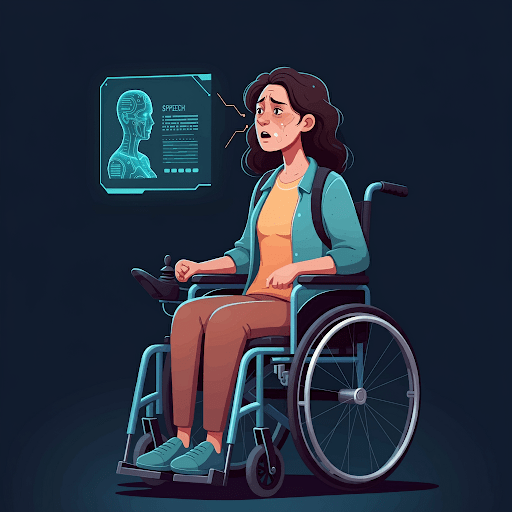
Over time, Lady M has proven to be an enthusiastic member. She is very brave. She wants so much to participate, including the table topics where one gets a short prompt to deliver a one to two minute impromptu speech response. Technology has come to her aid. She can type up her thoughts in group chats instead of speaking. Yet, her chats are hard to comprehend, the sentences are grammatically incomplete, and we cannot make sense of the words. Needless to say, most, in the club, have felt uneasy because of our limitations to interpret meaningfully what she has shared.  We have been candid to share that we do not understand. She is not deterred and has kept participating to my utmost admiration. 

Something happened in one recent meeting. In that meeting, I hosted the table topics. I called out a few club guests, gave them prompts, for them to deliver an impromptu speech.  I was about to conclude, when I got a glimpse, on the zoom window, that lady M was waving vigorously to get attention and to participate. I ended up posting the prompt in group chat for her to post a response. The reply was equally incomprehensible. AI has come to our aid this time. The president came up with the idea to use AI.  Rather than reading out the group chat of Lady M word by word, the president copied and pasted to the AI ChatGPT, and asked AI to help us to comprehend.  Afterwards he read out the AI-enhanced impromptu response.  How well has AI interpreted lady M? Judging by the reaction of lady M, it came across that, AI has read her mind better than any human toastmasters attending at the time. I have not seen lady M happier. That expression of feeling heard and feeling understood made a beautiful face.

Maybe we are bound by our learned grammar, words and languages. AI has gifted us this ability to better understand each other without that boundaries.  

A week after, at the Club, lady M was there again. This time, she shared that her father just passed away. In times of life’s most difficult moments, we hope her participation with the help of technology has brought her comfort and courage. We found her voice through Artificial Intelligence. 

Leave a comment »

AI Challenges

Toastmasters, a global organization about communication excellence, is celebrating 100 years. Toastmasters has global presence, with over 200,000 members and counting. I served as president of one toastmaster club for two terms. I remain active in two Toastmaster clubs including the AI club, the first toastmaster club with an AI themes. It is fitting to combine communication excellence and the latest AI technology as Generative AI storms into our lives, like no other technology before. Below is the speech script of my 7-minutes speech about AI challenges and how everyone can become an AI ambassador to have more people participating in the AI future.


I have been an active Toastmaster member and served as president of a Toasterster club for two-terms

We wake up with water, electricity and the internet. What if I decide not to use any of them? From where I live, the nearest body of water is over 5 miles. I would walk without Google Maps, no electric car, in the dark, to fill up buckets of water I need for the day. It would take over 4 hours for the round-trip. Technology has made our lives better. We have taken for granted people use helpful technology all the time. 

To my AI club fellows, I would like to share the obstacles facing AI adoption. By being aware of it, we can concretely set plans to address these obstacles.

I’m leading an initiative focused on upskilling and enabling AI, particularly GenAI, at all levels, to as many as possible for the company .  Every single day, I am humbled “people are not rethinking how their work and life can be improved with AI technology”. The reality is, technology adoption requires intentional effort to bring people along. Why is that? There are technical obstacles and psychological resistances.

Starting with the technical challenges,

  • We live in places with cutting edge technology. Do you know just about 65% of the global population are online (w/i internet). AI depends both on electricity and the internet. That means around 3 billion who do not have reliable internet, likely cannot benefit from AI. 
  • AI is intimidatingly complex. Some techies unconsciously throw out jargon. Terms like LLM, gpu, tpu, langchain, multimodal, neural network, encoder, decoder, transformer, hallucinations…just scared people away. 
  • Concerns about data privacy, biased input and security are real. Can you trust technology? When to trust , when not to trust AI? 

We develop strong opinions and emotions about things too. Every new technology challenges our comfort zone and injects the fear of the unknown, fear of mistakes and fear of losses.

Many people fear errors or lack of control when using AI for tasks traditionally done by humans. It is natural we are uncomfortable with machines generating creative content or making decisions in their personal lives.

  • Elon Musk said “We will have for the first time something that is smarter than the smartest human. There will come a point where no job is needed.“. He may have spoken his mind. How would you react about AI replacing human jobs and YOUR jobs?
  • When Singapore Prime Minister Lee was recently interviewed by Bloomberg, he said “There are a lot of things in AI that we don’t know.  We don’t know where it is going. The researchers do not know where it is going.”.  How could you manage the unknown?

You belong to this ai club toastmasters. I think you can do something. You can start with one thing.  Here are some suggestions.

  1. Listen to others’ concerns in adopting the technology. 
  2. Share how AI has benefited you
  3. Invite their curiosity to learn more.

Thomas Edison brought electric light to part of Manhattan in 1882. Even 4 decades later, only half of all homes in the US had electric power. Many Americans still lit their homes with gas lights and candles.

I invite you to stay aware of these Ai technical and psychological  obstacles, it is as easy as starting with one thing. Take the time to listen to concerns, share how AI works well for you and invite curiosity from others.  If you all do at least one thing, AI can be in more hands. We don’t need to wait 50 years.

Are you willing?

Thank you.


Leave a comment »