oliviatamccue

about everything, anything or something

Hike of a lifetime: The WAVE

It has been a busy few months.

In September, we did the Wave hike that only a rare few have ever experienced. In October, we did our first ever 3-day tennis camp at the beautiful Pebble Beach, California. In November, we had our 3-week “longest” visit to NYC.

The Wave is a once-in-a-lifetime hike (https://thewave.info/) in Arizona. 

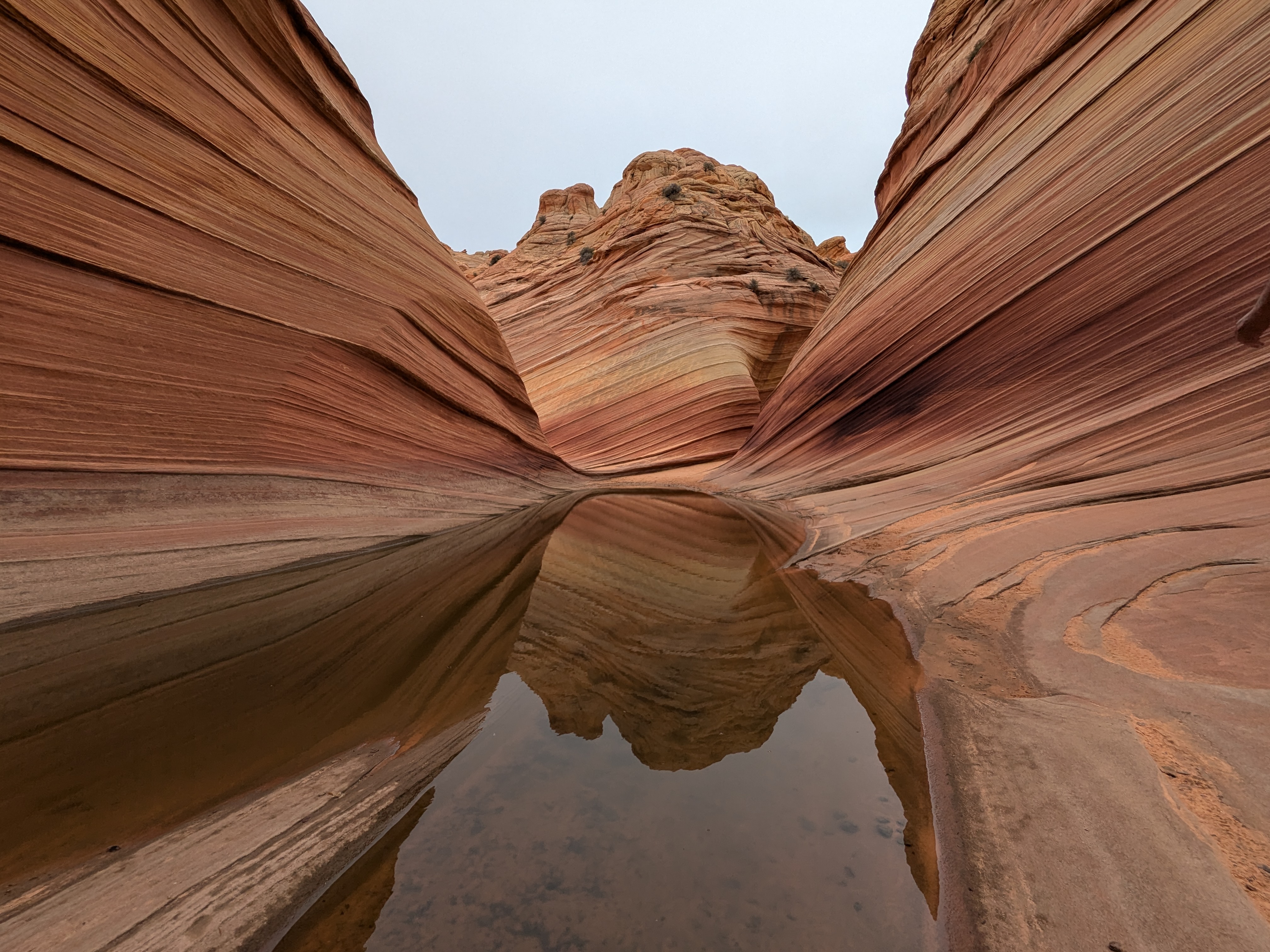
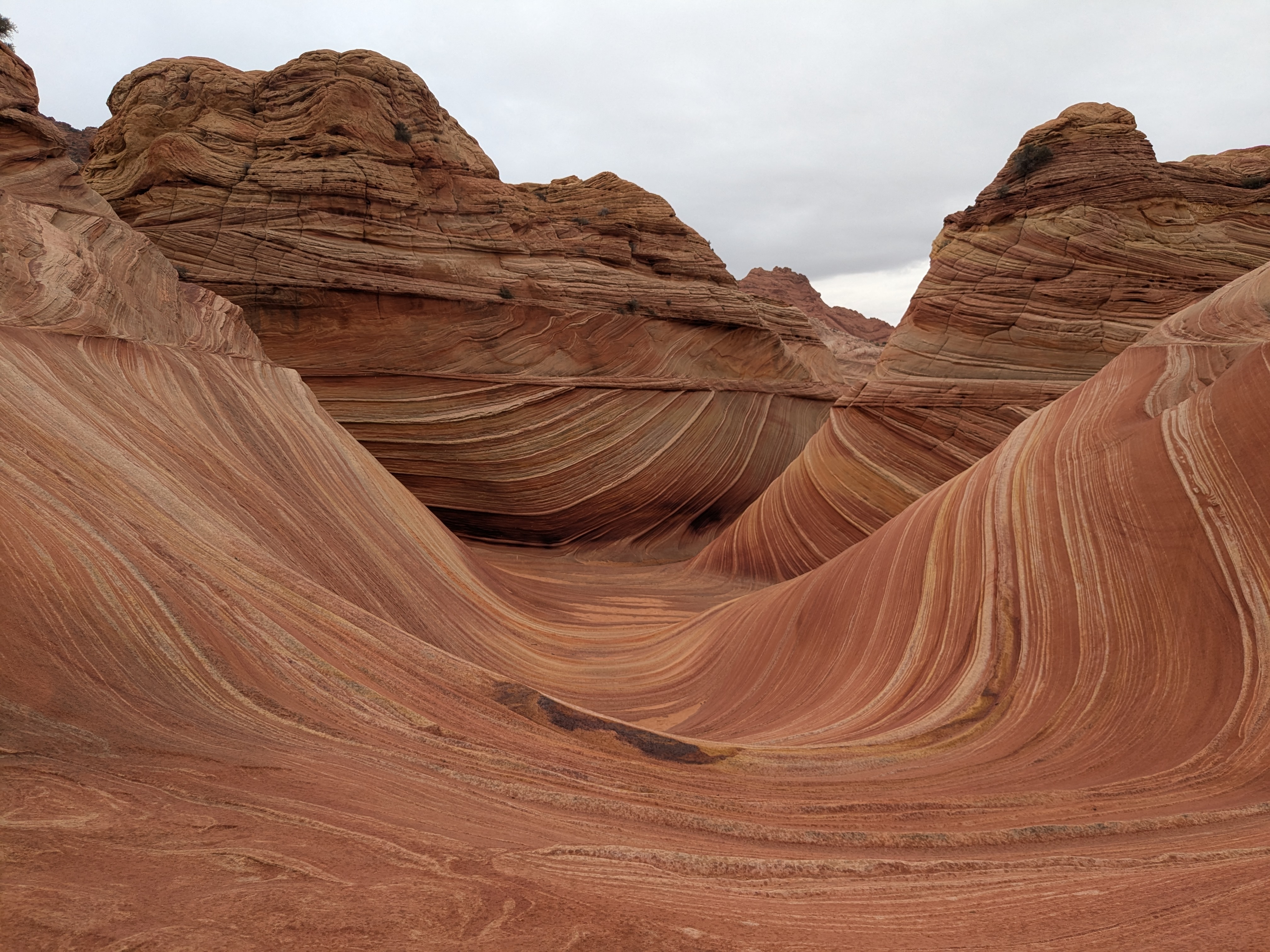
The Wave makes a dream destination for hikers. It is otherworldly, unique and unforgettable that I can stay there for days, and still be in awe of its natural beauty. Its photo tells a thousand words, but it pales compared to in-person experience.

The Wave in Arizona became widely known after Microsoft featured it as the default desktop wallpaper for Windows 7 on July 22, 2009. Fast forward fifteen years, many recognize the pictures but very few know about the place even fewer have visited the Wave. Why?  It may have to do with its being managed by the Bureau of Land Management (BLM) rather than the more well known National Park Service (NPS).  It may have to do with its accessibility.

The Bureau of Land Management (BLM) manages the Wave. BLM manages one in every 10 acres of land in the United States, including vast stretches of desert, grasslands, sagebrush steppe, coastal areas, and some forested lands . The National Park Service (NPS) manages US National Parks. The Wave is not part of any national parks. BLM and NPS both oversee public lands in the U.S., but their purposes and management differ. BLM manages vast areas of land (mostly in the western U.S.) for multiple uses, and emphasizes a balance between resource use and protection. BLM often leaves the wilderness alone where you can explore. There is no lodge, often no marked trails, lucky to have a parking lot or restroom. You are more on your own. 

NPS, which operates many world-renowned U.S. National Parks, offers recreational enjoyment while prioritizing conservation and strict protection. National Parks are more developed with visitor centers, with more infrastructure, more facilities, more accessibility and designated hiking trails. NPS makes the park enjoyable for generations while preserving them.

BLM operates Coyote Buttes, which includes The Wave, and limits visitation through a permit system. The Wave, being operated by the BLM, stays intact over millions of years. With only a daily maximum of 64 people getting the permit to explore the area, the human footprints are kept to the minimum. The least human footprints help the highest order of preservation. The Wave permit is hard to impossible to get. The permit can be obtained through an advanced lottery system, or a daily try-the-luck walk in. The advanced lottery system is simple. It opens four months before your trip date. You have the whole month to apply with a maximum of three preferred dates. The lottery is now open for April 2025 Permit. 

My first recorded lottery was dated March 2020. I did not try every month, as summer could be dangerously hot and winter could be harshly cold in Coyote Buttes. I only drew for the months with more forgiving weather. I did at least six attempts in the past four years. On June 3, 2024, I received this email: “Coyote Buttes North Advanced Lottery (The Wave) Lottery Results Announcement – Congratulations!”. It was an amazing feeling of a long forgotten dream coming true when I least expected it. Many tried for years, even decades, and are still trying. It is the closest we ever get to the Wilderness, seeing the same sceneries as the dinosaurs. There is no way that I will pass up on this.  We accepted the lottery results. 

A few weeks after accepting the winning lottery, BLM mailed us the permit and some directions for going to the Wave from some trailhead. It was like eleven pictures with detailed descriptions we can use to get from the trailhead to the Wave. It even states that markers placed by visitors may not be on the most direct path to the Wave. If we miss a picture and a turn, who knows when we will discover the miss and then backtrack. In short, we are on our own. We are too old to feel that getting lost, without a functional cell phone to contact outside, is an adventure. The Wave, as beautiful as it is, can be challenging and life threatening. It needs wayfinding skills and decent physical fitness to navigate through the vast wilderness. We are not confident wayfinder in the wilderness. We need to carry at least a gallon of water in a terrain of mostly sandstones. Even with the information provided by BLM, we decided to find a tour guide. The tour agency is very clear that we need to be prepared to walk 7+ miles in the rocky desert terrain, exposed to the elements. (In hindsight, we probably can figure out the navigation with some misses and backtracking, but then we will be focused on the navigation than the landscape)
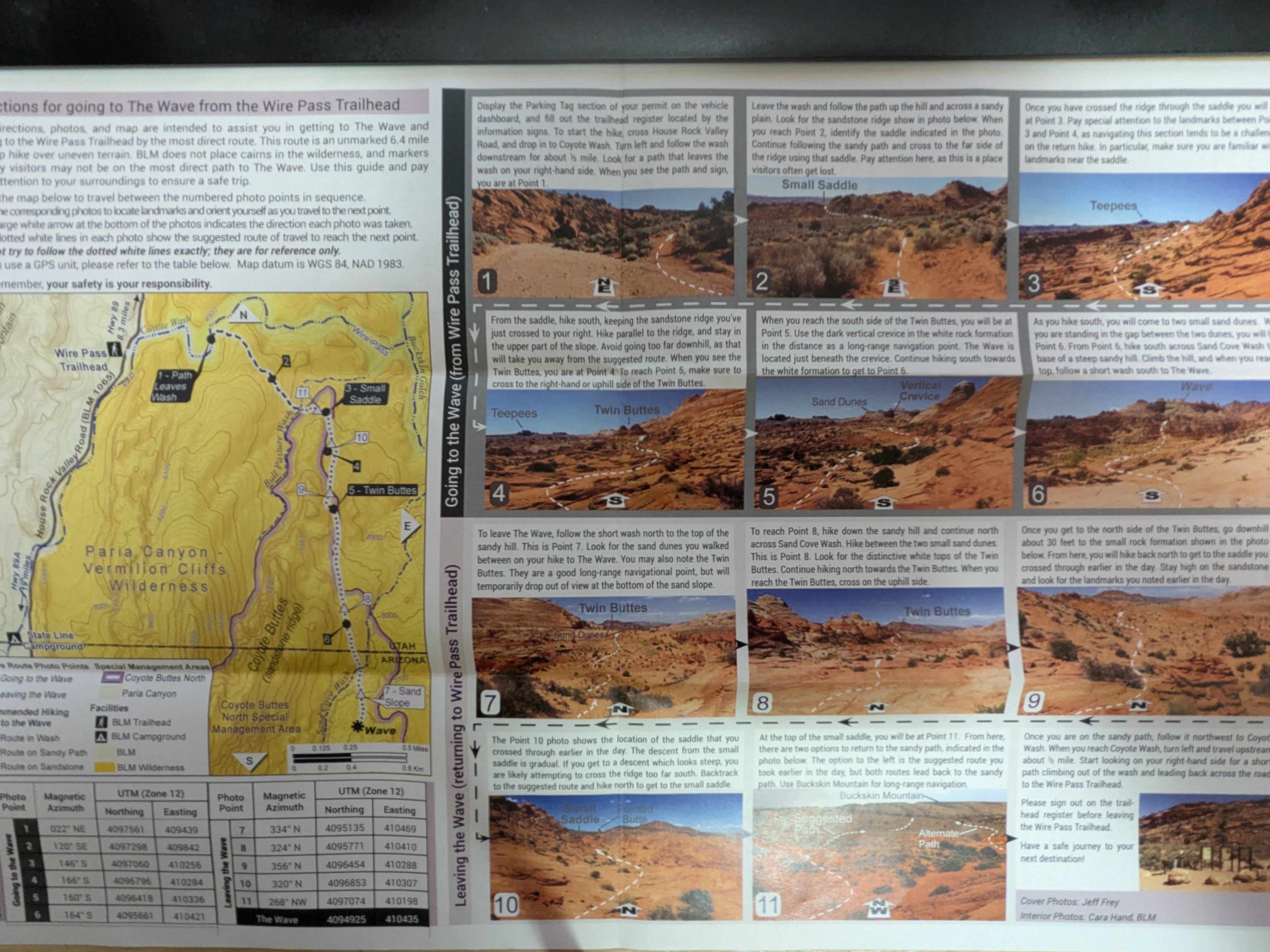
My group of 4 had three months to get fit. We started our once a week training hike to get fit. From early August to a week before the Wave, we did 6 training hikes at Coyote, Upper High Meadow, and Stephen E Arbors Loop at the popular Rancho San Antonio of South Bay. The 4 hour training hike covers 8.4 miles with 1686 ft elevation.  That is not quite the 7+ hours Wave hike. To build more confidence, I also did some stairmasters during the week. We felt ready.  

The Wave has an elevation of over 5000 ft.  We arrived at page, Arizona a day prior to the Wave hike. It helps acclimatize to the elevation. There is just so much to do at Page, Arizona and its proximity. We did a short beautiful hike at the Beehive Trail, sometimes called the New Wave. We felt ready.  

September 21 was the big day. The tour guide Tyler picked us up at 5:15am. We were half awake. It was cold. Tyler is a local. He knows the area really well. He is cautious and prepares his body well with frequent sips of water during the one hour drive there. After all, he must look after us in unexpected circumstances. The first half of the drive is on a smooth freeway. The outside was dark and peaceful. Along the way, there is zero signage to tell Wave’s existence. I think it is intentional to hide it from the public. Without the experience of Tyler, It would be so easy to miss the turn to the unpaved side road to the Wave trailhead. The road becomes unpaved and gets tougher after the turn. We did not see another car until we got to the parking lot. It was too dark to see animals. We did not find any visitor center. Instead, there was a logbook, we registered our group in a log book. That log book is likely the communication protocol for the park range to figure out if everyone leaves the Wave, or gets trapped in the Wave. The pink permit was attached to my backpack all the time.

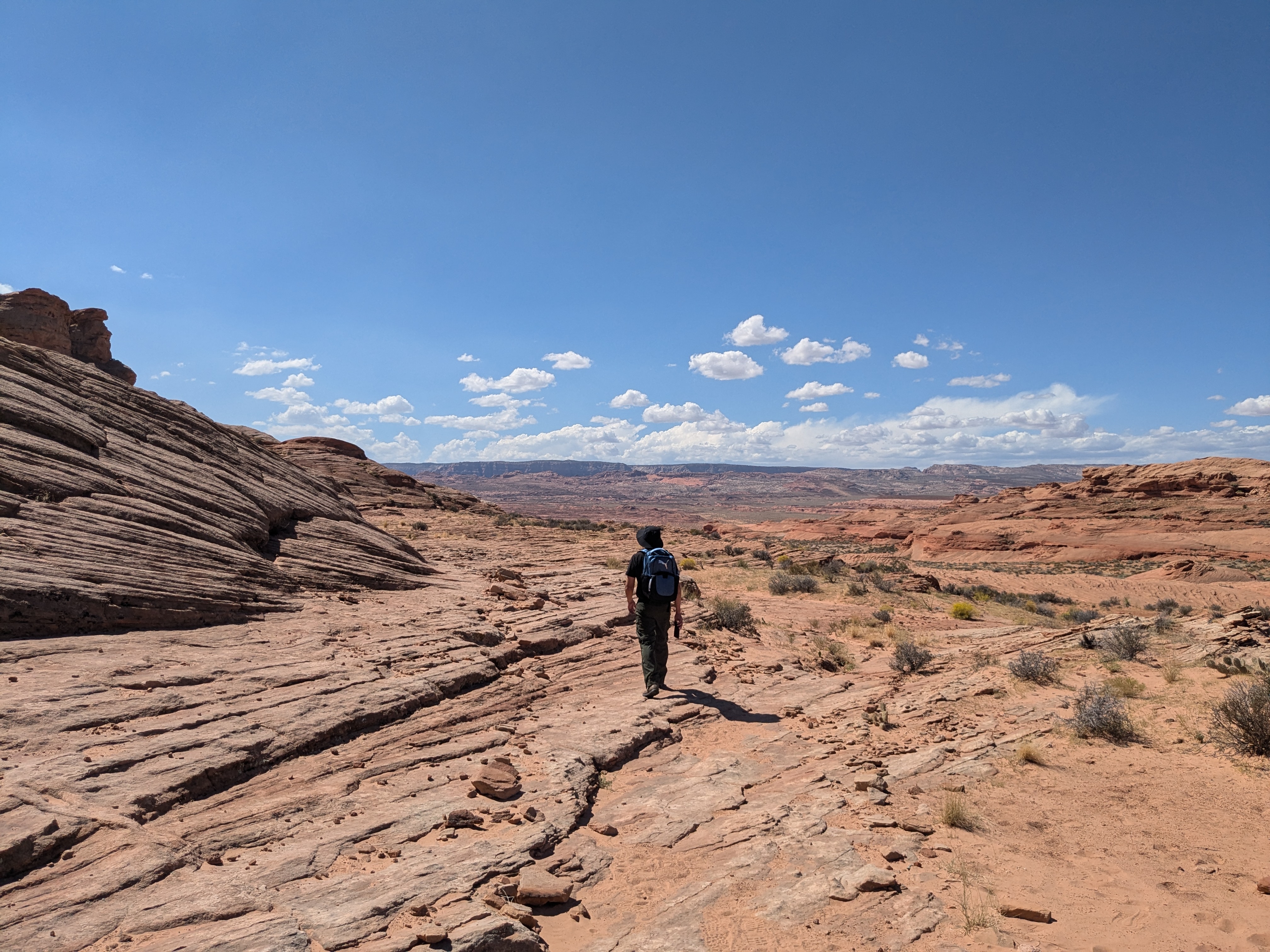
It was overcast, it was cool. There were tiny showers from time to time. It made the perfect weather for a hike. We did not need to consume much energy to overcome the sun. For the first few hours, we had the wilderness for ourselves. We did not run into another group. It was quiet and peaceful. The tour guide helped us with the better routes and avoided slippery terrains.
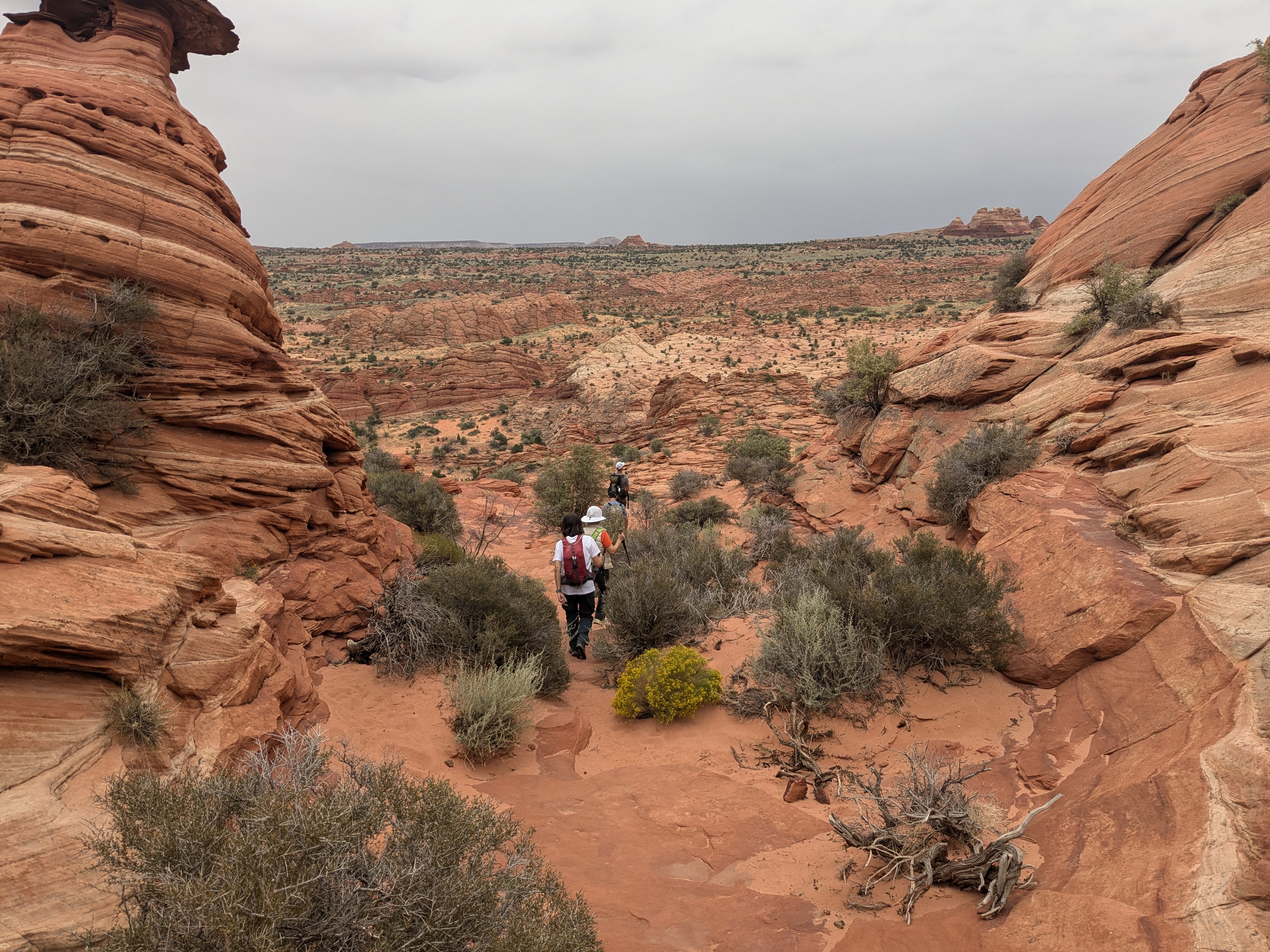
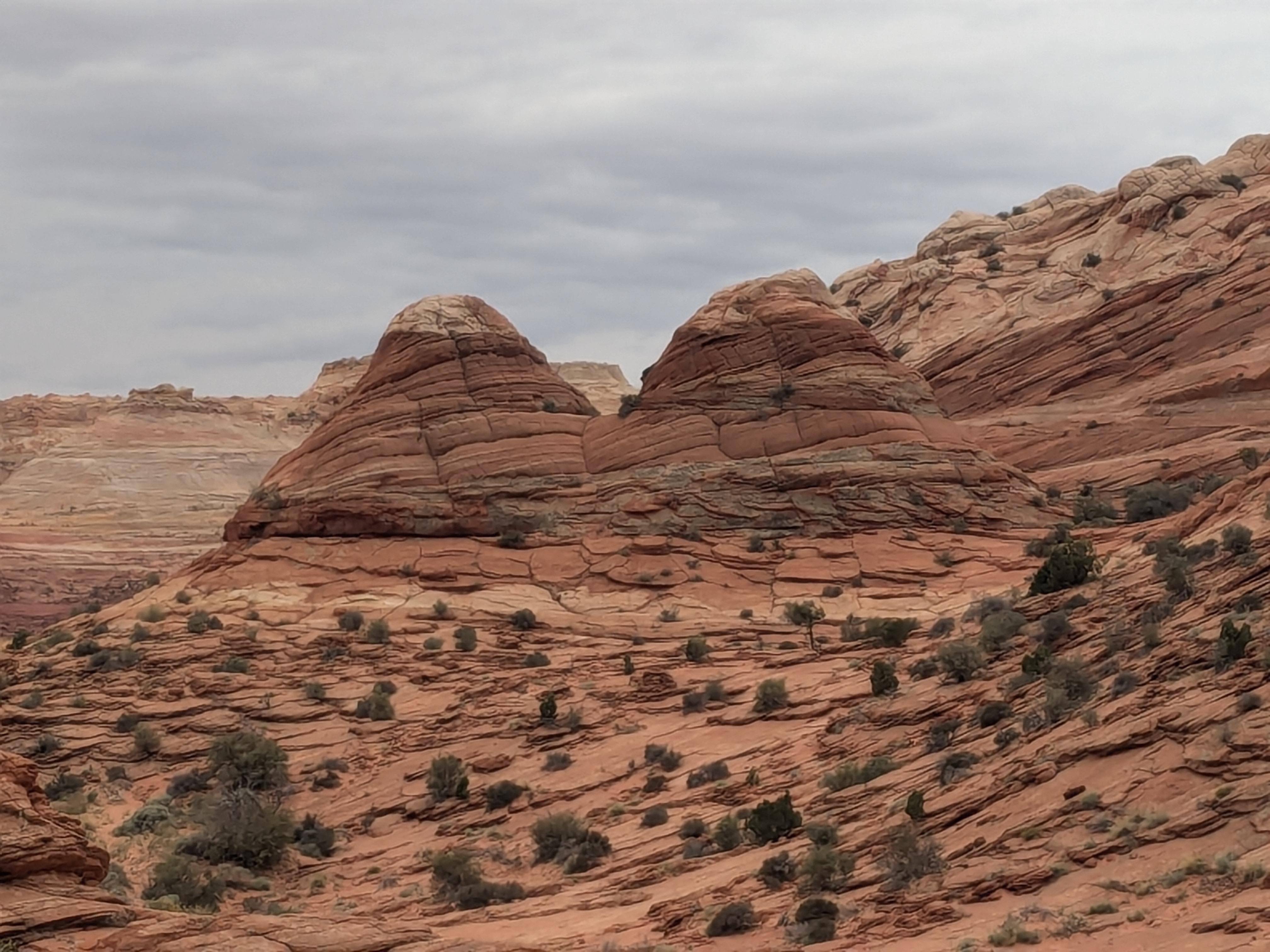
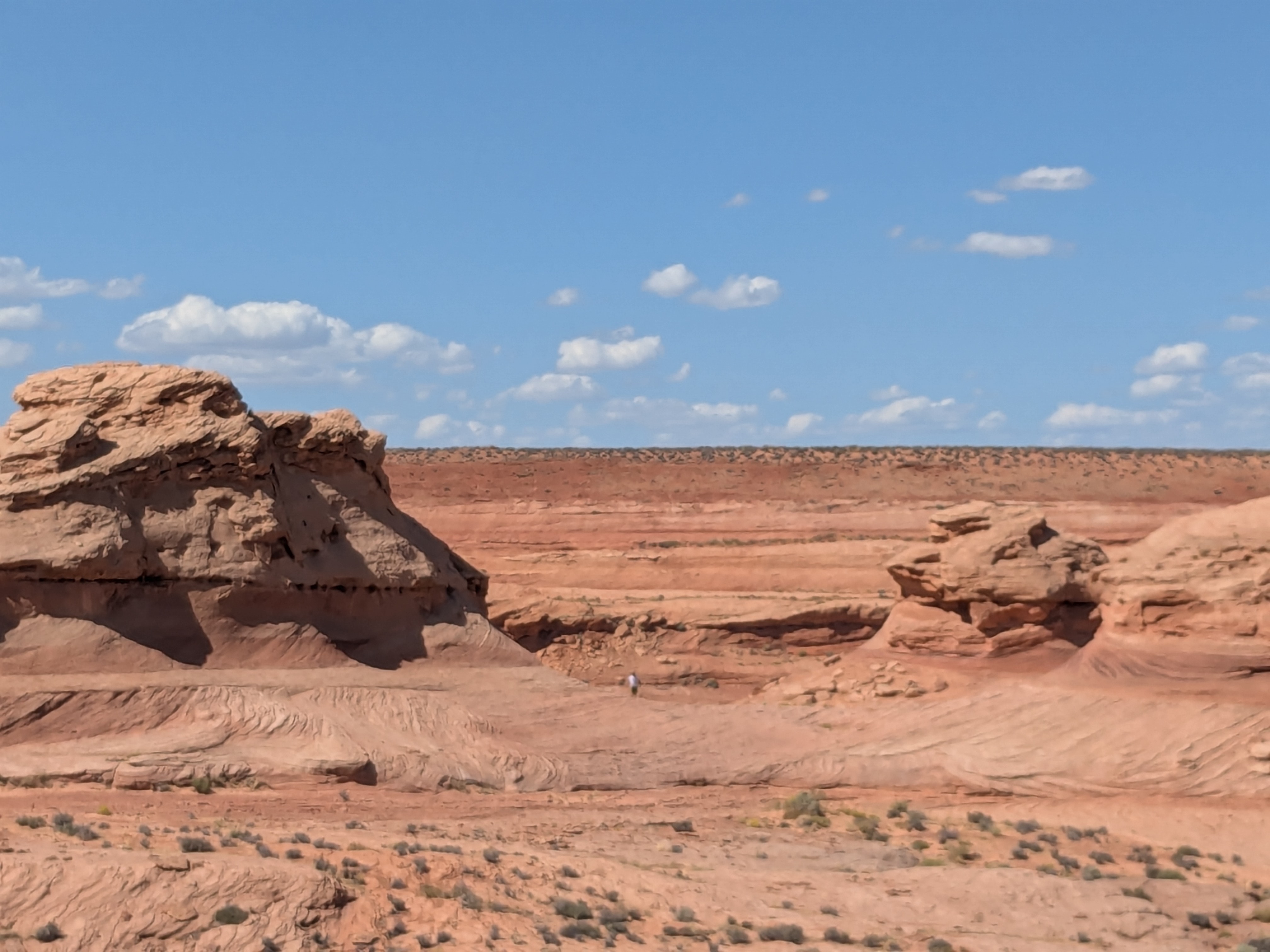
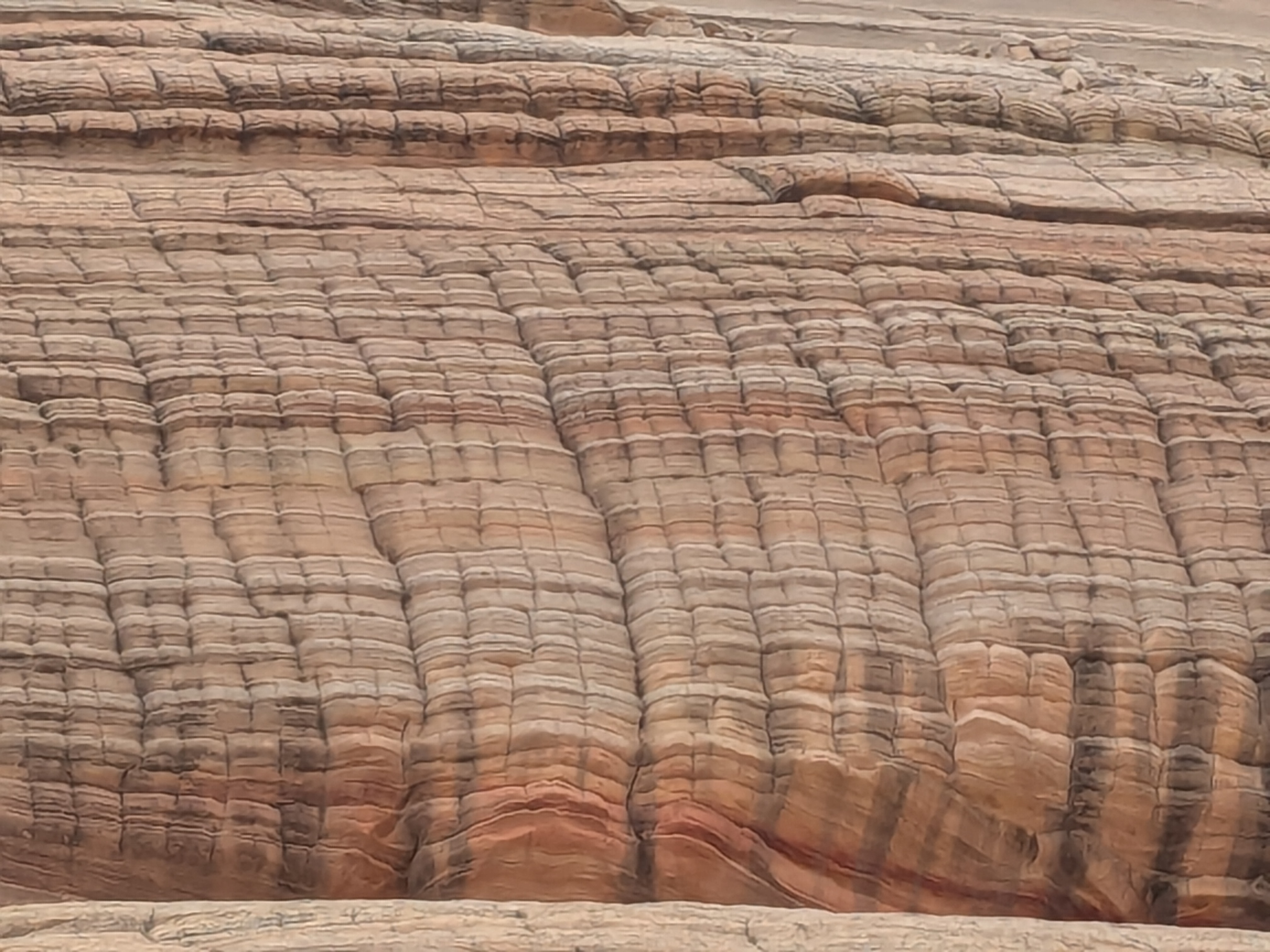
Along the path, there was this big rock that was shaped like a hamburger. Some rocks that looked like cauliflowers, and some just looked like human brains. Because of the shower, we found a few tiny water bodies, with some tadpole shrimps. These tadpole shrimp species have existed for hundreds of millions of years and are likely to exist after we are long gone.

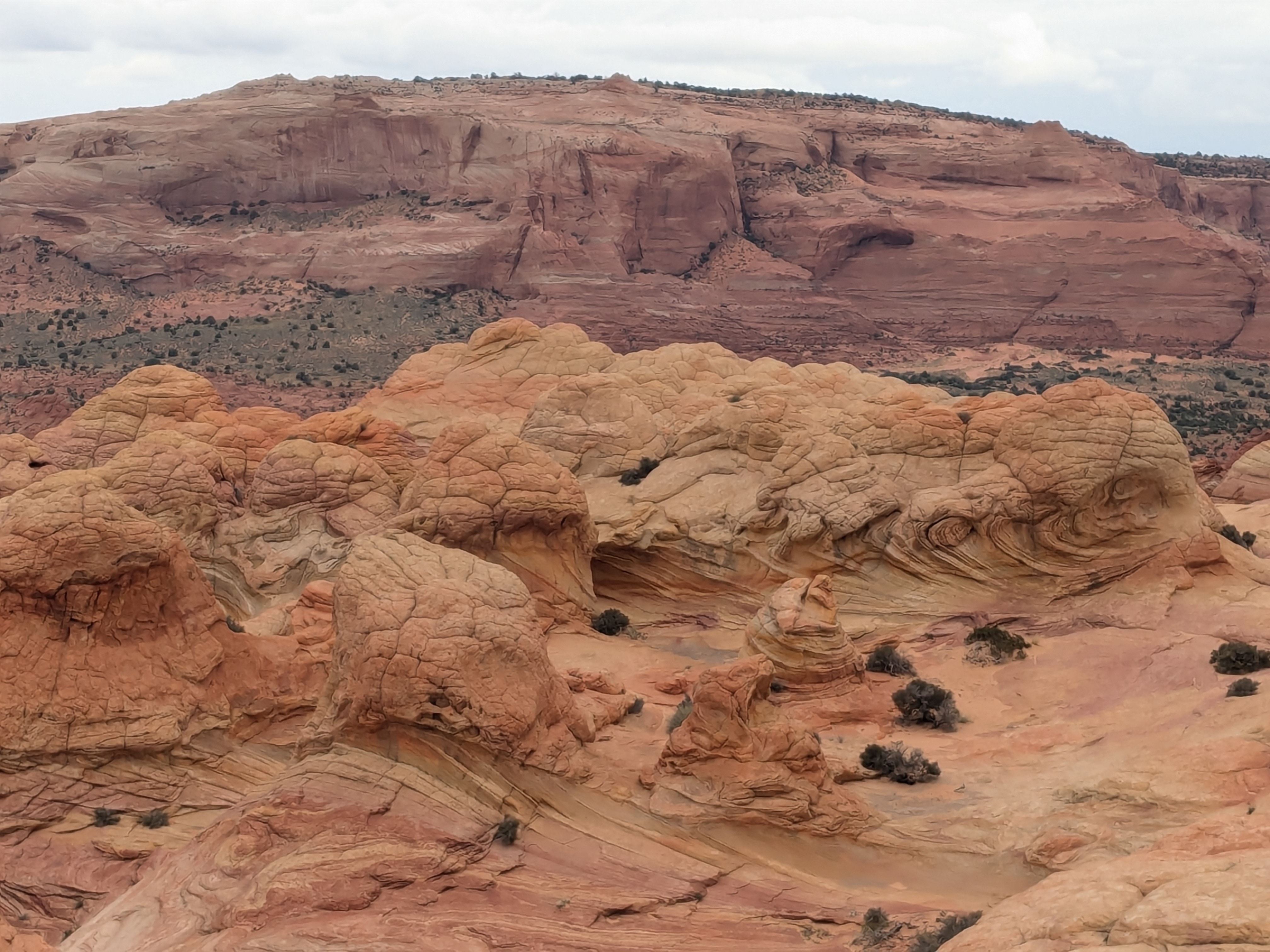
The blue sky was missing that morning. The cooler weather was a blessing. We were also rewarded with different colorings of the terrain. The red rocks, the subtle green and blue color of the terrain came out indescribably beautiful under the cloudy sky. 

The Wave is under the “black line”


We  arrived at the Wave entrance in about three hours. It felt surreal to finally be in the Wave after all these years of lottery, all these weeks of preparation. The photo may disguise the Wave as soft, curly and smooth. In reality, it is formed of incredibly hard sandstones. We enjoyed just staying there to appreciate and had a lunch break. After  lunch, Tyler, our tour guide, took us to different “vista” points and an area with the dinosaur footprints. 
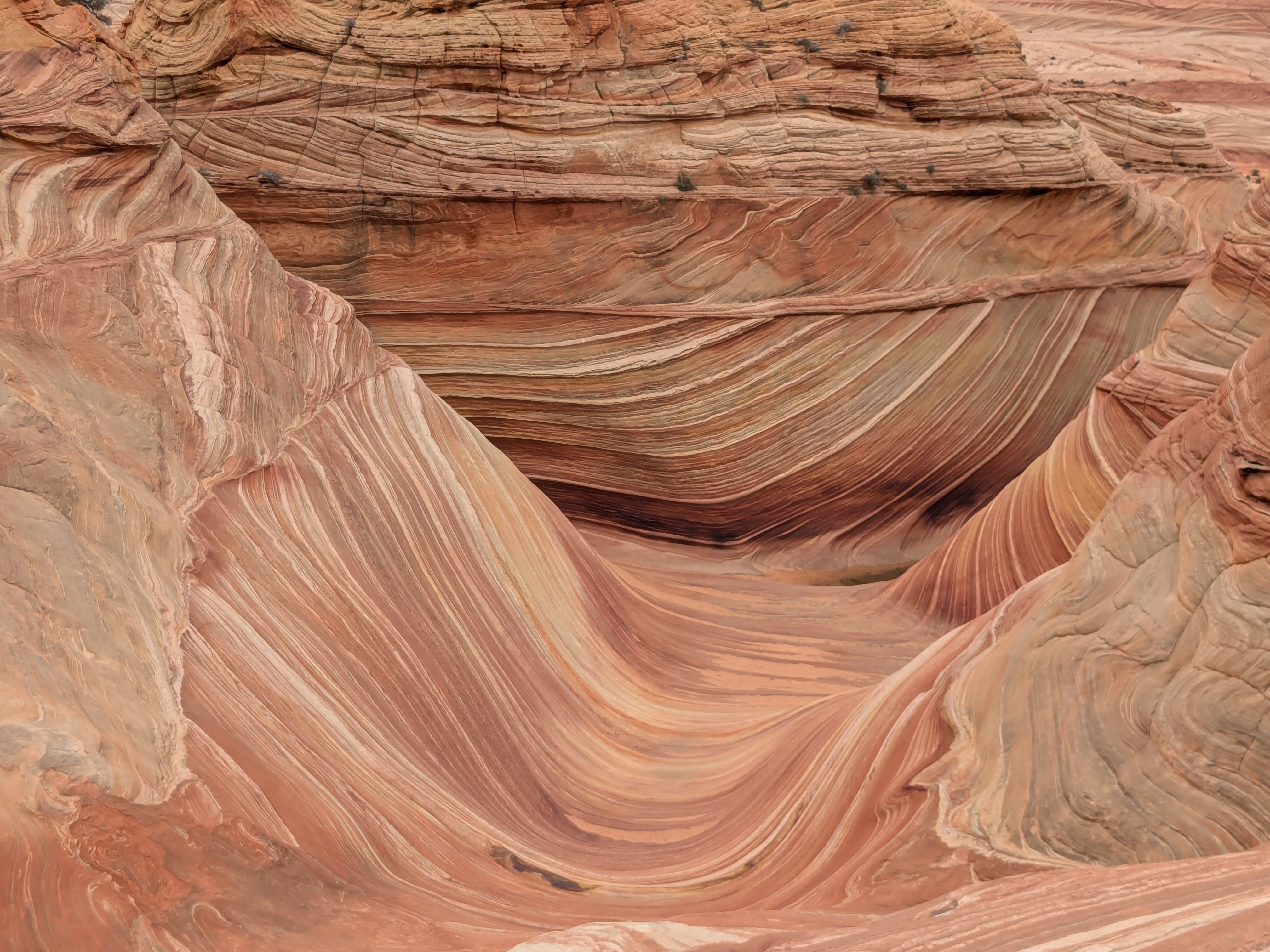
The sun started to show after lunch. As much as we wanted to enjoy it for more  hours, it was time to hike back. We saw a few small groups without a tour guide. They were all busy navigating and we wondered how many backtracking they would experience.  

As confident as we felt about the direction and the distinct landmarks on our return trip, we soon realized that we could easily mix up the Teepees and Twin Buttes landmarks with many other look-alikes in the wilderness. The size of the landmark changes too with the distance we are from it.  The landscape changes too. The look and feel of the landscape changes too with the weather. 

We hiked for almost seven hours for the round trip hike to the Wave. We signed out on the trail-head register before leaving, so concluded the Wave Hike.  

The Wave hike is up there as the top three hikes of my life, if not the top. I am going to cherish the beauty and the once-in-a-lifetime hike for the remaining years.  I am missing it already.  
Leave a comment »

Let’s go travel US West

Like many travelers, I am more often attracted to visiting new countries and new cultures miles away from where I live. It is a guilty pleasure to add to the number of countries traveled. After a few days traveling the West and another few days traveling in Florida,  I am reminded once again of the many attractions in the US. 

Few things are more enjoyable than family traveling together. Traveling at a time with less crowdedness just a week after the holiday season, makes the experience better. We did just that in January, when most were getting back to school or getting back to work. Kauai was our first choice. The airfare was not particularly expensive. Yet that sentiment of “why we pay for this price when we can get a cheaper airfare another time”. Truth be told, we were a bit late in our planning. The “let’s go somewhere” won the family vote over “let’s stay home”. We planned, within a day, a scenic “wild west” trip to Las Vegas, Antelope Slot Canyon, Monument Valley, and Grand Canyon. Arizona and Utah’s hot summers are particularly well known. Little did we know about the snowstorms in the cold winter in these places. These snowstorms turned out to be beautiful, dangerous and scary.

January | Horseshoe, Antelope, Monument Valley, Grand Canyon, Las Vegas  

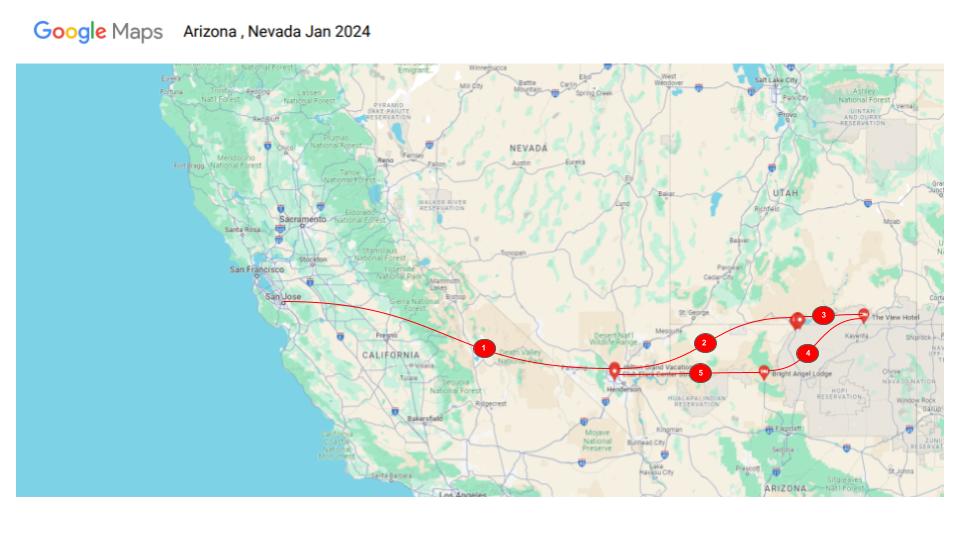
  • Day 1, Jan 5, SJC -> LAS, drive to Page, Arizona
  • Day 2, Horseshoe Bend, Upper Antelope Canyon tour, drive to Monument Valley, Utah-Arizona
  • Day 3, Monument Valley, drive to Grand Canyon
  • Day 4, Grand Canyon
  • Day 5, Grand Canyon, drive to Las Vegas, Nevada
  • Day 6, Jan 10, Las Vegas, LAS -> SJC

Our flight from San Jose to Las Vegas was smooth. We crossed from the State of Nevada to the State of Arizona, arriving at Page in less than 5 hours of highway driving. Along the way, the landscape changed from the dry desert landscape of Nevada to one of the otherworldly and peaceful brownish-red rocky landscapes of Utah and Arizona. The less well-known town of Page makes excellent base camps to many amazing National Parks (NP), including Zion NP, Bryce NP.  It also makes a convenient hub for our itinerary: Antelope Canyon, Monument Valley and Grand Canyon.  

The next morning, we were greeted with chilly and sunny weather. Sunrise time was between 7 and 8. It was still dark when we arrived at the parking lot of the Horseshoe bend. After a short and scenic walk, we arrived at the Horseshoe bend, before the sunrise. The gradual sunrise painted the sky and the rocks with changing colors. Its beauty was better described in pictures than in words. I felt the acrophobia even looking over the fence to see the bottom of the horseshoe bend. The river at the bottom was partially frozen, making it a half mirror and half flowing water. The time to stay there varied with personal preference. We stayed there for a while to soak in its beauty, and take pictures from as many angles as possible. In spite of the chilly and windy condition, I would have liked to stay there much longer. 

The Upper Antelope Canyon is famous for its wave-like structure, and the light beams. It is one of the most-photographed slot canyons in the world. The slot canyon is narrow and cannot be more different from the Grand Canyon. It is under the management of the Native Americans. They offer guided tours providing short lorry rides to take us there, and serve as visitor guides in the walk through the slot canyon. The wave-like structure comes in different colors and shapes. With some imagination, I could see a fox, a president, a monument valley and many more. We enjoyed the tour and the pictures immortalized its unique beauty. I would have loved to hike to experience the slot canyon. Unlike National Parks, we are not allowed to explore on our own.

Like the Antelope Canyon, the Monument Valley is also managed by the Navajo Native Americans. Its landscape is best appreciated from the View Hotel, Monument Valley. We did just that. The sunset was nowhere to be seen with the cloudy sky. There was a forecast of a snow storm in the evening. The View Hotel has one of the best gift shops with some unique offerings from rugs, carpets, sand paintings, and many different souvenirs. There is also a museum sharing the history of Navajo Natives since the early twenty centuries, and their contributions in World War II. I would not have known that their unique language codes have been used as encrypted communication channels during the war. I got a better understanding of the history and how their land has been colonized. I recommend fellow travelers to visit the museum as they enjoy the natural beauty of the Monument Valley.

There was snow overnight. The weather was quite gloomy the next morning. The monuments in the valley had more patches of snow that looked like layers of shattered glasses at the base of many monuments.  These monuments looked different from the evening before. The scenery in the overcast weather was unique in its own way and we could not get tired of taking pictures. We intended to spend an hour driving in the valley, before heading to the Grand Canyon. Similar to the Antelope Canyon, the Monument Valley is not a National Park. There is not much of a sign on where to go. We made the wrong turn and exited the valley accidentally. As we U-turned back to the entrance, we were told that we had to pay the entrance fee again. We had been told clearly the day before, when we paid for the admission, that our ticket was valid for 24 hours. After some back-and-forth, the entry station agent absolutely denied everything we heard what they said less than a day ago. We were upset enough to skip the driving tour, and headed directly to the Grand Canyon. It was unlikely we would make a return trip any time soon. We were pretty annoyed. Only a few hours later, we realized it was a blessing in disguise as we ran into a bad snowstorm on our way to the Grand Canyon. If we had taken the time to explore the Monument Valley, we might have been dangerously stuck in the road, and risked not reaching the Grand Canyon.

It is a four hour drive from Monument Valley to the Grand Canyon. We did not foresee the danger awaited. Once on the road, we felt the effect of the snowstorm the night before, when the landscape turned into the Christmas white. The road was still good. The scenery was beautiful. We stopped near Flagstaff for a quick lunch and were still on track to arrive at the Grand Canyon south rim before dark. 

No-one could predict the weather. We walked out of the restaurant to find heavy snow and we were in the middle of a snowstorm. The snow plow was working hard to clear the parking lots. We were still relaxed knowing that we were about 90 minutes from the Grand Canyon south rim, we had a SUV, and we had enough time on hand. We realized the full scale of the danger when the brake of our SUV did not respond in one downward turn. Our SUV skidded to the other side of the road, which left us shaken to the core. We had to thank God that the SUV stopped just in time. There were no incoming cars which would have hit us badly. Afterwards, we were driving at 20 miles per hour on a highway with snow all around us, and were nervous at the most gentle grade of the road.  

We cannot be more thankful to the well paved straight roads all the way to the Grand Canyon south rim. It was already dark as we parked outside the Grand Canyon Bright Angel Inn. We breathed the biggest sigh of relief and appreciated our dinner even more. The Grand Canyon was substantially colder than Monument Valley. We snuggled in our cabins. As we drifted off, we still felt the shock of the earlier SUV skid. That shock stayed with us for weeks.

We were delighted to see a clear blue sky the next morning.

The weather could not be better for our mule ride along the south rim. We got busy preparing for the ride: received a water bottle, cleaned it, filled it with water, and attached any loose items (eye glasses, phones) to our body. The mule guides helped us to get on our mule, one at a time. We were more than ready to go as we shivered in the cold on our mule. Shortly after we started our tour, we arrived at the south rim, and were in awe of the grandeur of the Grand Canyon. When our mules turned to face the grand canyon, it was quite frightening even though we were still more than a few feet away from the cliff. According to the guide, having the mules facing the grand canyon would remind them of the danger. I could not tell if the mules knew the danger, we certainly felt it and could only comfort ourselves that no mules had ever jumped into the canyon. Soon we got comfortable on the back of the mule. We appreciated the canyon views and the forest areas more and more. We were relaxed enough to take pictures. It was certainly the highlight of this road trip. We recommend the mule ride to all visiting the park.

After the mule ride, we took a leisurely drive and strolled in the park. We caught a beautiful sunset over the Grand Canyon. We finished the day with a nice dinner at the El Tovar Dining room to celebrate a family birthday. As we walked back to our cottages, the stars were twinkling on a clear night sky. It made a perfect night for star gazing.

We felt we were back to the safe urban zone as we settled in the super size hotel suite at Las Vegas. Our adventures were not over yet. The next morning, we mistakenly put an electric kettle, placed next to the stove, over the stove. It was burnt badly. The smoke triggered the fire alarm.The hotel agents reassured us that it happened before, and we had nothing to worry about. Then without any mention, we were charged over $1000 for the kettle on our bill. It took us another few weeks and we had to involve the Better Business Bureau to dispute the charge.

The road trip was memorable. We were treated to unique and amazing landscapes. We encountered unforeseen incidents and thanked God for overcoming them.

We are ready for a more relaxing family trip in January, 2025. Kauai maybe.

Leave a comment »