oliviatamccue

about everything, anything or something

To the book lovers out there, what better way to start the year with some great reads?

The books I read during the holiday, transported me to new places, and new experiences. The Worlds I See had been on my to-read list for ages, and I finally checked it off. It’s a memoir, an immigrant story, a personal journey, and an AI journey all wrapped into one. It doesn’t get better than this. The other books were serendipitous finds, with The Little Books offering delightful reads for everyone.
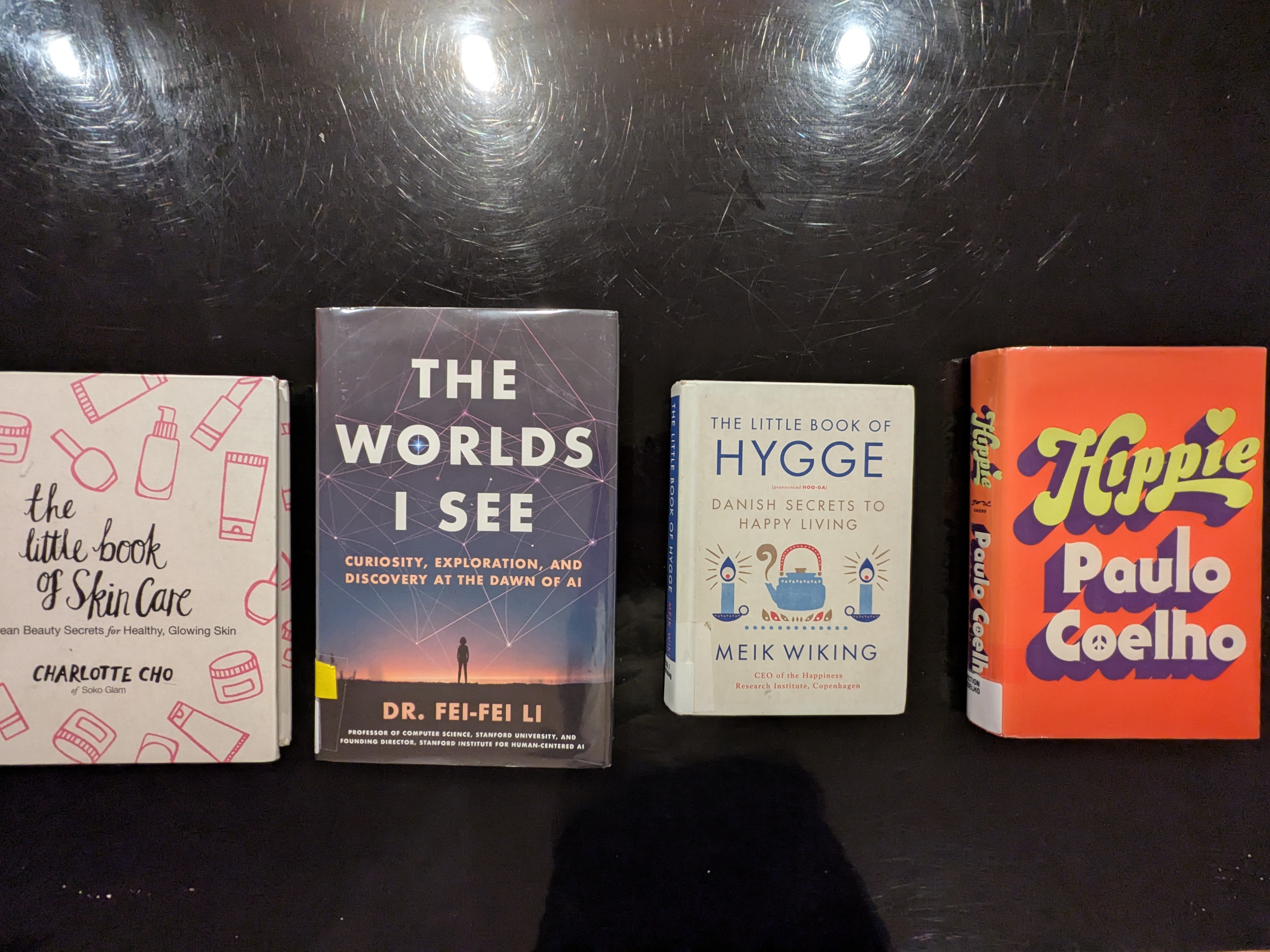
The worlds I see 
By Dr. Fei-Fei Li

If you search “Godmother of AI”, Google search results will list “Dr. Fei-Fei Li” at the top.

Dr.Fei-Fei Li is a through-and-through trailblazer. In the tech world, Dr. Fei-Fei Li has chased after Data, when algorithms and complex logic have been the unparalleled kings and queens in the computer kingdom. The resulting ImageNet has contributed to AlexNet and Neural Network. In the world where technology is the hype, Dr. Fei-Fei Li established the human-centered AI institute (HAI) in Stanford. 

Her research and accomplishments are numerous. Her resilience, her commitment, her passion and her value stands out more in this world where the rich and the powerful get it all.  It is touching to read about how she achieves, while caring deeply for her family, her parents, her spouse and her children, her students and the people around.

Her personal journey from China to America, New Jersey to Palo Alto will inspire you.  The world will be better, if more of us see it through her lens. 

Please add this to your to-read list. 


The Little Book of Hygge: Danish secrets to happy living
By Meik Wiking

I love these little books. The first chapter of light, about candles and lamps, is almost a bore. That is the whole point that many found all the normal things around us become a bore. 

If you can pass through the first chapter of very normal things around us, you will be rewarded with a real sense of Hyggeligt.  If you get through the last page, you don’t need to be in Denmark to discover the secrets of Happy Living.

The whole point of Hygge (contentment, comfort, coziness, and so much more) is about making the most of what we have in abundance : the everyday.

I love this little book. I am deeply grateful to the author Meik Wiking, CEOof Happiness Research Institute, Copenhagen.  The world will be a better place if more people see and enjoy the common things around them.


Hippie
By Paulo Coelho

I love his book “The Alchemist”.  This is an autobiography of the author, travelling with a newly known Dutch woman from Amsterdam to Kathmandu. It has a bit of everything in life, the spectrum of people (real characters) they met and their experiences, the personal discoveries as they journeyed together from Amsterdam to Kathmandu. Just like many things in life, when we are seeing it as it is, there is some weirdness that cannot be comprehended or making sense of it.  That weirdness stays with me long after reading the book.


The Little Book of Skin Care: Korean beauty secrets for Healthy, Glowing Skin
By Charlotte Cho

This book transforms how I think of the skin care routine from a chore to really enjoying it.  It has real good tips if you want to have a dewy look.  I recommend the book to readers of all ages.

Leave a comment »

Book Reviews of AI and diverse reads

Artificial Intelligence has arrived. 

In the AI-powered world, the Large Language models, Gemini, ChatGPT and the like, can summarize a book, give a nutshell of things, answer questions, and even analyze a book together with you. It is impressively powerful. It meets the ever raising expectations of what it can do. AI writes book reviews well too. I am sure that AI can do a better writing job after it digests trillions of words which I never would be able to. 

Let AI have the better ability in reading and writing. There is no existential crisis about it. I am pleased to keep the enjoyment of reading a book at the speed of a snail. I have the choice of my own interpretation of a book, the intent of its author and writing the book reviews.


You look like a thing and I love you
By Janelle Shane

It is a book about how Artificial Intelligence works and why it’s making the world a weirder place. With the hype of generative Artificial Intelligence (GenAI), it feels like eras have passed since this book was published in 2019. The ChatGPT / Generative AI debut is however not a baby born out of nowhere. The breakthroughs in computing, memory and storage power, the leap in machine learning and the focus in data science are all important notes leading to the Generative AI crescendo in November 2022. Many of the “how it works” are as relevant now as in 2019. 

This is a highly engaging and informative book. AI has already arrived. The best way to go forward with AI is to understand it – understand what problems AI can solve, what issues AI can create, and what can we do to manage the situations.

This book will endear you to AI, and why there’s every reason to be cautiously optimistic.


Never let me go 
By Kazuo Ishiguro

In a dehumanized world of dystopia, what would the experience of growing up, falling in love, making friends and the sense of mortality be like? The novel starts with a mystery that the protagonist is a carer unlike any carers we are familiar with. She takes care of different donor patients who need to recover from donations, and at times multiple donations. As the protagonist recalls her school lifes, her friends, her guardians and her years as carers of her closest friends, the readers discover a dystopia, unlike anything we have seen. In that world, their growing up, their relationship and mortality still resonate. 


Song of the Cell : an exploration of medicine and the new human
By Siddhartha Mukherjee 

Mr. Mukherjee is among my favorite authors. His book is always well researched and is a joy to read. Cells make up everything in our body. There are step jumps in our knowledge of the cells and there are still more to be discovered. Mr. Mukherjee perfectly combines the technicality of the deep complex topics and the poetic touch of his personal experience. Through his writing, the scientists, the doctors and the patients each come alive with their own unique characters. It is a book that requires focus to read, pause, and resume. As I finish the last page of the book, I feel there is so much in it that I would like to start all over again. 

Reading his book not only gives you a good set of knowledge of the topic. Reading his book  gives ideas on how to write a technical topic filled with beautiful personal stories, each with a human touch. It is these human touches and their stories that endears us to the doctors, the scientist and the new scientific discoveries about the cell. 


Determined. A science of life without free will
By Robert M. Sapolsky

The initial chapters of the book are pretty dense as the author introduced the framework among the free will, deterministic, nondeterministic, predictable, unpredictable together with different terminologies and how our brain works in neuro-science terms.

Halfway into the book, I got the gist of the author’s position and his argument. There is no freewill or there is much less freewill than what we think we have. Our behaviors, decision-making, failures, and successes are results of our nature (genes) and nurture (environment, family, friends and societies). 

So what? Why did the author, professor of  biology, neurology, neurological sciences, and neurosurgery at Stanford University suspend his teaching commitments, and spend time to write about the topic?

The second half of the book would provide the answer.

Do you believe that illness is a punishment of evil acts of our doing? Do you believe that schizophrenia is caused by bad parenting? Do you agree that people committing crimes deserve  the most severe tortures so justice is served?  Society has changed a lot in many things.  Depending on whether it is a “Yes” or “No” to these questions, we see the world with different degrees of empathy and compassion with one another. 

If more people agree to no free will or limited free will, there will be more support to change the education system, the justice system, and the moral system. The author conveys that we don’t need to be heartless, and judgmental to others with less fortune. There can be better systems and societies. 

This book has been named one of the best books by the Washington Post and the Wall Street Journal.

I suggest reading it with patience, taking breaks and taking as much time as needed. I get a lot a lot out of the book, and it gives a new perspective of many things around us.

Leave a comment »