Bariloche has a lot to offer for a relaxing vacation and makes it a popular destination for travellers in the region.
San Carlos de Bariloche is about a two hours flight north of El Calafate. Having lived in the Northern Atmosphere for my whole life, we believe going north means going to cooler weather, only to discover it works the other way in the Southern Atmosphere. We were met with warmer weather in San Carlos de Bariloche. We rented a car for the first time in Argentina with the places we plan to visit being more spread out. The car rental experience cannot be more different from the rental experience in the States. It took us over an hour, mostly waiting with only us in the line, to get the rental. When we finally got to the parking lot, the Avis rental lady took a lot of pictures of an unassuming Fiat. She carefully showed us the repair kit and spare tire, reminded us of the speed limit and the police camera before emailing the rental contract with all the pictures she had taken. It turned out the extra caution is not a sign of danger, more that the city has narrow roads, and is not always paved.
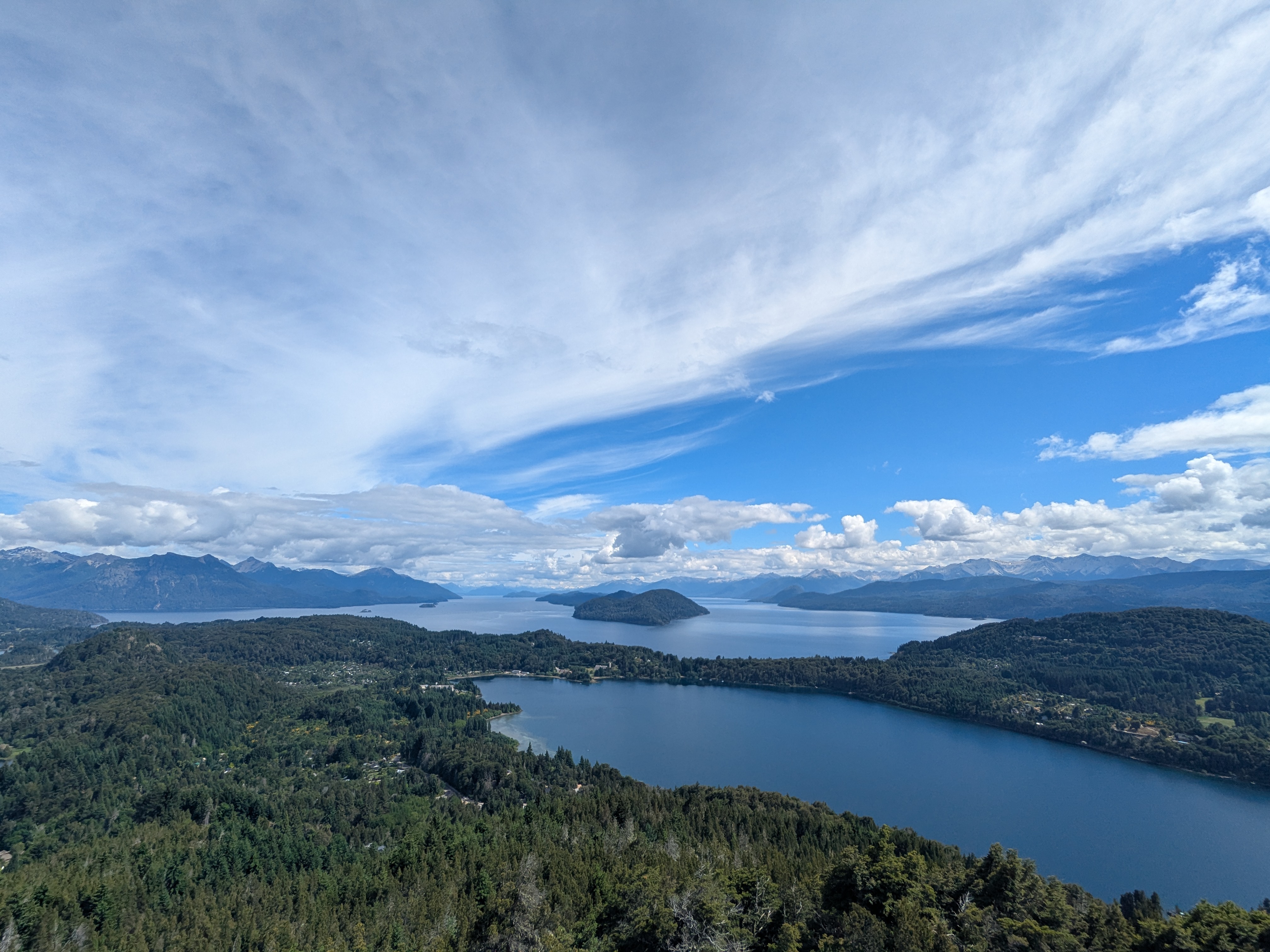
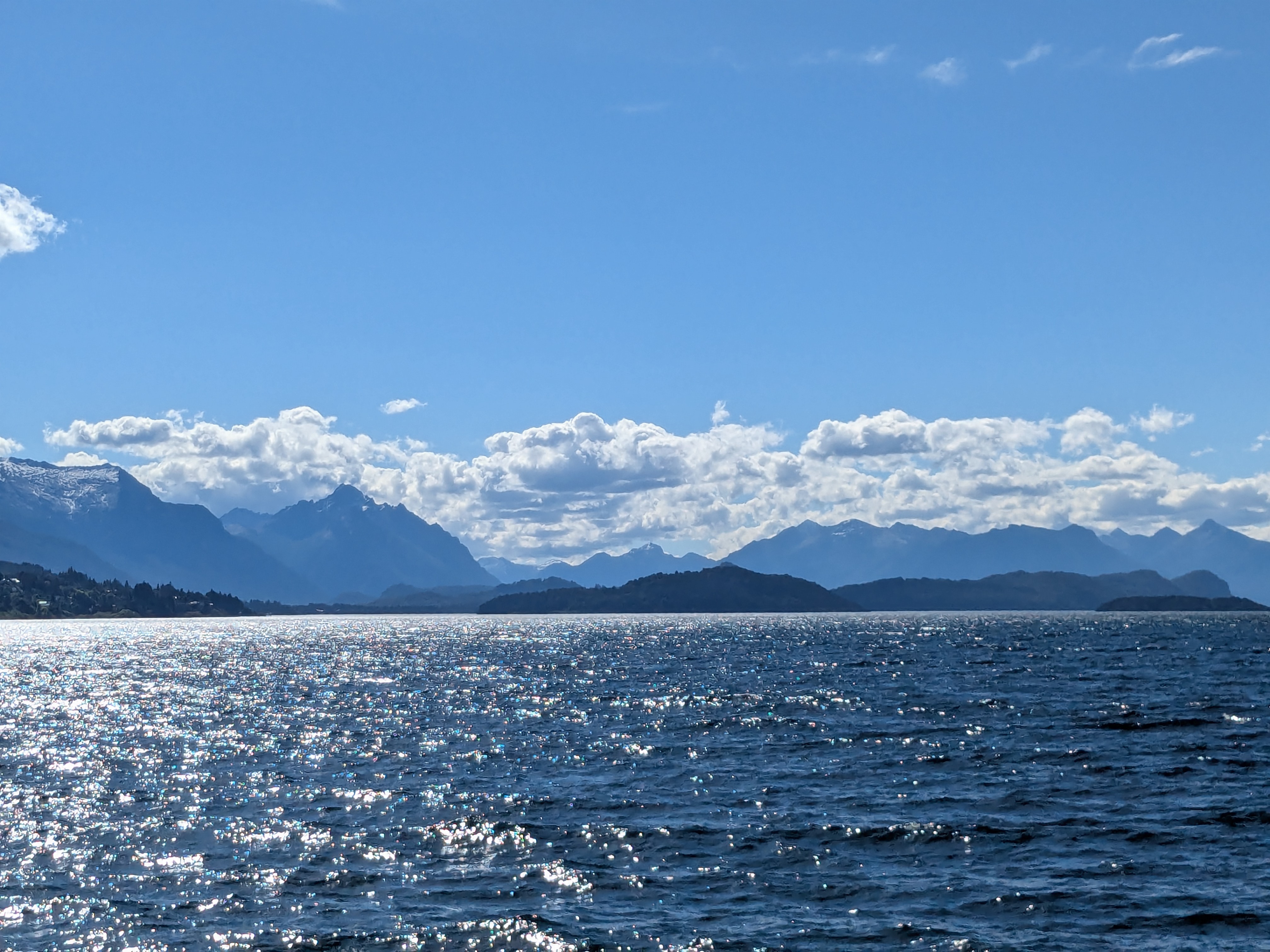
We safely arrived at our Airbnb which is on a narrow street. Fortunately, our Airbnb host Mariano met us outside and there was a very small parking garage. Airbnb reminded us of the beautiful Airbnb we had in Buenos Aires. It is a 2-story unit on the 7th floor with a great view of Nahuel Huapi Lake. Nahuei Huapi Lake is a massive, crystal-clear glacial lake in Argentina’s Patagonia region. The Chilean Border is only about an hour and a half drive.
San Carlos de Bariloche downtown has a street lined up with many chocolate stores. Even though the chocolate is not as world renowned as Swiss Chocolate, the quality is equally good, and we recommended “Nanpui” for their chocolates. Almost all the chocolates sold have warning signs of “too much sugar” and “too much fat” on the box. These signs do not deter any customers. From the chocolate street, it was an easy stroll to the lake front. There were some antique cars events on the day, and the city center was crowded with spectators. After a month in Argentina, we craved Chinese food and had an early dinner at Wong, one of the only two Chinese restaurants in town.
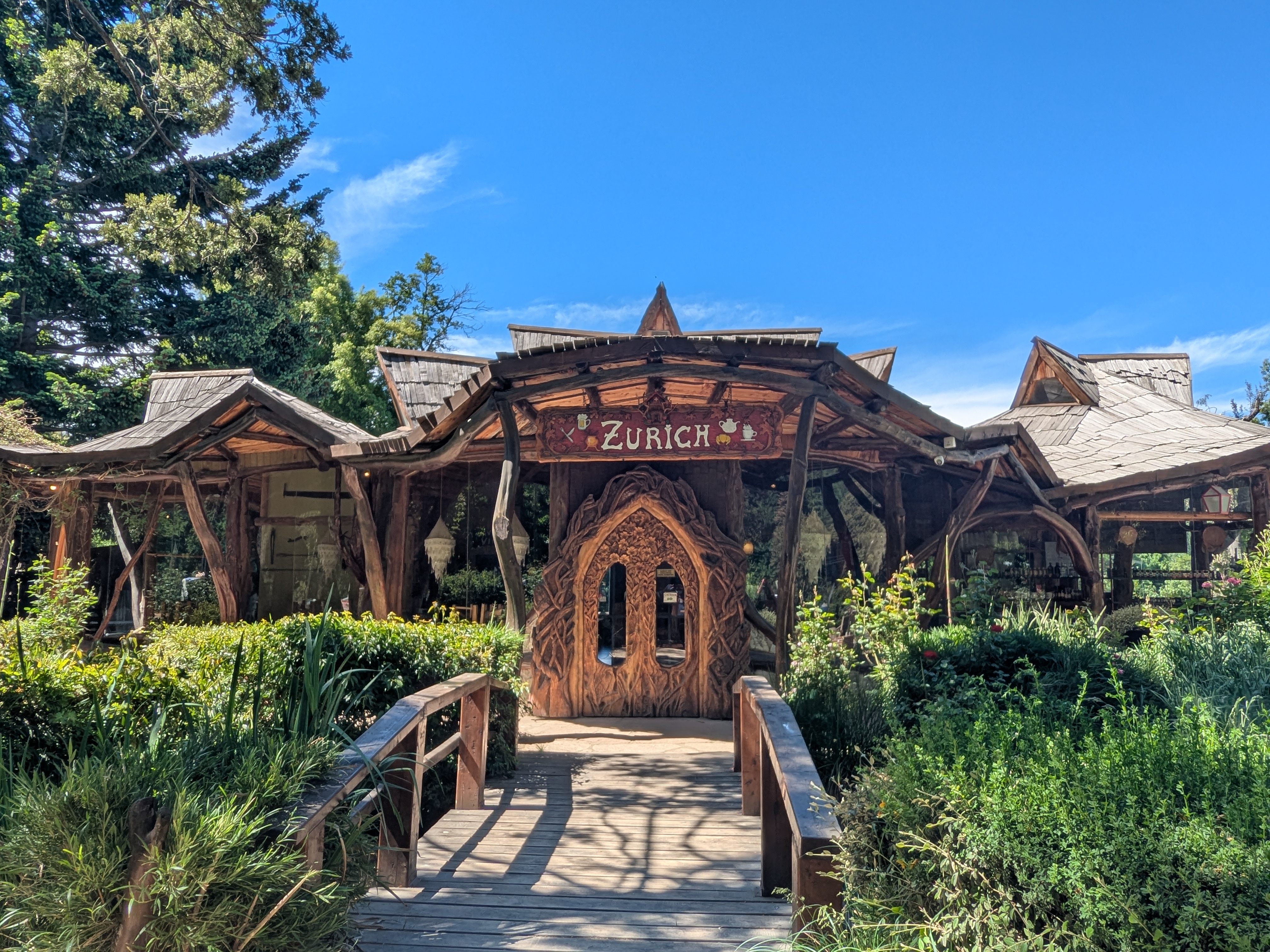
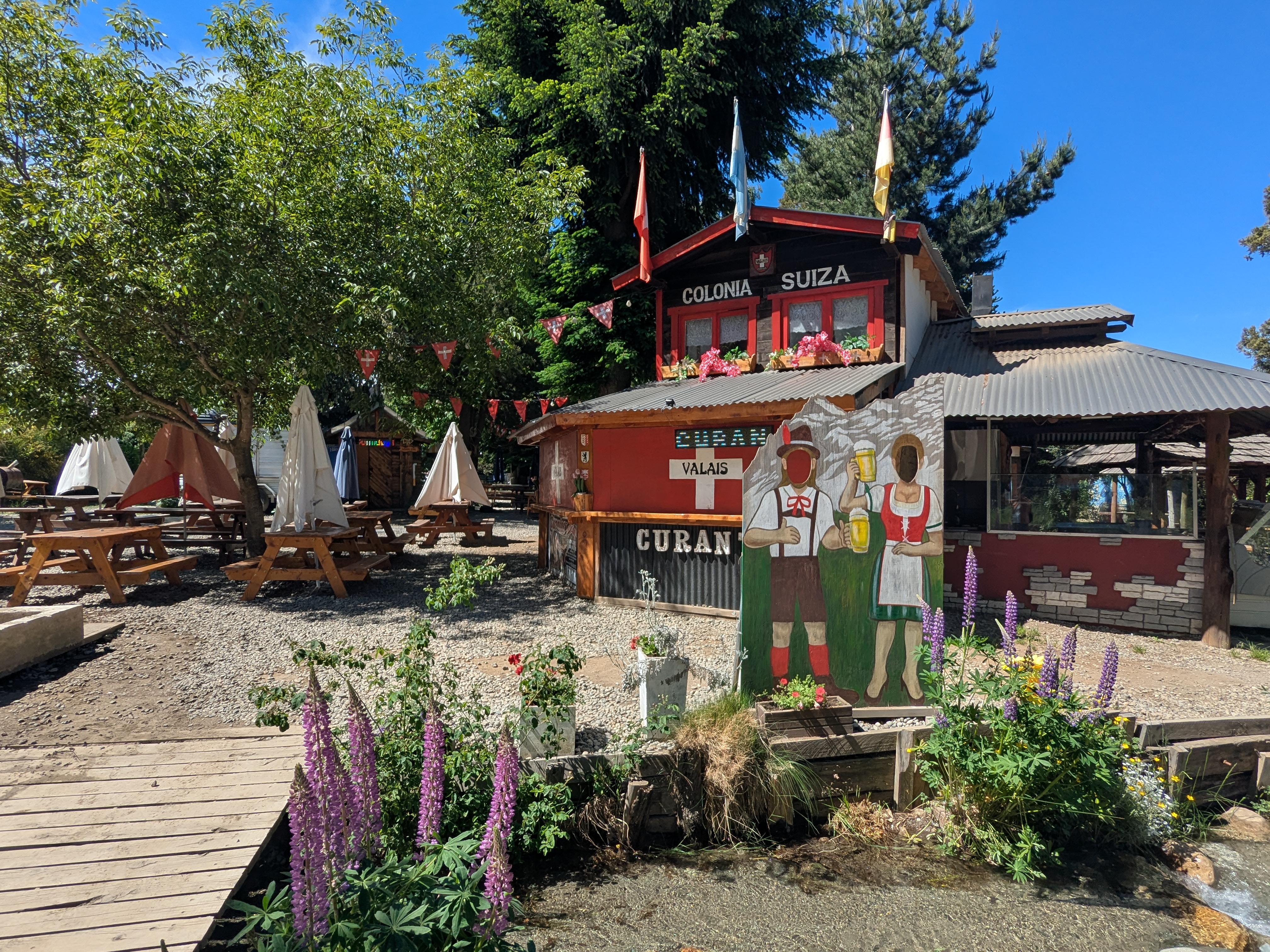
If you only have a day, the Circuito Chico is a convenient one-day road trip. There are chairlifts and hiking trails to walk up to enjoy some gorgeous views of lakes and mountains. The Llao Llao hotel is a top 5 star hotel with rustic cottage decor and a good place to enjoy snacks. Its service does not live up to the 5 star standard. The Colonial Suiza, a small Swiss-style town, can only be reached through gravel roads. We drove so very slowly that the rental Fiat handled the gravels without causing a flat tire. There were small ships good for getting some souvenirs, and we got some Patagonian tea bags. In Patagonia, the animals do not seem to be scared of people. We saw a small fox stopping in the middle of the road and did not seem to care.
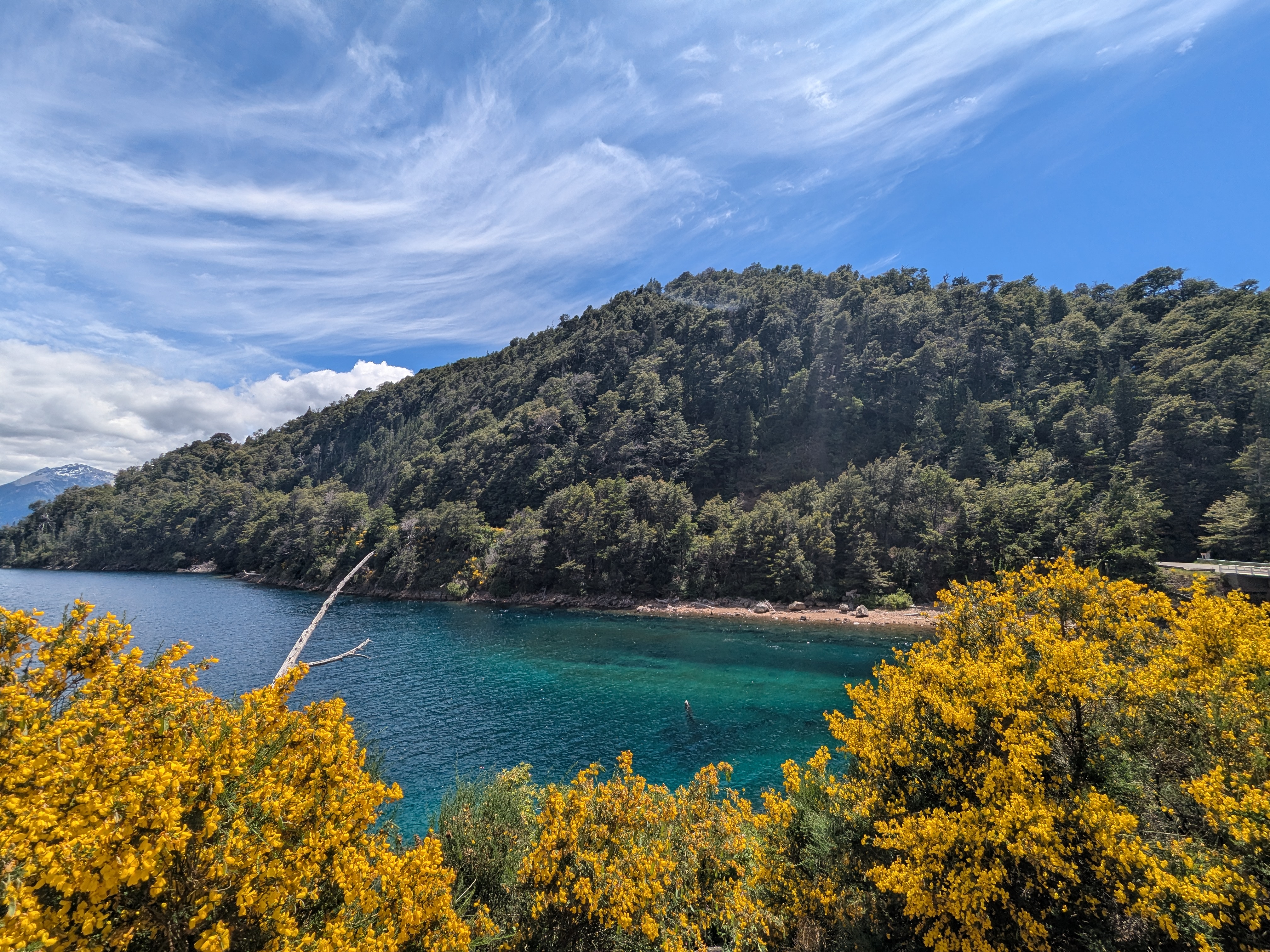
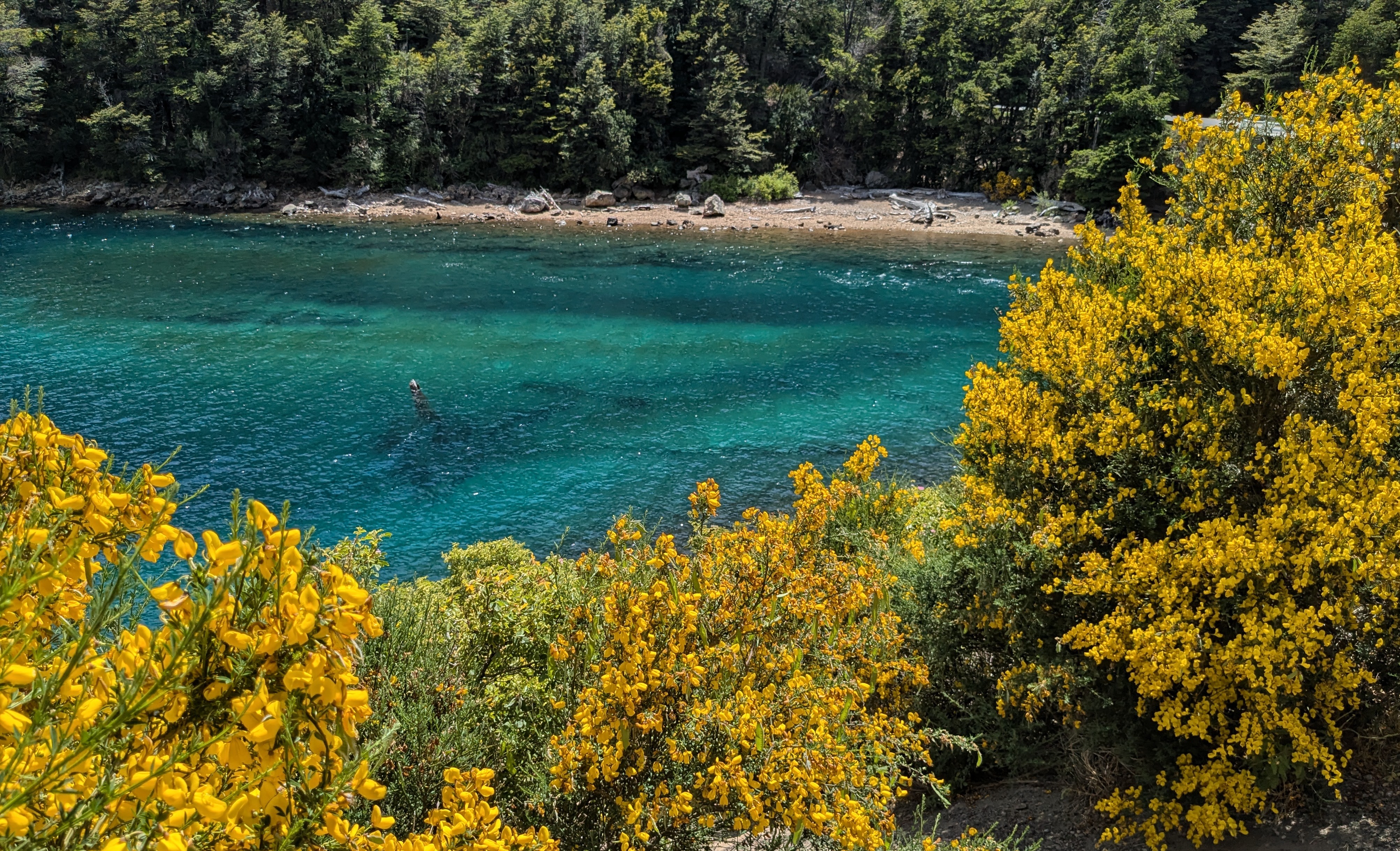
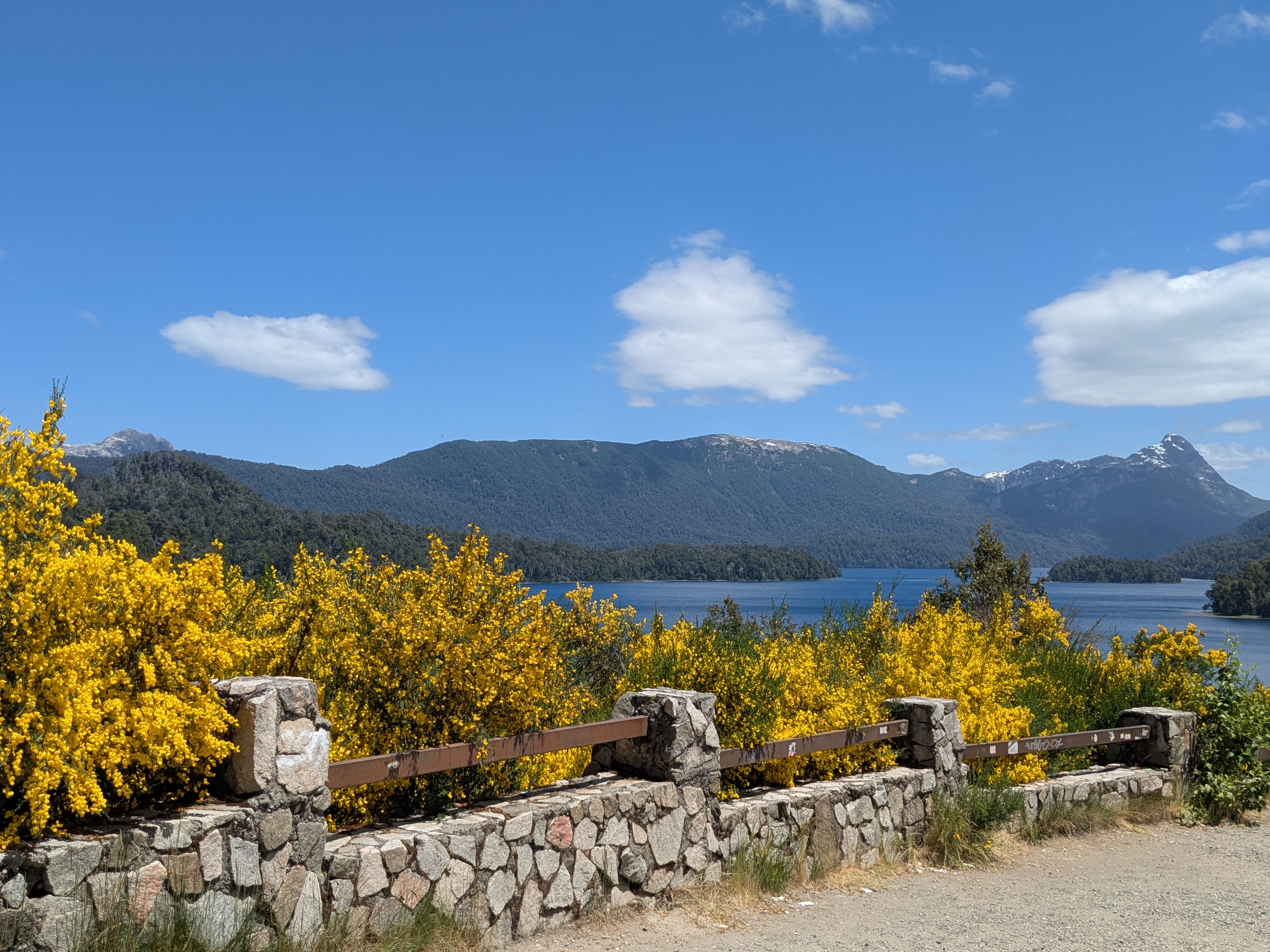
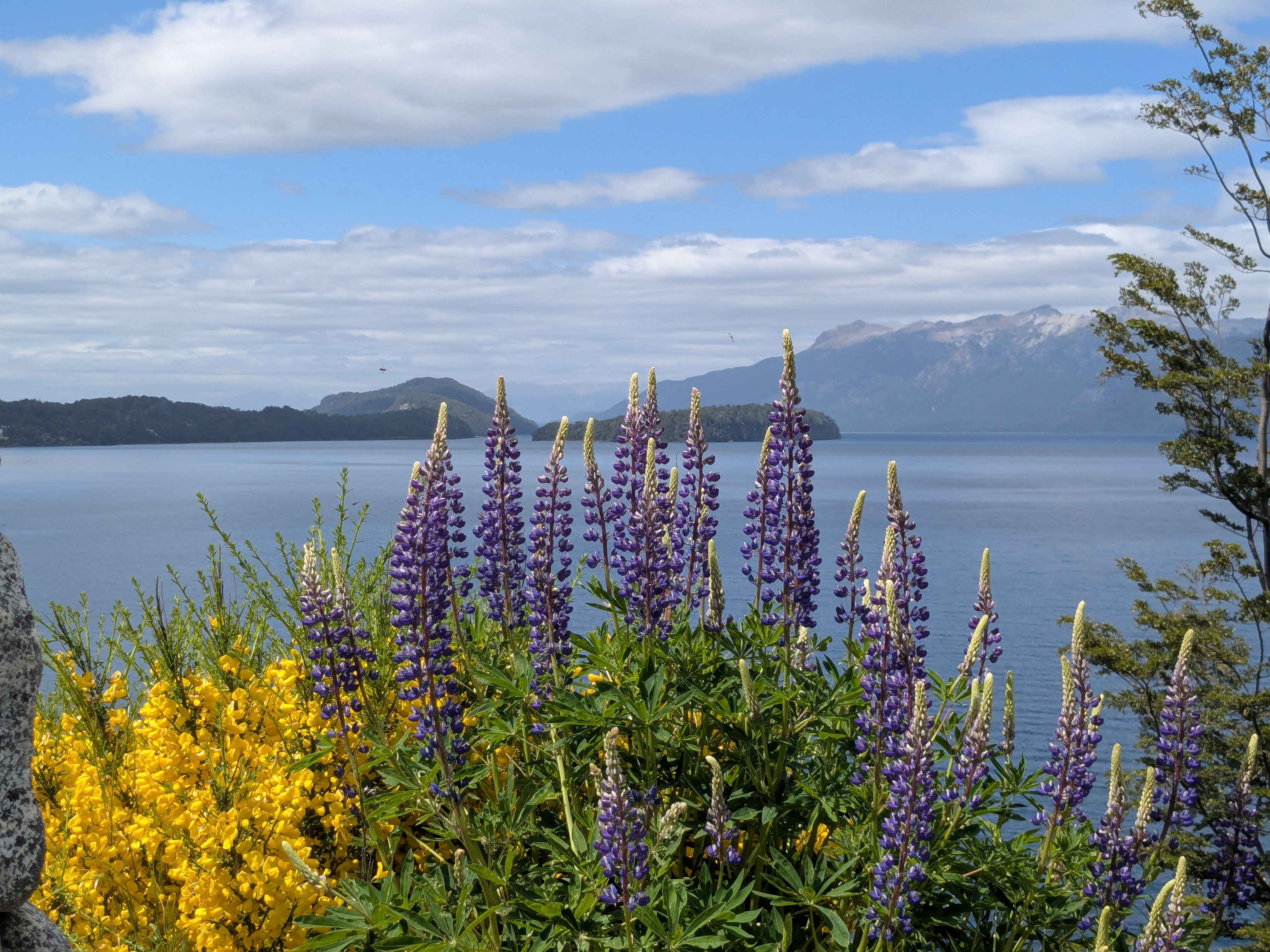
If you have more than one day, the seven lakes road trip would take you to Nahuei Huapi and Lanin National Park. It makes a full day trip on a scenic 110-120 km stretch of the famous National Route 40. There are lakes after lakes, small and large. Living up to the Patagonia wilderness, there are only two big towns: Villa de Angostura and San Martin de Andes; there are hardly any other small towns or inhabitants in between. Angostura is a charming small town with shops and eateries, and better roads. These lakes remind me of Lake Tahoe, equally beautiful. The seven lakes are enhanced with the surrounding forestry landscape and at times the beautiful bright yellow Scotch Broom and purple Lupines lining up along the freeway. It is an easier road trip with the well paved National Route 40 that connects the national parks of Argentina in Patagonia.
If you have more than two days, there is a boat trip to Victoria Island and Forest of Arran where Sequoia Trees, Black Sand Beach, Native Trees and Hiking trails await.
Bariloche is Patagonia with peaceful lakes, Swiss atmosphere, chocolates and National Parks connected through a myriad of roads, from unpaved to well paved, with speed limit from 20, 40, 60 and 80 km per hour.
Few travellers spend five weeks in Argentina on their first trip to South America. We had experiences for a life time.
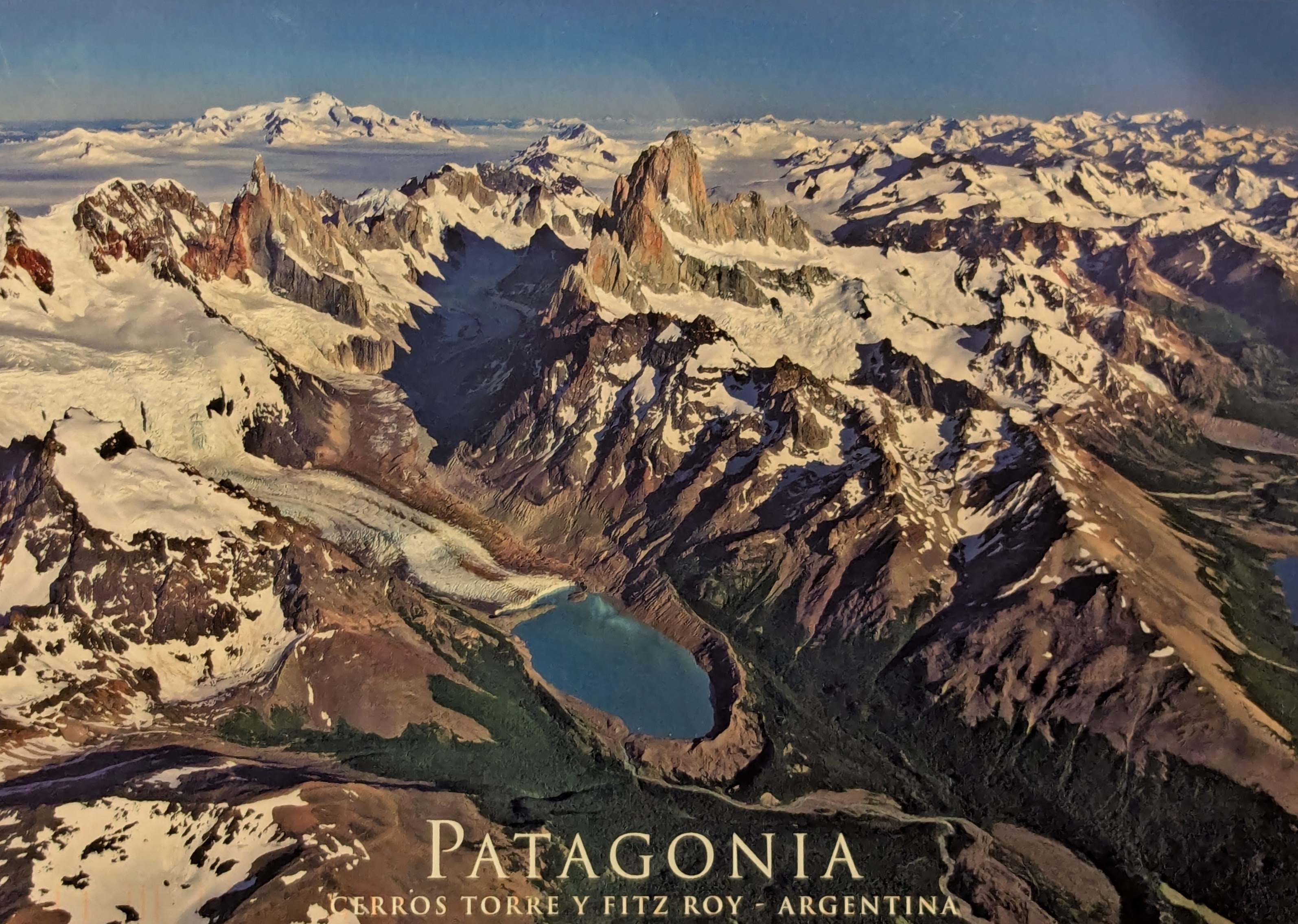
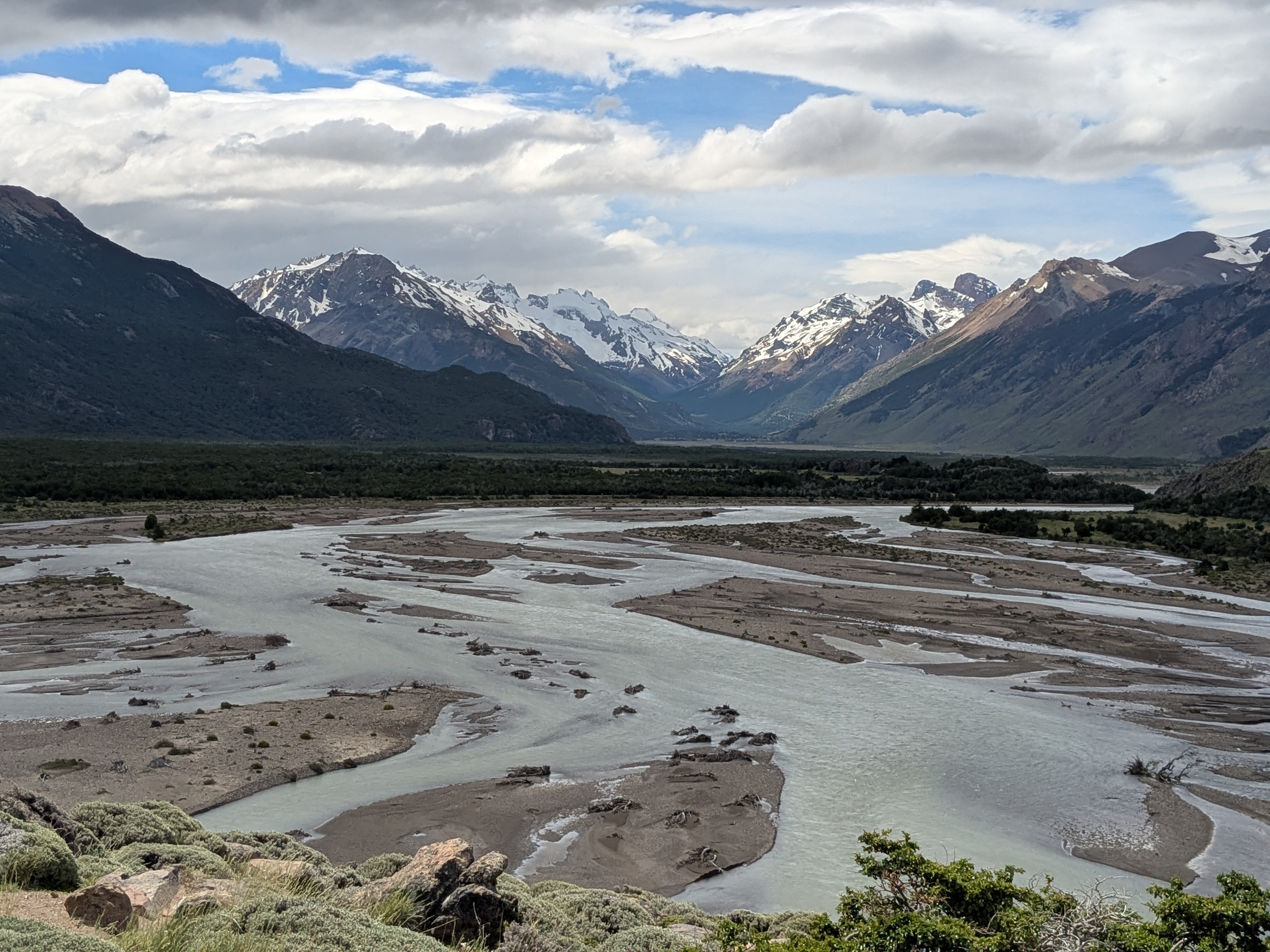
El Chaltén is the hikers paradise. It is the place where hikers meet and it has the iconic hike of Lagoon de Los Tres. Laguna de los Tres offers breathtaking, close-up views of Mount Fitz Roy and its glacier. The 20 km round trip takes 7–9 hours. Laguna de los Tres, “Lake of the Three”, is not about three lakes, It refers to the three prominent peaks towering above the lake, which are Mount Fitz Roy, Poincenot, and Saint-Exupéry, located in Los Glaciares National Park near El Chalten, Argentina. Fitz Roy captained the HMS Beagle Charles Darwin was on almost two hundred years ago. He explored the El Chaltén region with Charles Darwin in 1834.
We are not among the rock climbers who scale the Granite Wall of Mount Fitz Roy. Chouinard and team did that back in 1968 (Pg 45 to 52 of Dirtbag Billionaire) before he founded the Patagonia company. The Patagonia logo is based on none other than Mount Fitz Roy.
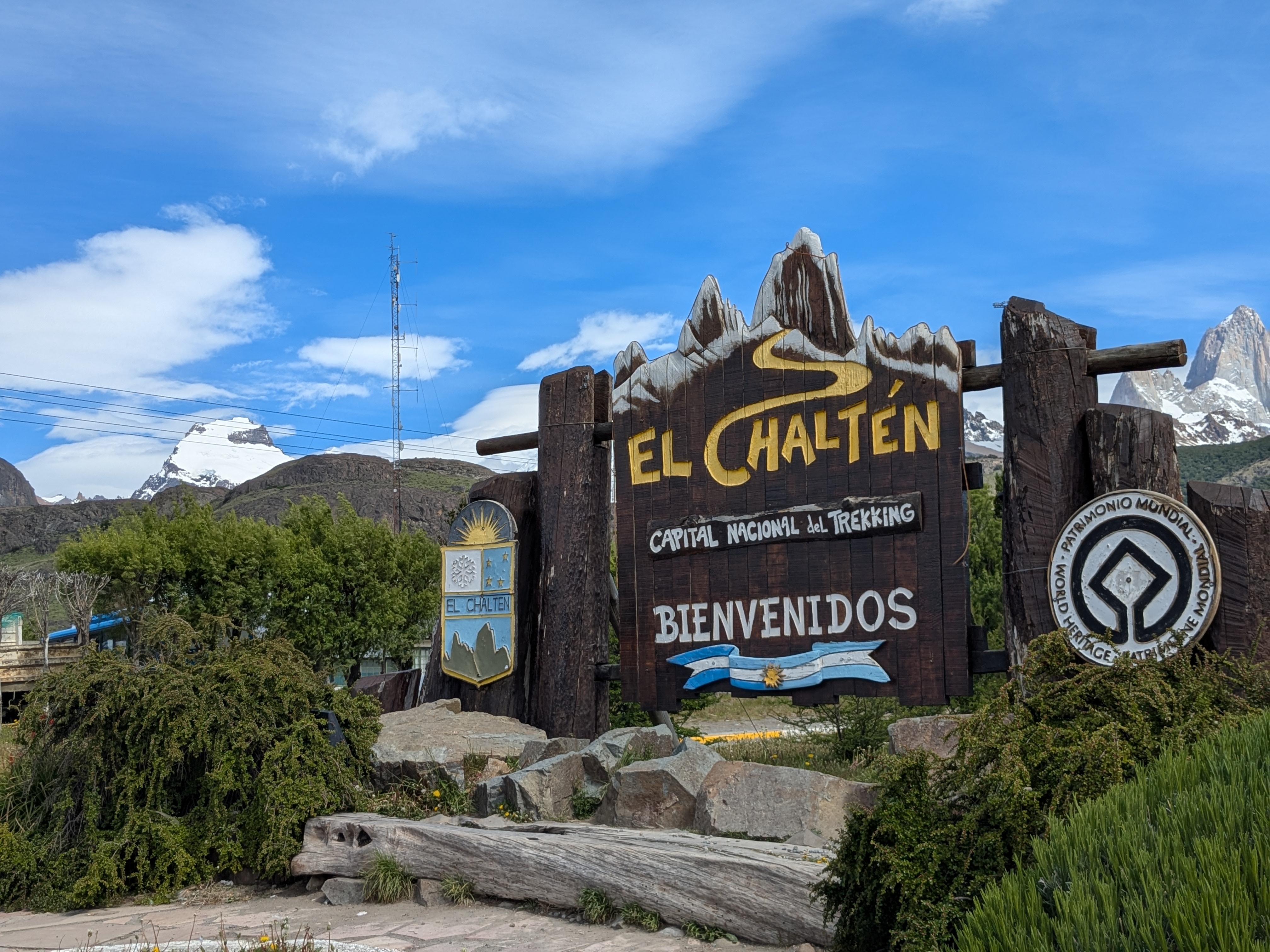
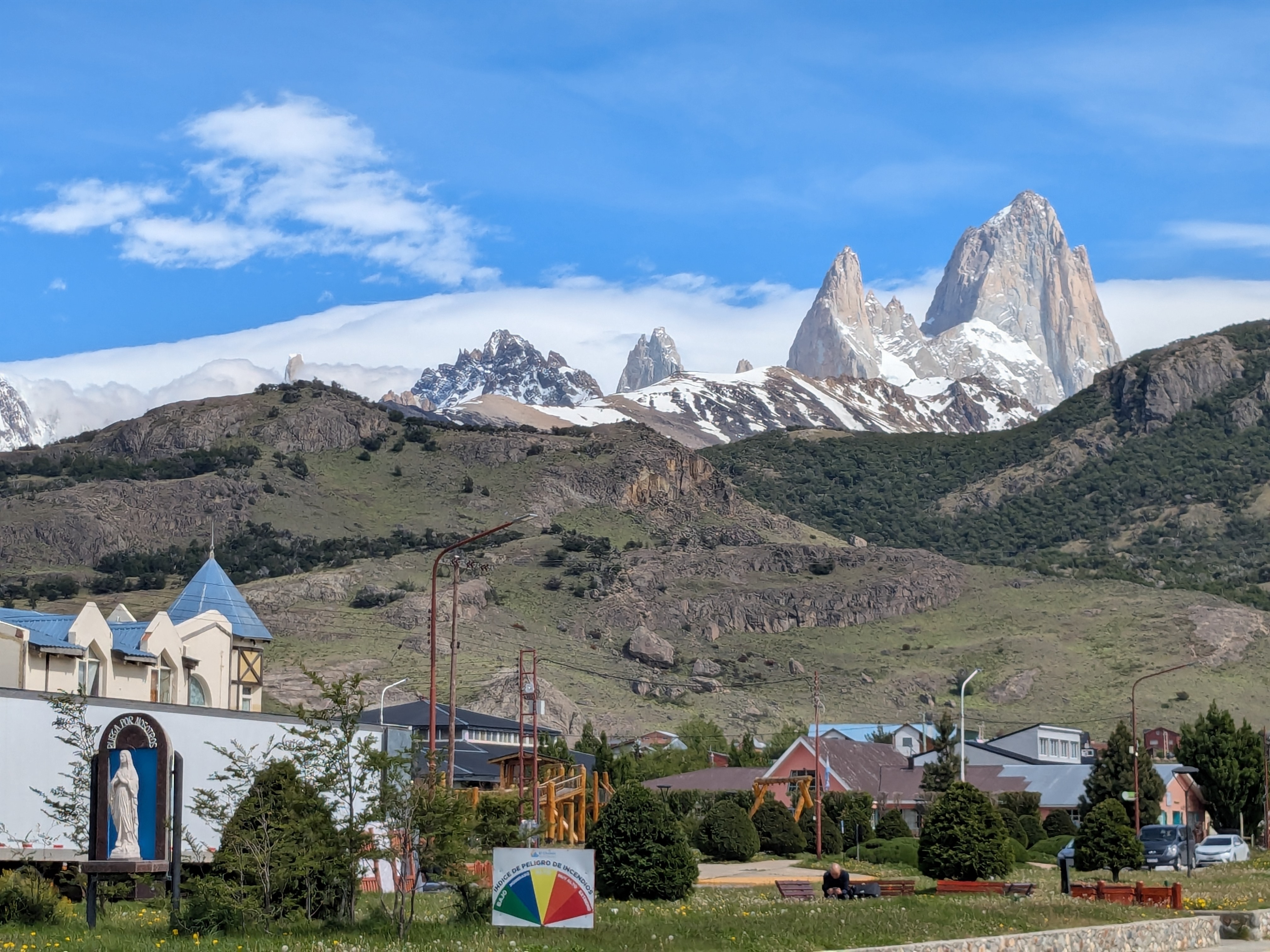
El Chaltén is a convenient 3 hours bus ride from El Calafate. El Chaltén has a different vibe and is like a village where visitors have just one thing in mind – outdoor exploration/hiking. It takes less than 30 minutes to stroll from one end to another. San Martín is the main avenue, not one of, in El Chaltén. Strolling in the town, we can see the different faces of Mount Fitz Roy from afar. The town is filled with hostels/hotels/airbnb, coffee shops, gift shops, grocery stores and choices of restaurants. Our Airbnb, a comfortable unit next to the host family, is in a perfect location.
El Chaltén’s itinerary is very simple – hiking followed by day(s) of rest.
A day after the arrival, we did the primary waterfall hike in El Chaltén, Chorrillo del Salto (Waterfall) to test our hiking gear. It is a relatively short forest trail, located at the north end of San Martin Avenue. It offers a view of, 20-meter high waterfall at the end. On the day, it was windy and dusty, creating a slightly unexpected challenge than an easy and flat trail that it is known for. After the hike, we went for an early dinner at a Parrillo restaurant, which displayed pictures of communist leaders Fidel Castro, Ernesto “Che” Guevara. “Che”, an Argentinian, has been a hero. “Las Malvinas son argentinas” is another discovery how some Argentinians still believe Las Malvinas (i.e. the Falkland islands) belong to Argentina.
Argentina Correo (Post Office) is undergoing changes so much that the Post Office looks terribly run down and it stays closed during opening hours. There are one or two gift shops selling stamps. To mail a postcard, it costs more than $10 USD, equivalent to 15000 Argentina peso, in 5 different stamps. I mailed two postcards. We then had lunch at the restaurant next to our Airbnb served with Parrillo lamb, salad, we enjoyed and had enough left over for dinner. Our star gazing plan faltered after knowing that the time for it would be after midnight.
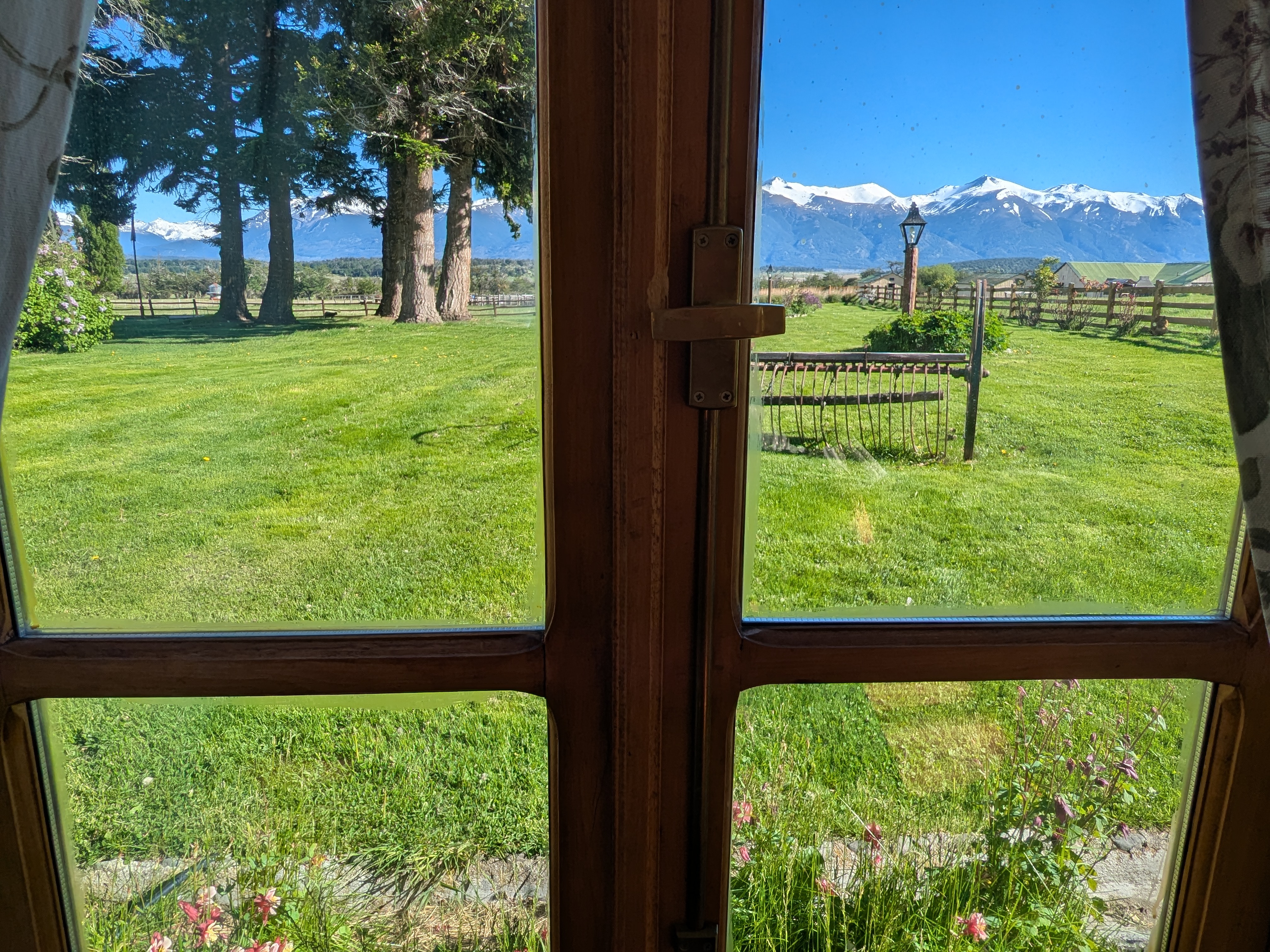
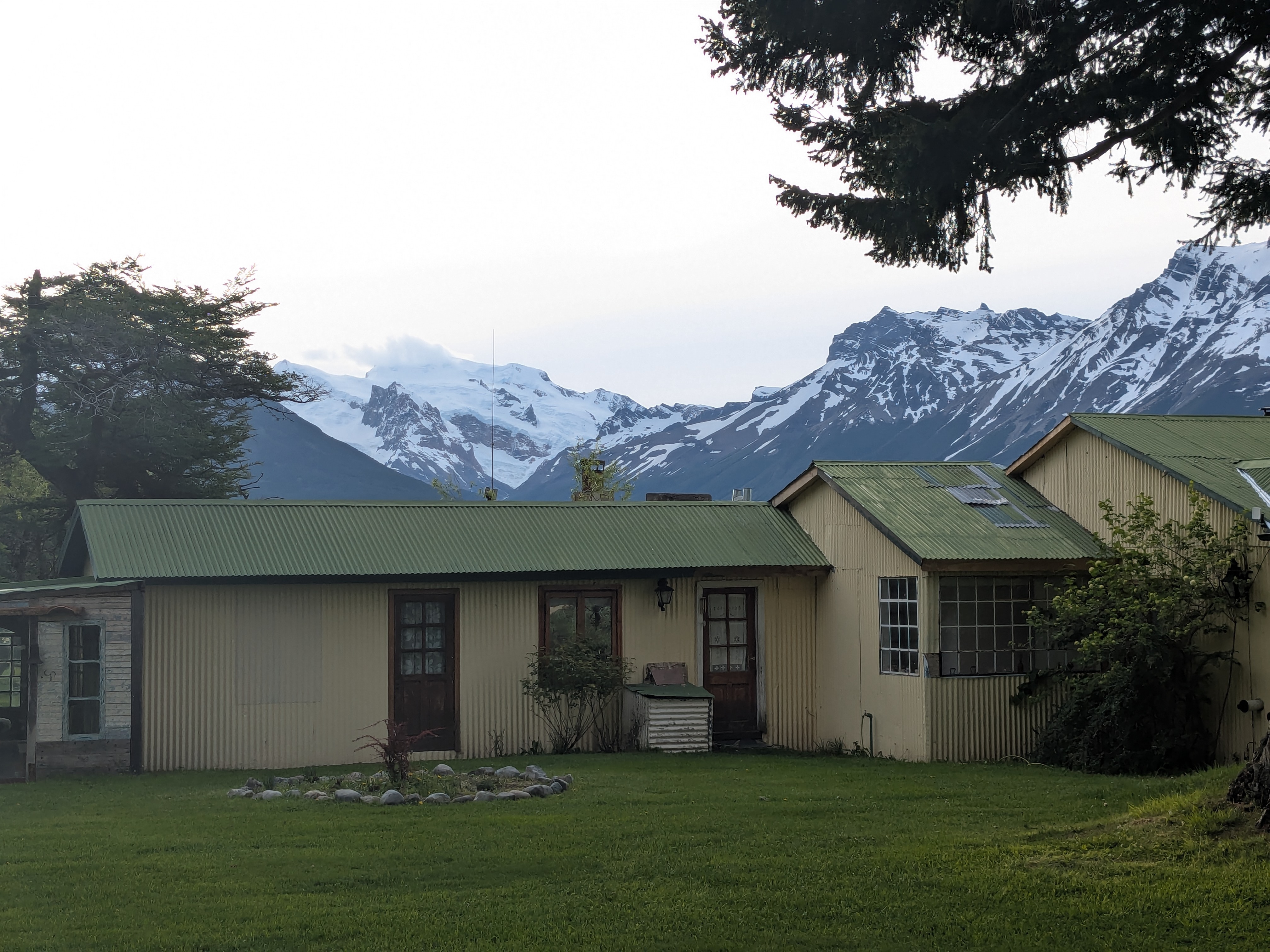
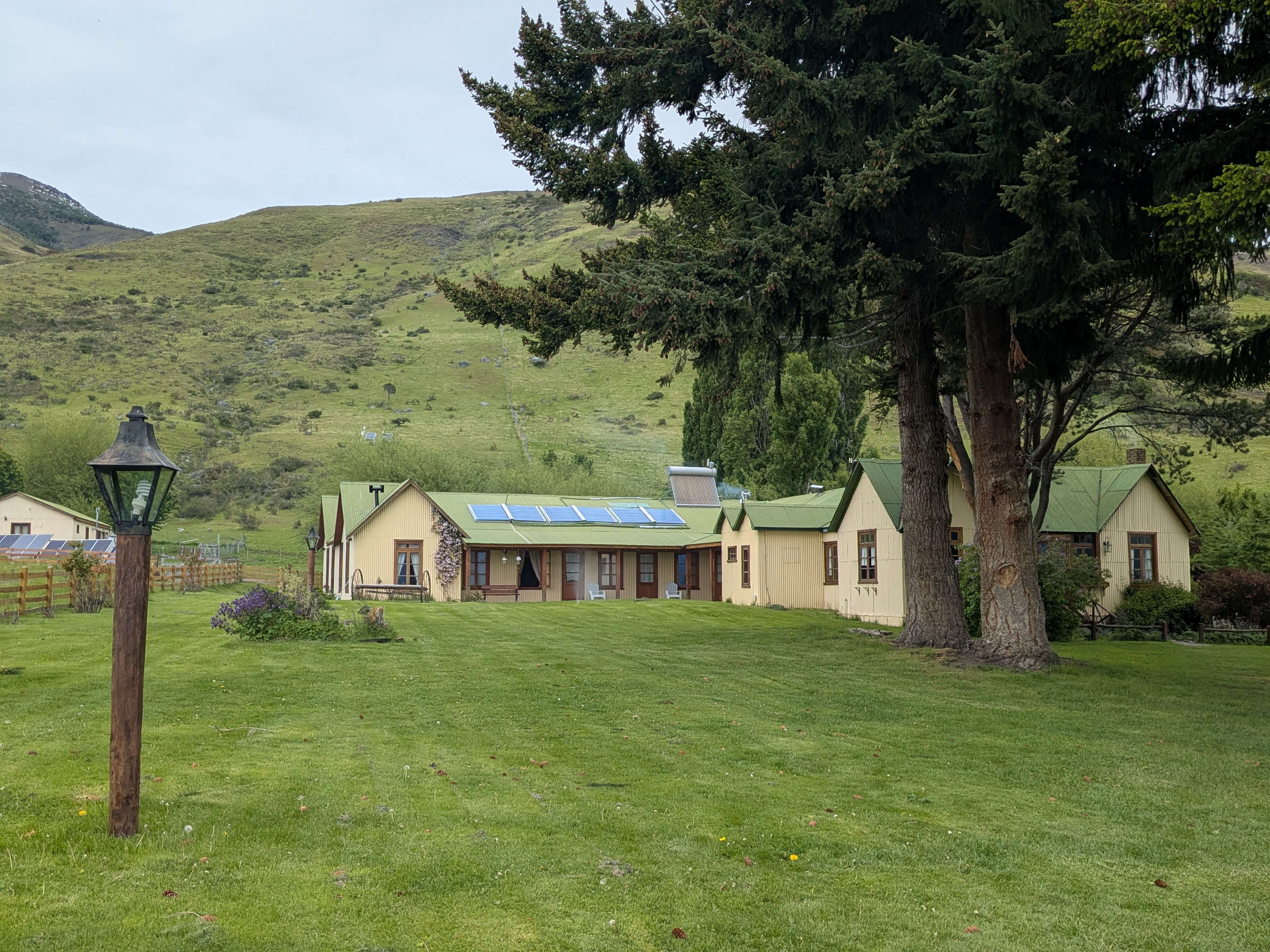
In Nibepo Aike, through the windows of our room, we have a perfect view of the snow-capped mountain ranges, the beautiful scenery, sometimes chickens and birds outside. We could stay in our room, sitting on the sofa, zipping tea, reading books and from time to time, look up to appreciate the beauty of nature.
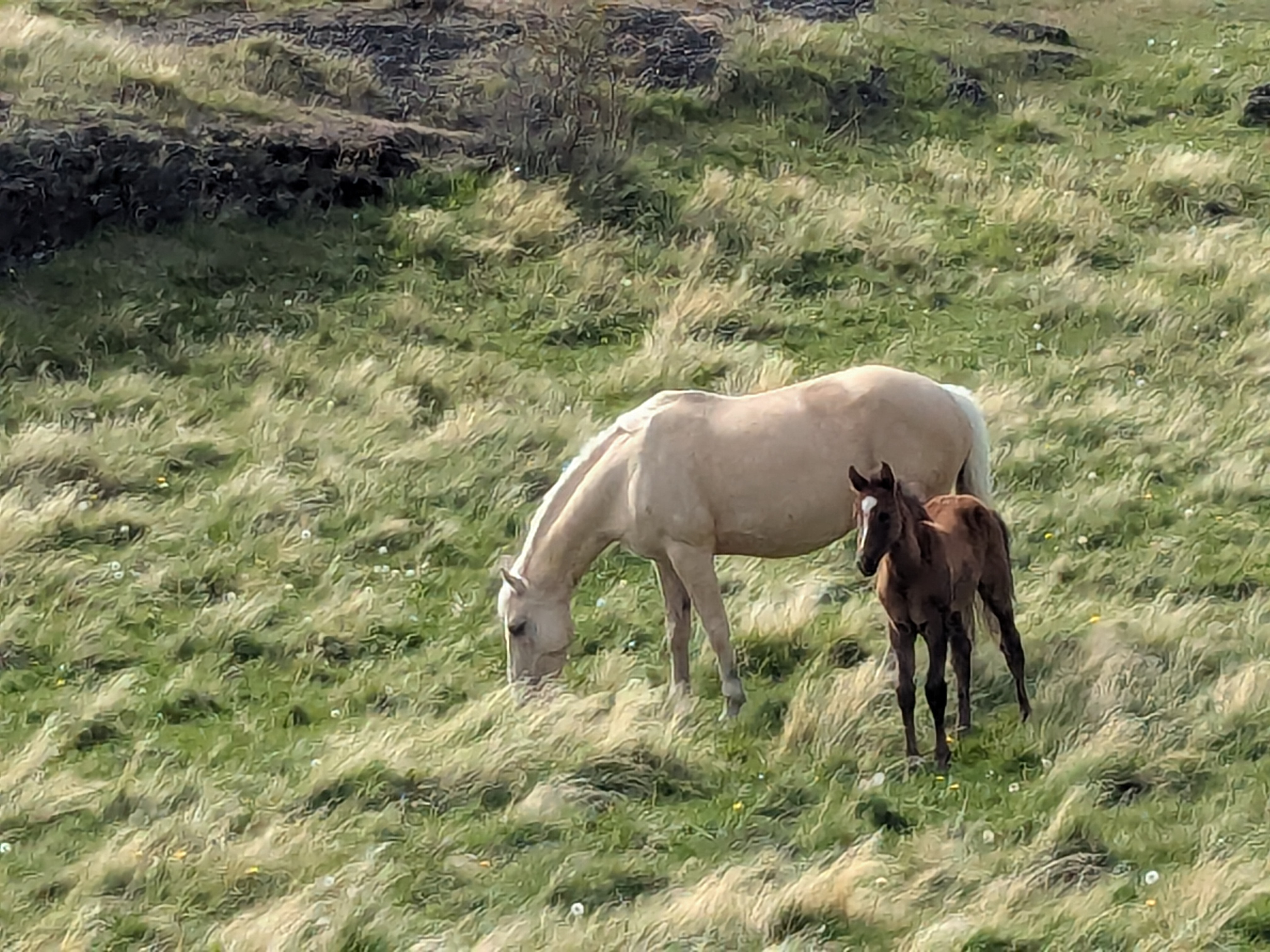
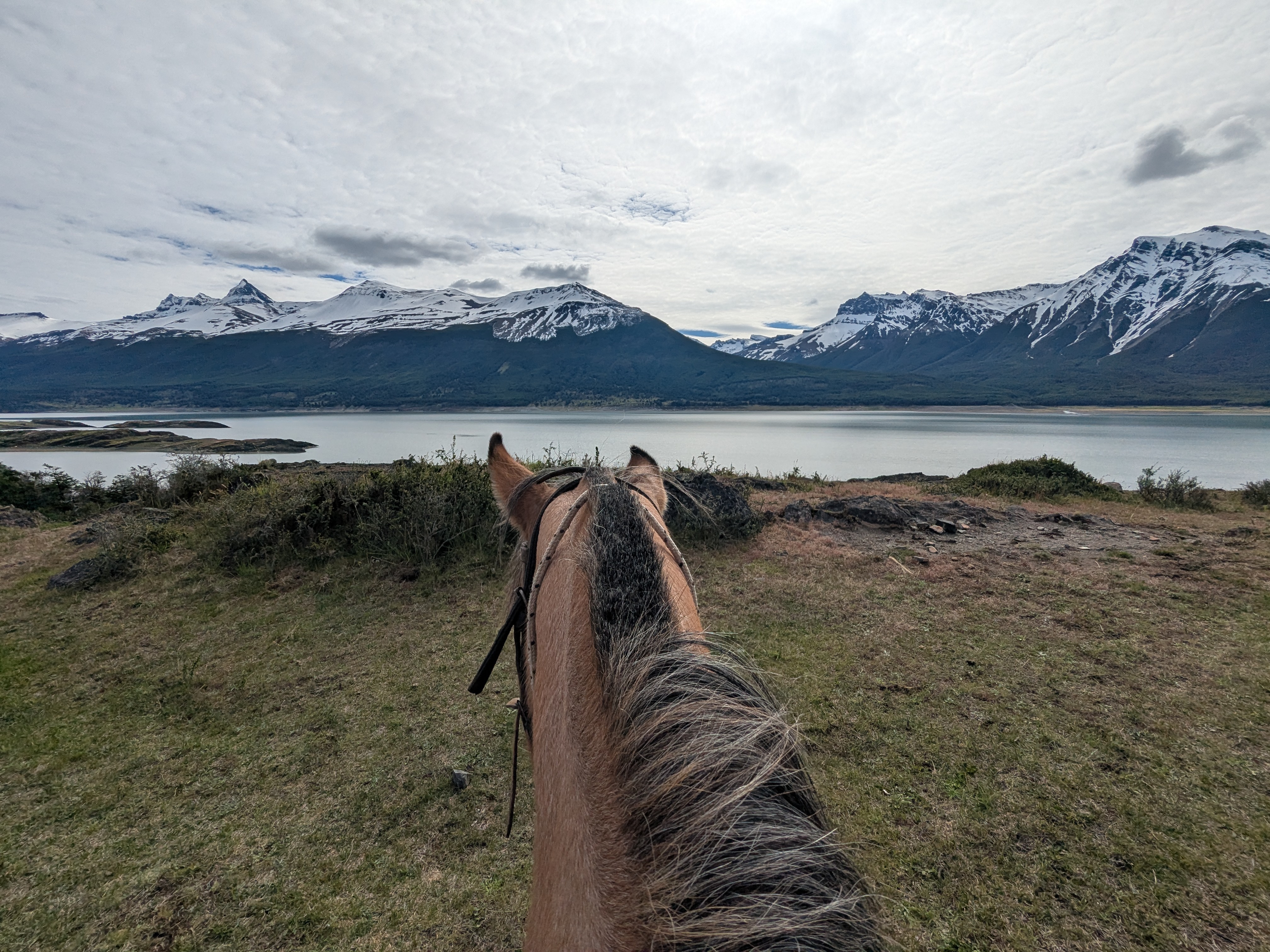
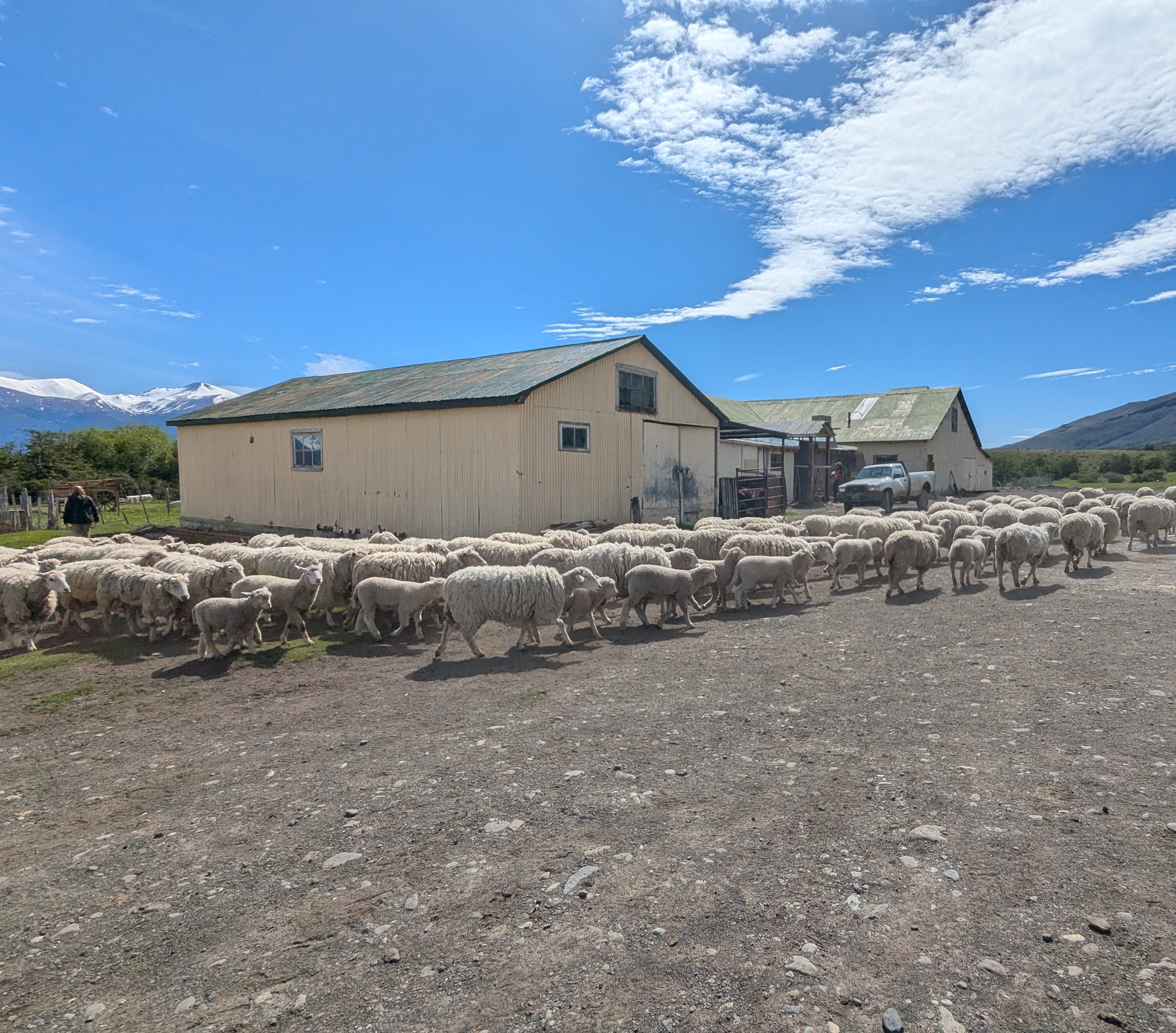
There are horseback riding activities from one hour to three hours. The first day we did a 3-hour horseback riding in the afternoon around the area. The pasture and the lake are tranquil and beautiful; the horses, the cattle and the birds look relaxed. Patagonia Criollo horses are renowned for their endurance. Criollo horses are intelligent, steady and calm, often forming deep partnership with the riders. The tan-colored horse I rode on the first afternoon lived up to the reputation. It was the best. She was gentle, experienced and responded well to the rein. Its narrower body was comfortable to ride on. I connected with it right away. This afternoon in Patagonia Estancia gave me the best horseback riding experience ever. Unfortunately “my horse” needed rest in the following days. The next afternoon, I rode a black horse with a broader body. It was not as comfortable. We did an hour of horseback riding to herd the sheep back to the barn in the evening. It was fun even though it was mostly the staff riders who guided the sheep back to the barn. The third day was a morning ride. My white horse was the most active. It just wanted to gallop, especially when she saw other horses galloping. I had to keep reining it in. Three horses in three days, even in a short time, it is apparent these horses have very different temperaments. I am most connected to the gentle tan-colored horse on the first day and the other two horses seem to sense my preference.
We got to know a few of the Estancia staff. We met the owner when we looked for the directions to the hiking trail up the short hill overlooking the ranch. The owner looked older. He was so tall and energetic that he walked three times faster. We needed to jog to keep up with his walking. He is a happy fellow. The general manager Silvano took such good care of us. We chatted with him whenever he was not as busy. He makes a wonderful hotelier with good knowledge of the ranch operations, and endearing people skills. There is a native, the know-it-all, taking care of all kinds of chores in the farm and he is everywhere working all the time. There is also a gentleman and a young lady taking care of the horses and are very knowledgeable about them. The female tour guide spoke arguably the best English and handled multiple languages at ease as she took us around on the ranch day. Even for a few days, I came to know the ranch staff better than the staff of other accommodations, as we saw each other throughout the days.
The Estanica experience gives us a true connection to the animals, the caring staff and nature. It is an experience of a lifetime.
We had great experiences in Patagonia, visiting Glacier, hiking scenic trails, strolling the lovely towns, enjoying Patagonian tea and Argentinian cuisines. The best of all belonged to our three days and two nights at Nibepo Aike Estancia. The Estancia experience is a childhood dream come true. I felt like I was living in a fairy tale, the kind of experience to freeze time just to stay there for a bit longer.
Estancia in Latin America is similar to a ranch in America. Nibepo Aike Estancia offers an all inclusive package, covering the transportation, the room, the boarding and all the Estancia activities. Nibepo Aike Estancia is about an hour drive from El Calafate. The Estancia staff picked us up from the Airbnb we stayed in El Calafate. There were only three guests in the van – the two of us, and Jackie who stayed in a hostel in El Calafate. J, short for Jackie, was a retired Math school from England. J is tall, fit and is a seasoned solo traveller. Being a British, J insisted that the way to prepare milk tea properly is after brewing the tea, we should pour the tea into milk, not the other way round. I have changed our milk tea preparation ever since. We ran into J a few more times in El Chalten. I remember her fondly and sent her New Year Greetings weeks after we all returned home.
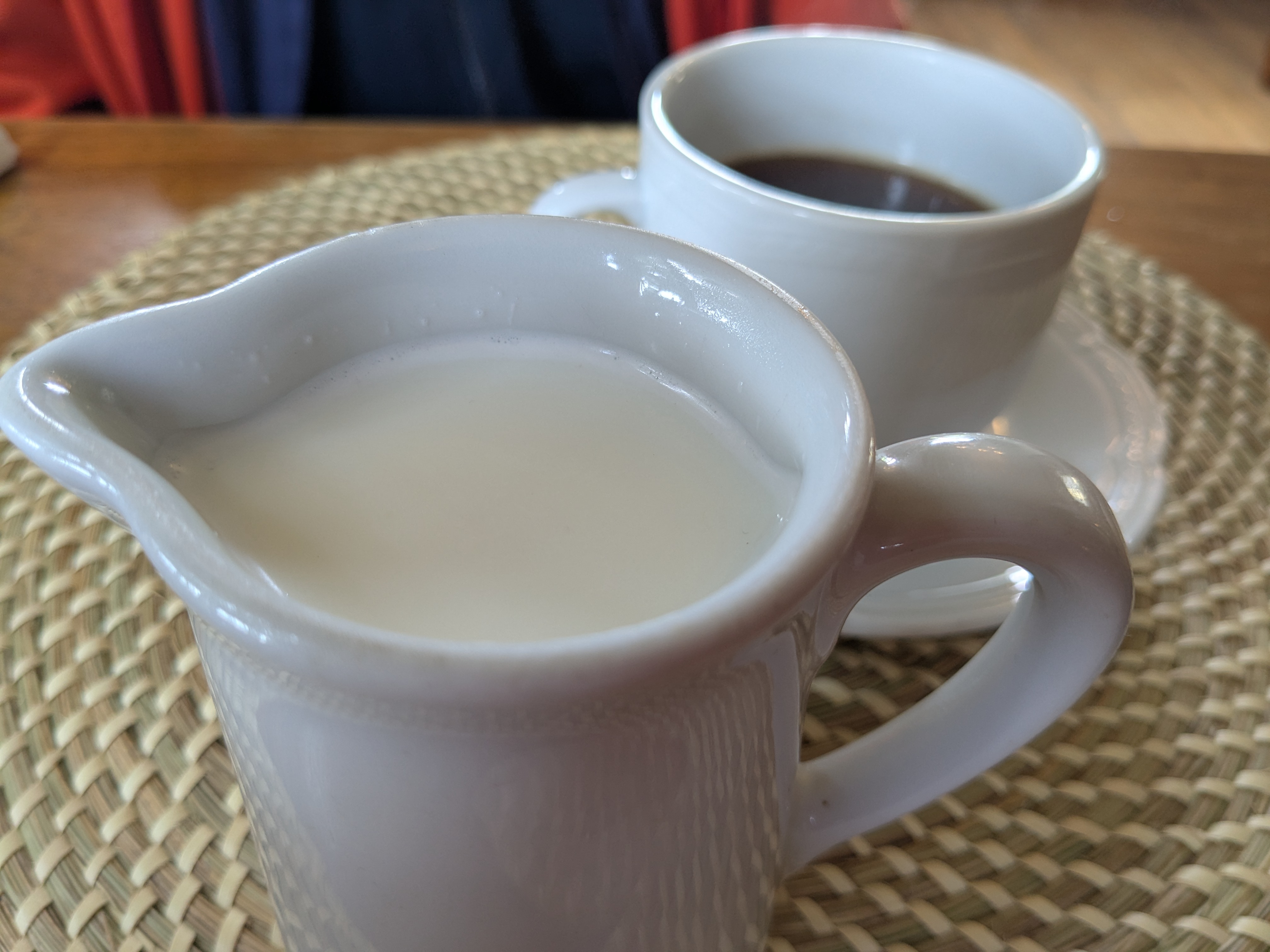
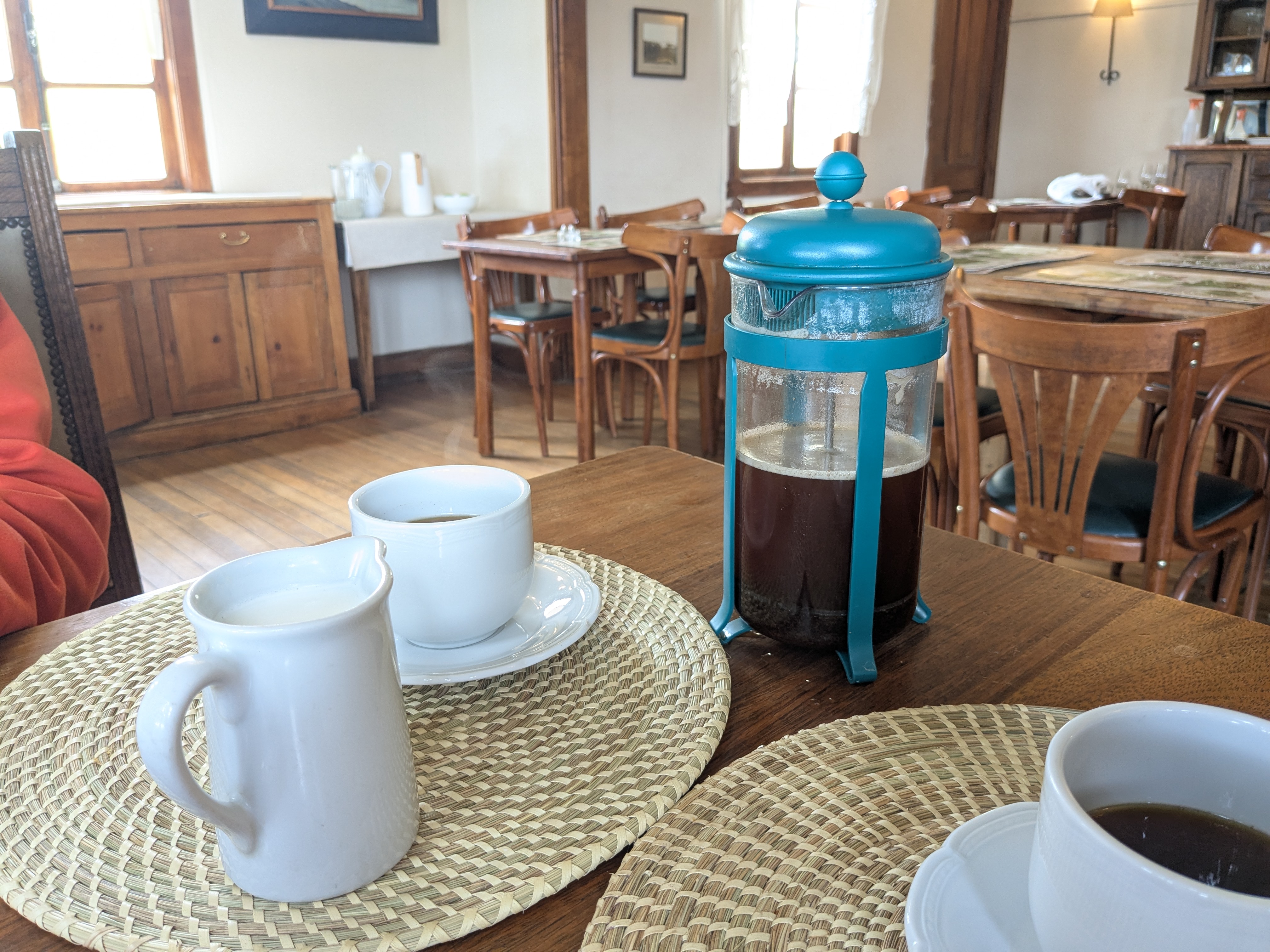
We arrived at the Estancia and experienced a change in pace almost immediately. It accommodates only about 20 guests in a big ranch. It was quiet on the day of our arrival. Still it has taken us quite a while to check in. No one was in a hurry. We settled ourselves comfortably in the cafe. It was not meal time yet, there were hardly any other guests. While waiting for our room to be ready, we were treated with the coffee offered by the General Manager Silvano. It was not any ordinary coffee. It was his own coffee beans and his own coffee maker. Silvano went out to milk the cow to get the freshest milk possible. That cup of coffee made one of the most delicious coffee in the quiet cafe listening to relaxing music.
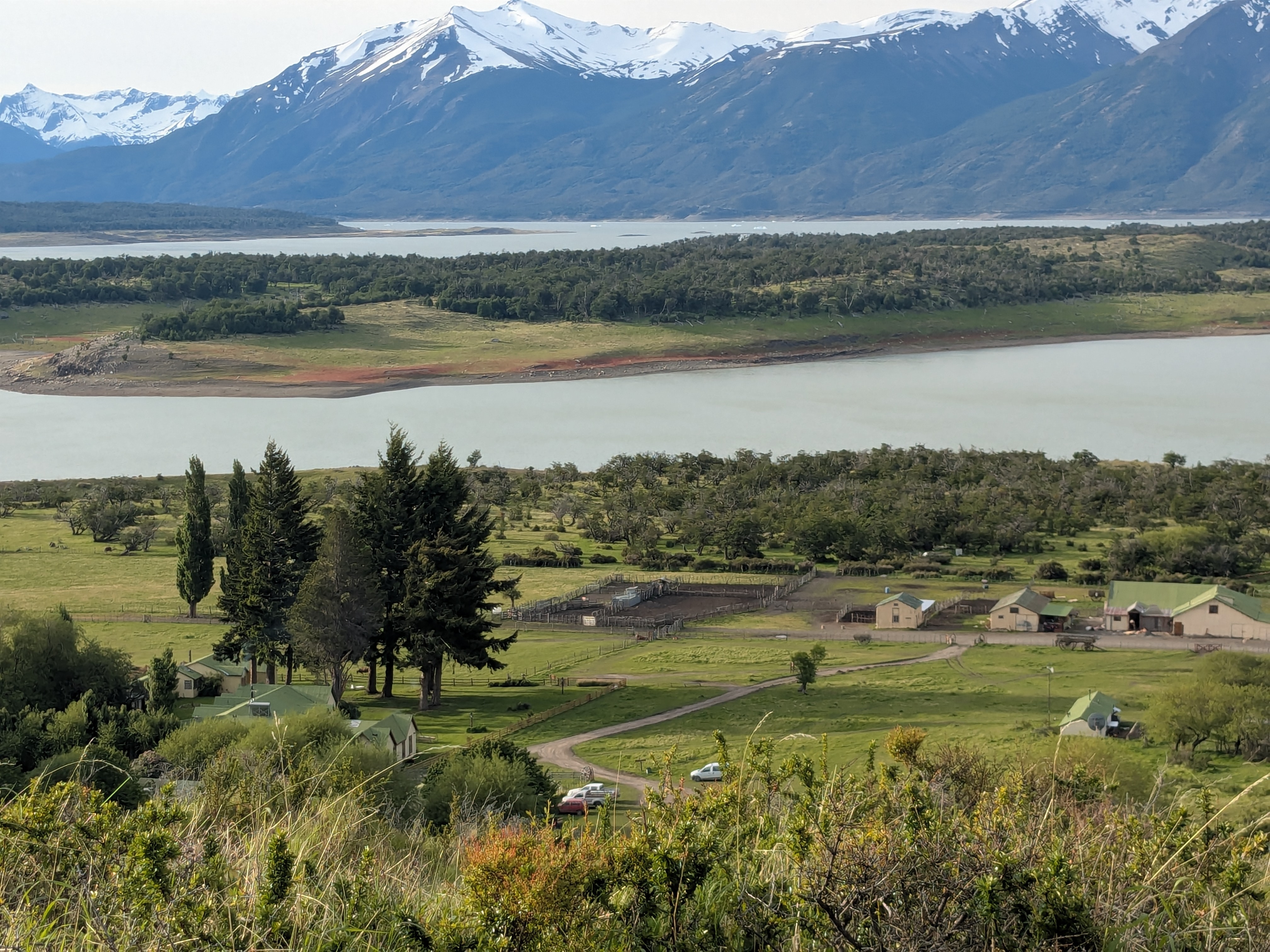
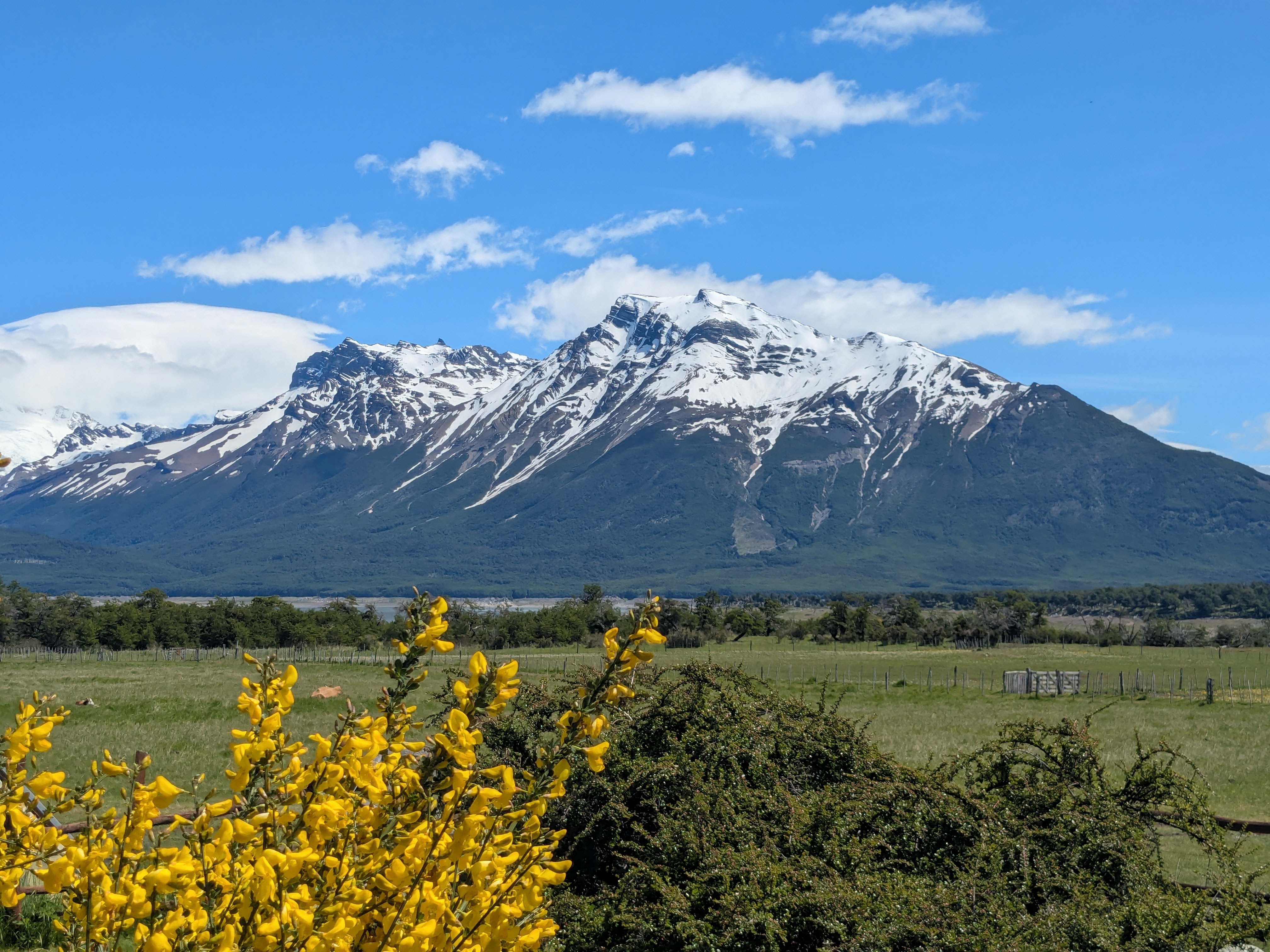
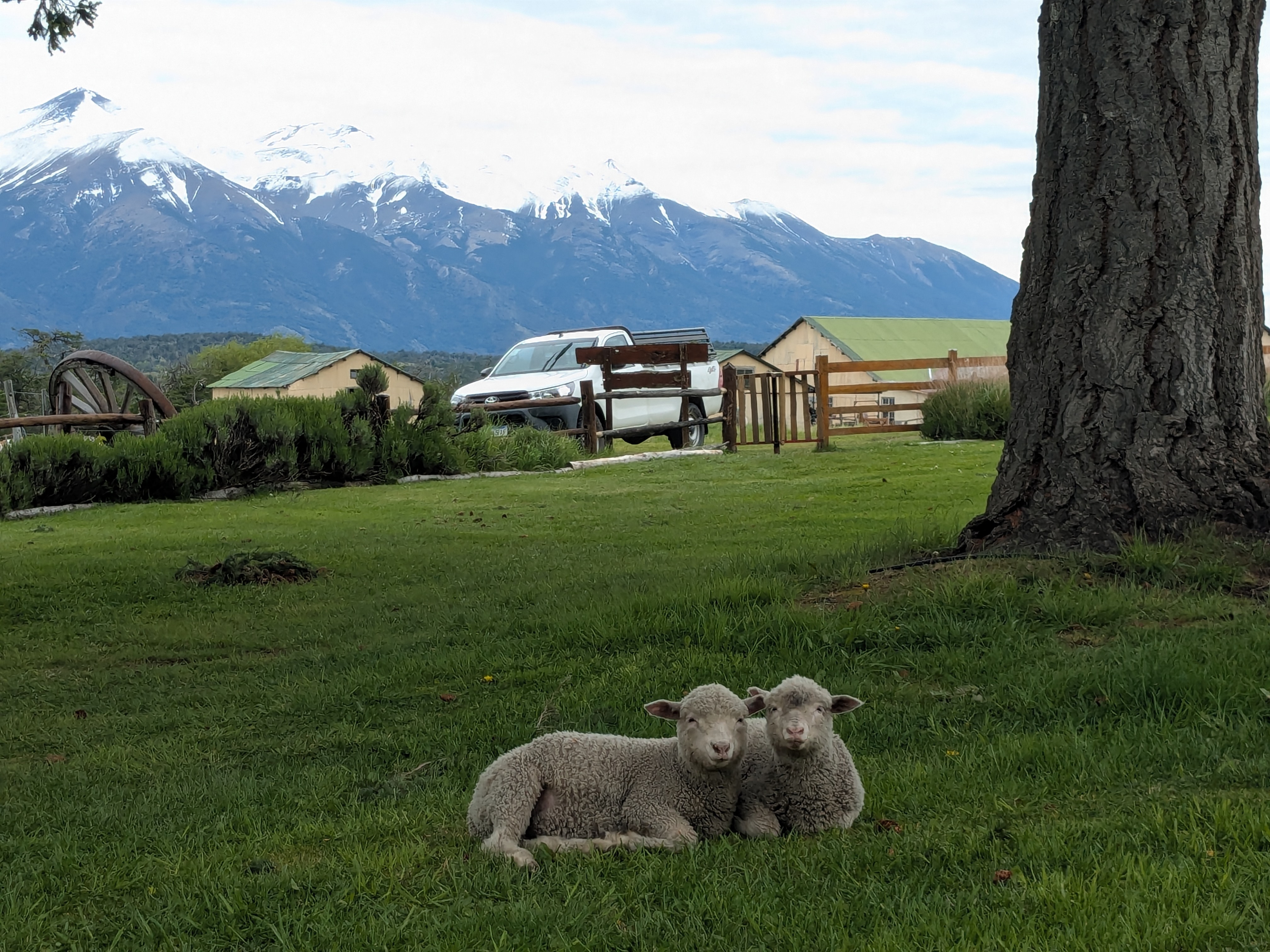
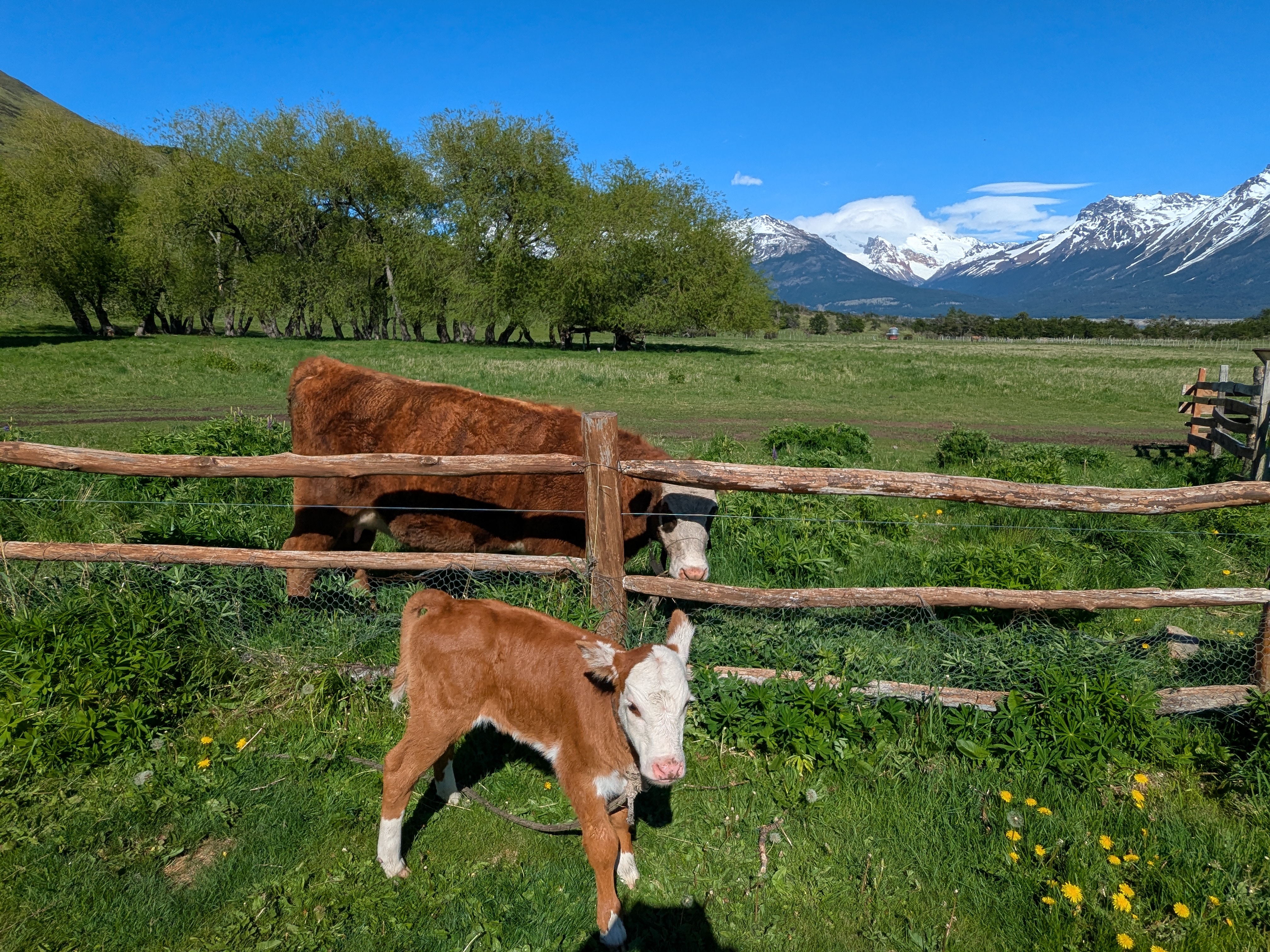
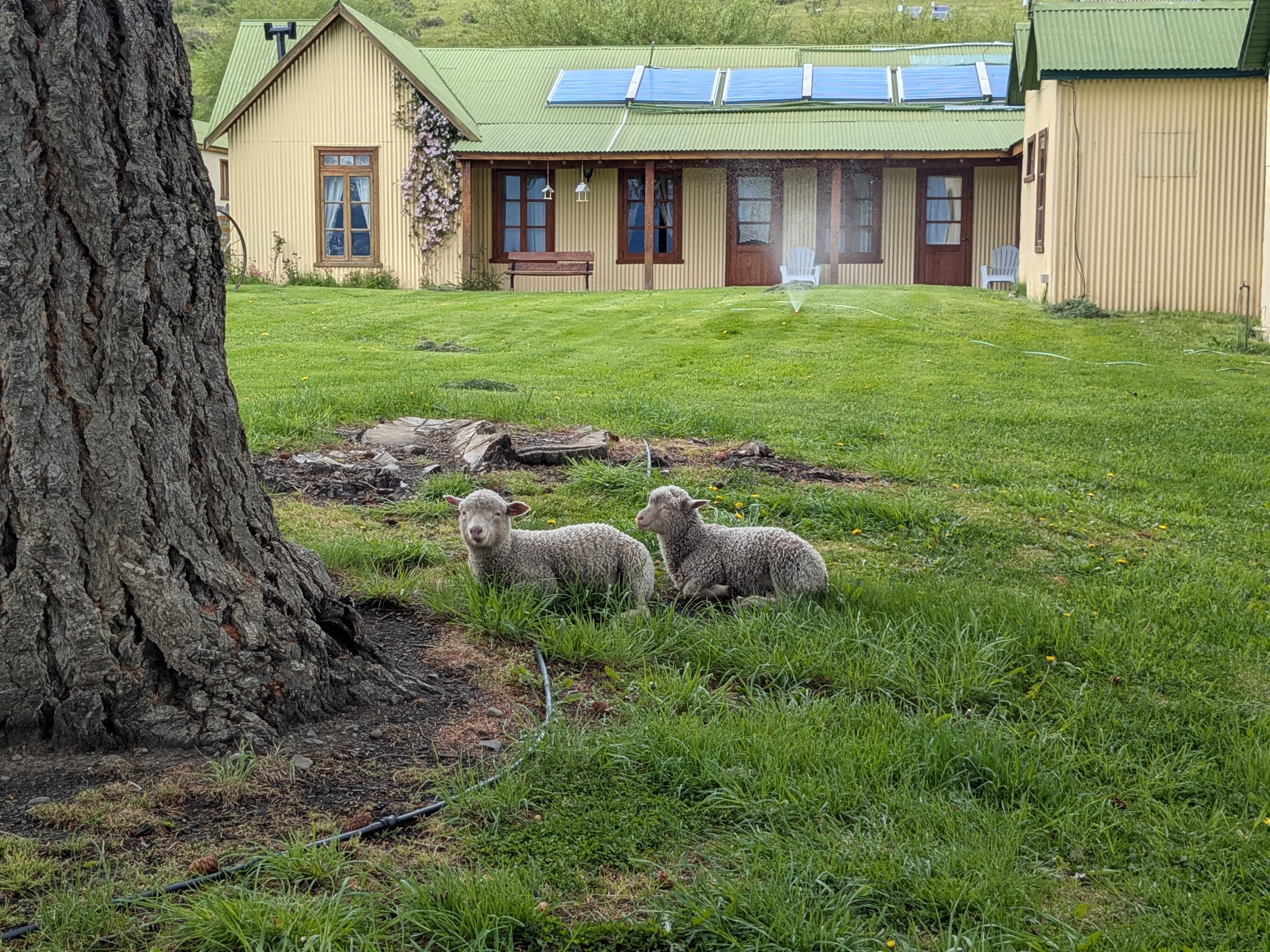
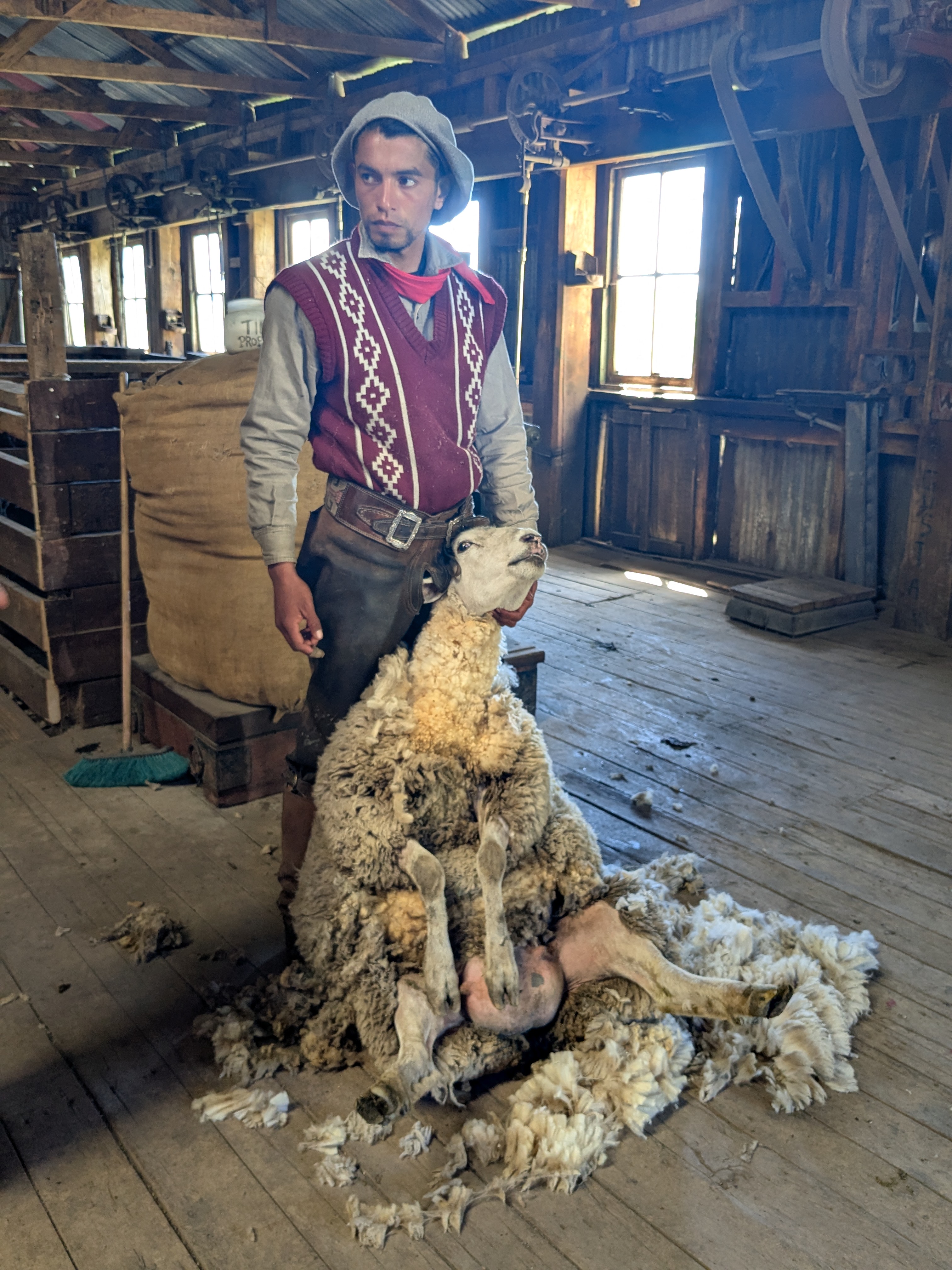
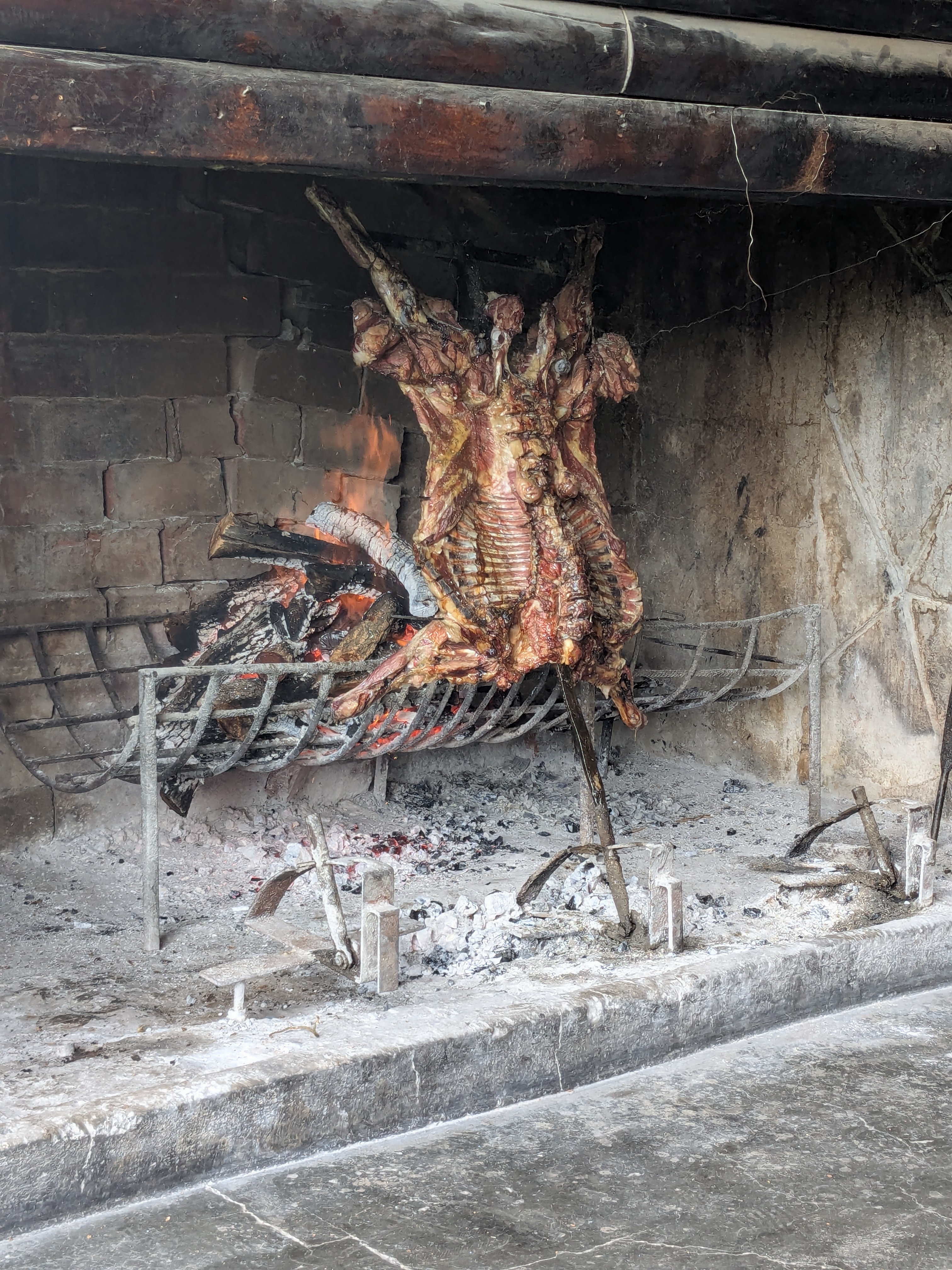
It may be a slow pace for travellers. Life in Estancia is very busy and is full of errands for the staff. Nibepo Aike Estancia is one of the very few that remains functional, with sheep, cattles, horses, chickens in a beautiful and peaceful landscape. The grass is greener. The lakes are clearer. The snow-capped mountains are changing daily with the snow-cap shrinking daily with Spring arriving in this part of the world. There is a short hill that the guests can walk up to appreciate the ranch. Imagine Heidi in the Swiss Alps, that is the kind of life – the freshly produced milk from the cattles, the sheep, the sheep shearing and the scenic landscape. We participated in a ranch day with a tour guide. We had a chance to milk the cow. To keep us safe, the hind legs of the cow had to be tied for our milking. The cows produce less milk in the Estancia than those milked by the machines in cities. I am convinced the milk tastes better when the cows are more relaxed in the Estancia. In the morning, hundreds of sheep were let out of the barn. The sheep were in such a hurry to feed on the pasture that we often found the nearby shrubs caught their wool. We also had a chance to feed milk from a bottle to a baby sheep. A native know-it-all demonstrated the sheep shearing. I am not much of a lamb eater, but the whole lamb asado, as part of the ranch day, made the best lamb dish with its fragrance, its tastes, and its warmth.
Patagonia’s snowy mountains, the glacier and natural beauty can remind us of Alaska (My 2021 trip to Alaska). They are different from each other. Alaska is about 1.6 times the size of Patagonia and its glaciers are about 4 times larger. South America is far different from North America in culture, their languages are different, and the history is very different. Patagonia has comparatively milder weather, and has some world famous hiking trails such as the W trek and the Laguna De Los Tres trek. For us, both Alaska and Patagonia offers once-in-a-life experiences.
The Portuguese explorer Ferdinand Magellan discovered the land and coined the name Patagonia five hundred years ago. Was he in awe of the natural beauty? Did he admire the Perito Moren Glacier? Did he track the strenuous Laguna De Los Tres trek to get a good look of Fitz Roy? Or simply treasure its vastness? The term “Patagonian” (or Patagon/Patagón) historically denoted the “giants”, the tall natives with big feet compared to the Spanish colonist. Patagonia has not been useful in commercial purpose until the industrial revolution hundred years later, with the consumer interests in wool. Patagonia spreads itself across Chile and Argentina. Argentina has the majority share of Patagonia but the smaller neighbor Chile has arguably the more famous Torres del Paine National Park, the popular W trek. Last November we flew into El Calafate from Buenos Aires, and had a memorable two weeks in Patagonia, Argentina.
Travelling to Patagonia requires some good planning. There is no easy international direct flight to El Calafate, Patagonia. It took us 8 hours to fly from Iguazu (IGR) to El Calafate (FTE) via Buenos Aires (AEP). El Calafate is the southernmost city among the places we have been to, so far. It has a lot to offer but is more known as the gateway to Los Glaciares National Park and the massive Perito Moreno Glacier within.
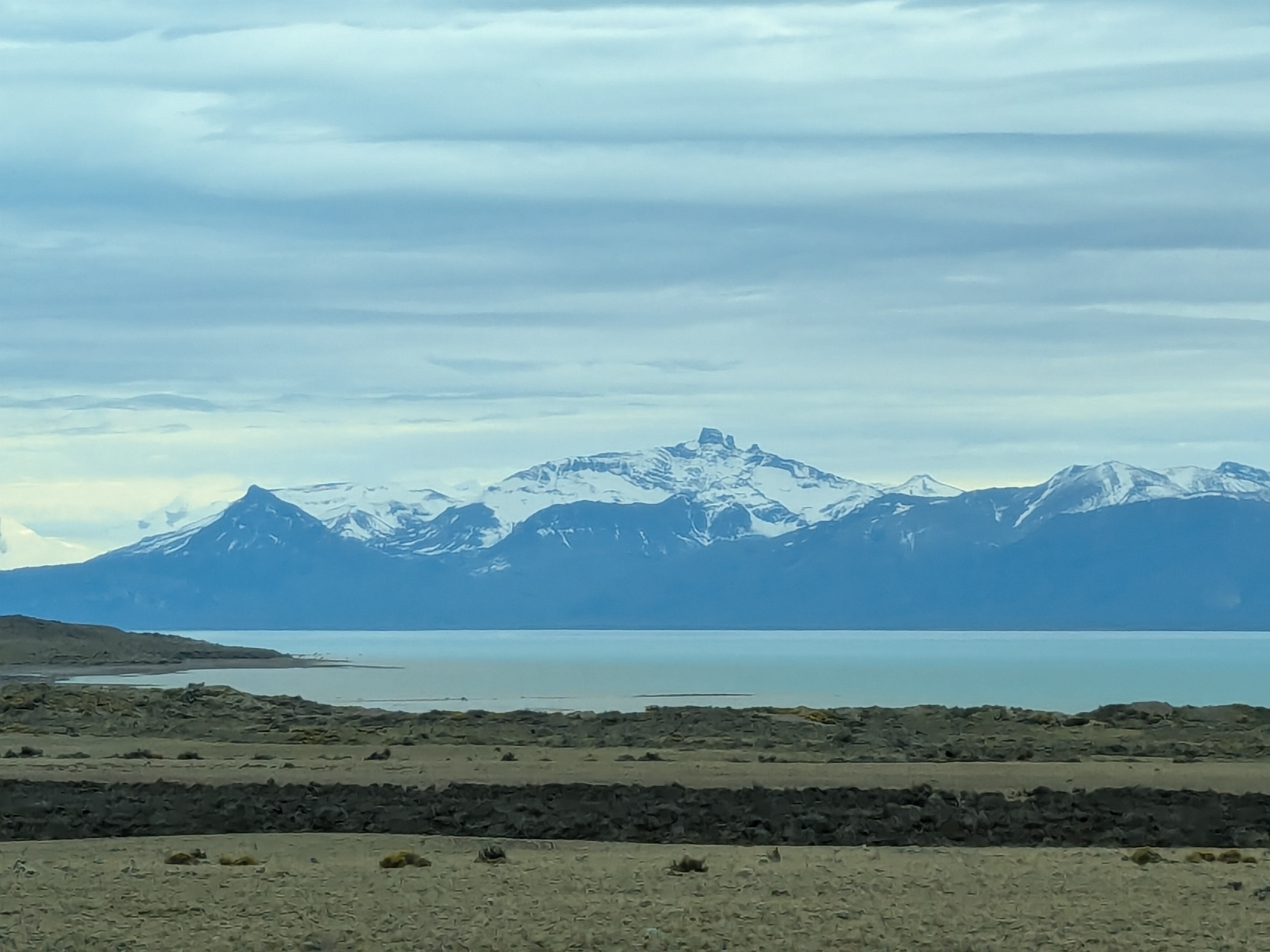
My first impression of El Calafate is the beautiful turquoise color and the tranquility of the huge Lago Argentino (Lake Argentina). I hoped the car, taking us to our Airbnb, moved slower so that I could appreciate the lake and the first Patagonian impression slowly from afar.
The Airbnb is a comfortable unit, located 15 minutes walk to the downtown. The proximity to the touristy downtown area is why we picked it. It turned out that to walk to the touristy downtown, we needed to pass through the neighborhood with a few run down houses, some half done construction and several stray dogs that were not particularly welcoming. I am afraid of dogs so that did not help. I made a mental note to check the neighborhood of future Airbnb carefully and not just rely on its proximity to touristy areas. (Fortunately, we picked another Airbnb when we came back a few days later to El Calafate. That other Airbnb is arguably one of the best decorated Airbnb cottage with a colorful garden of beautiful Lupines and a remote view of the Lake).
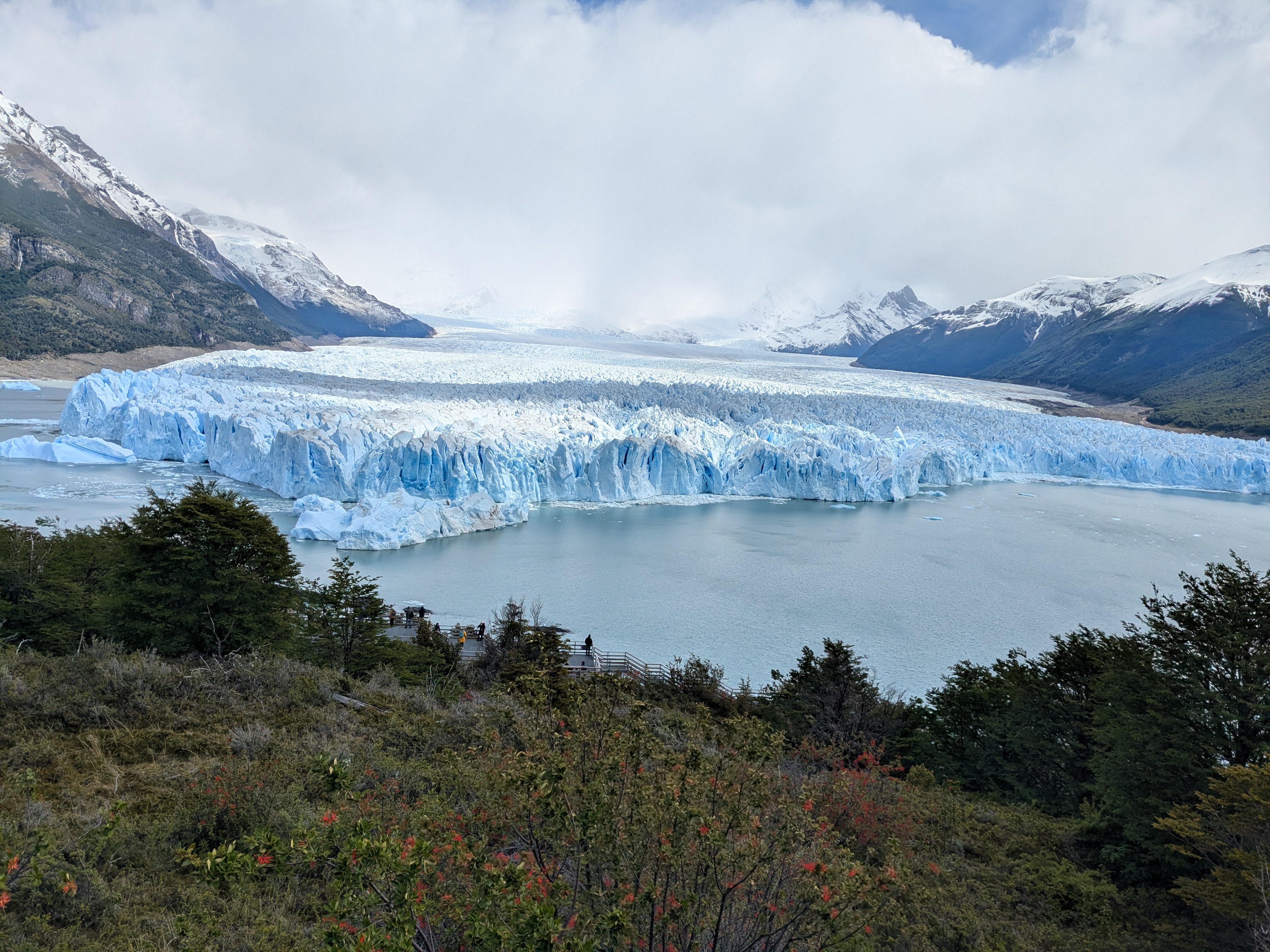
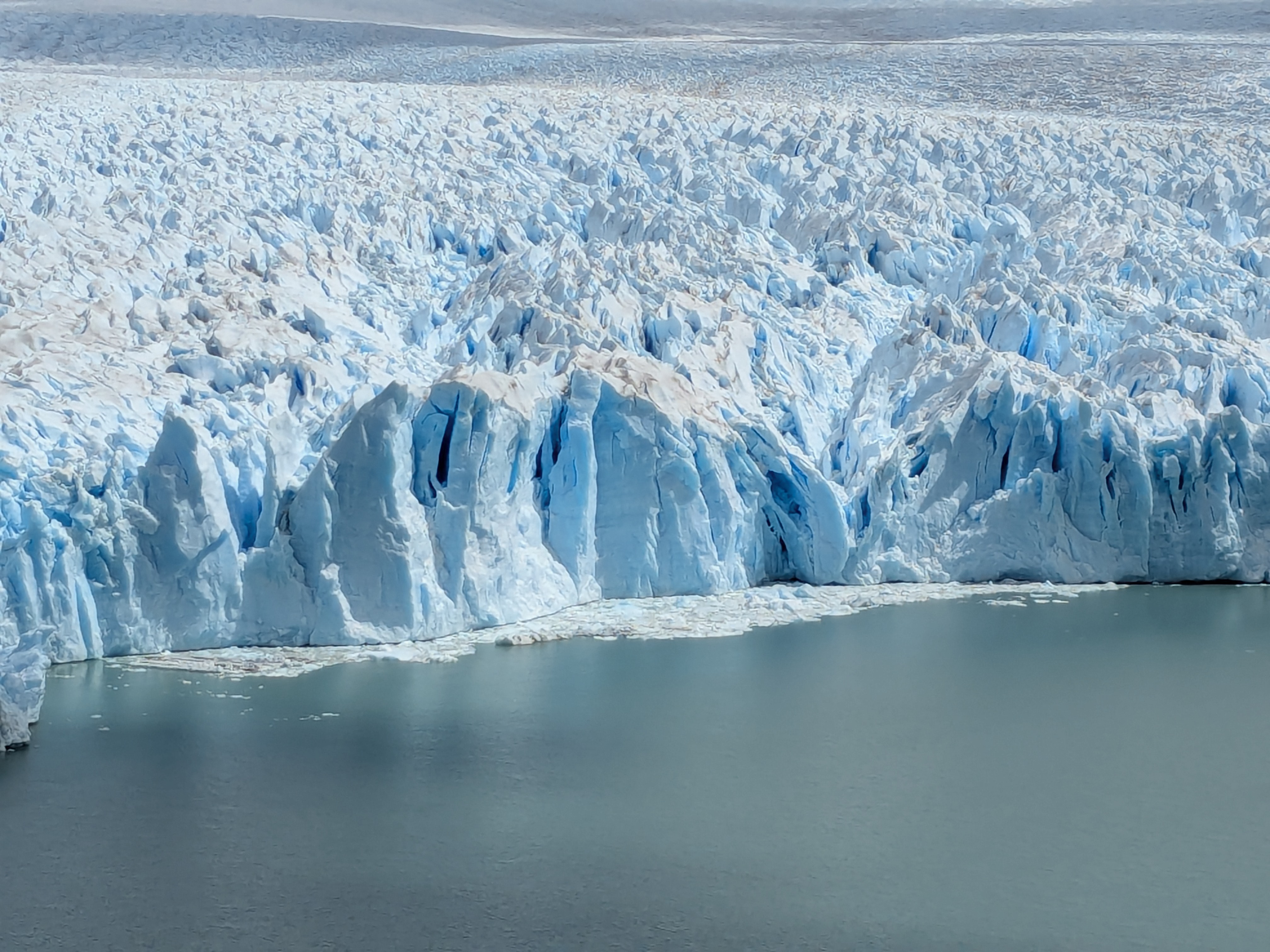
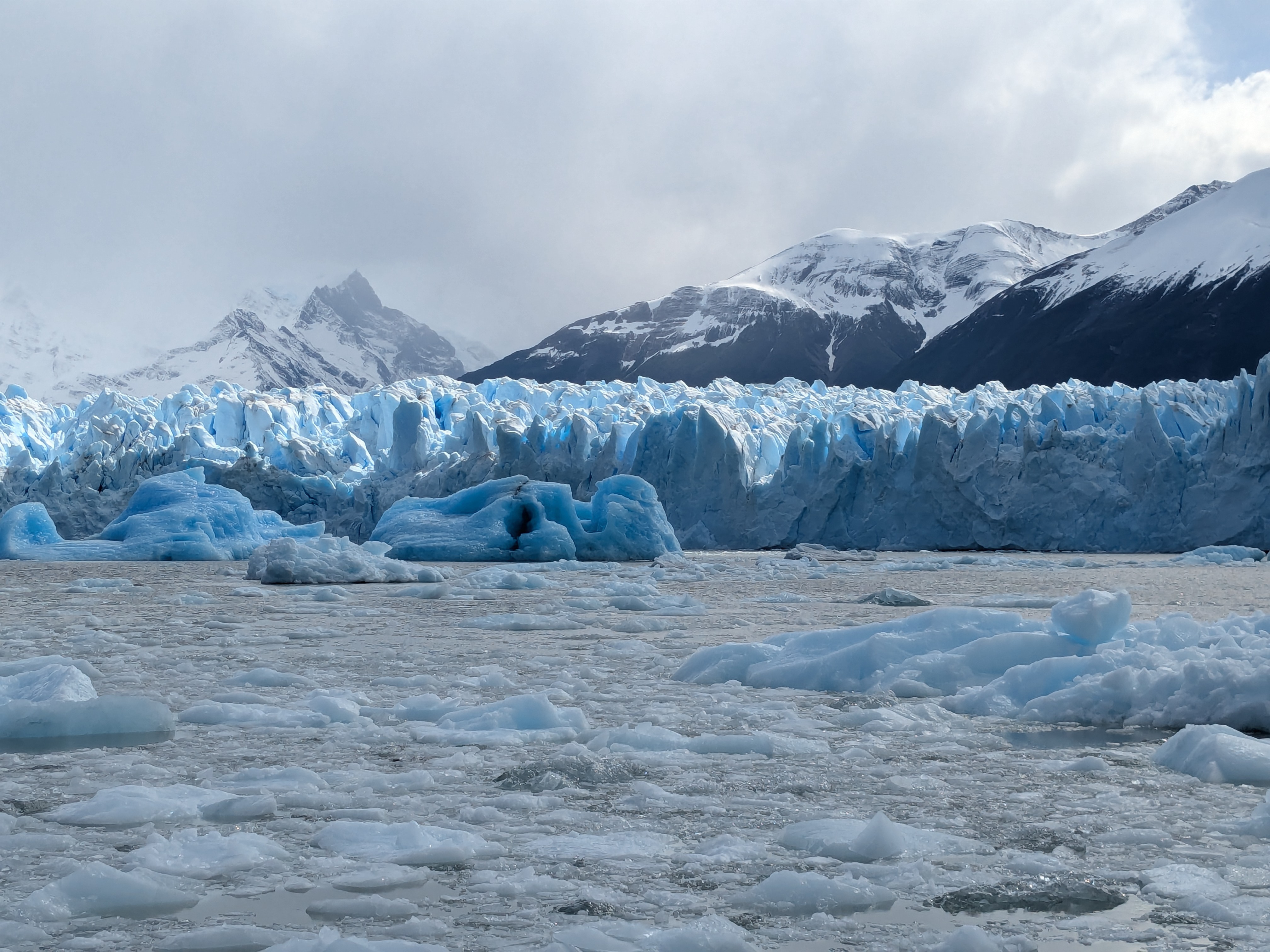
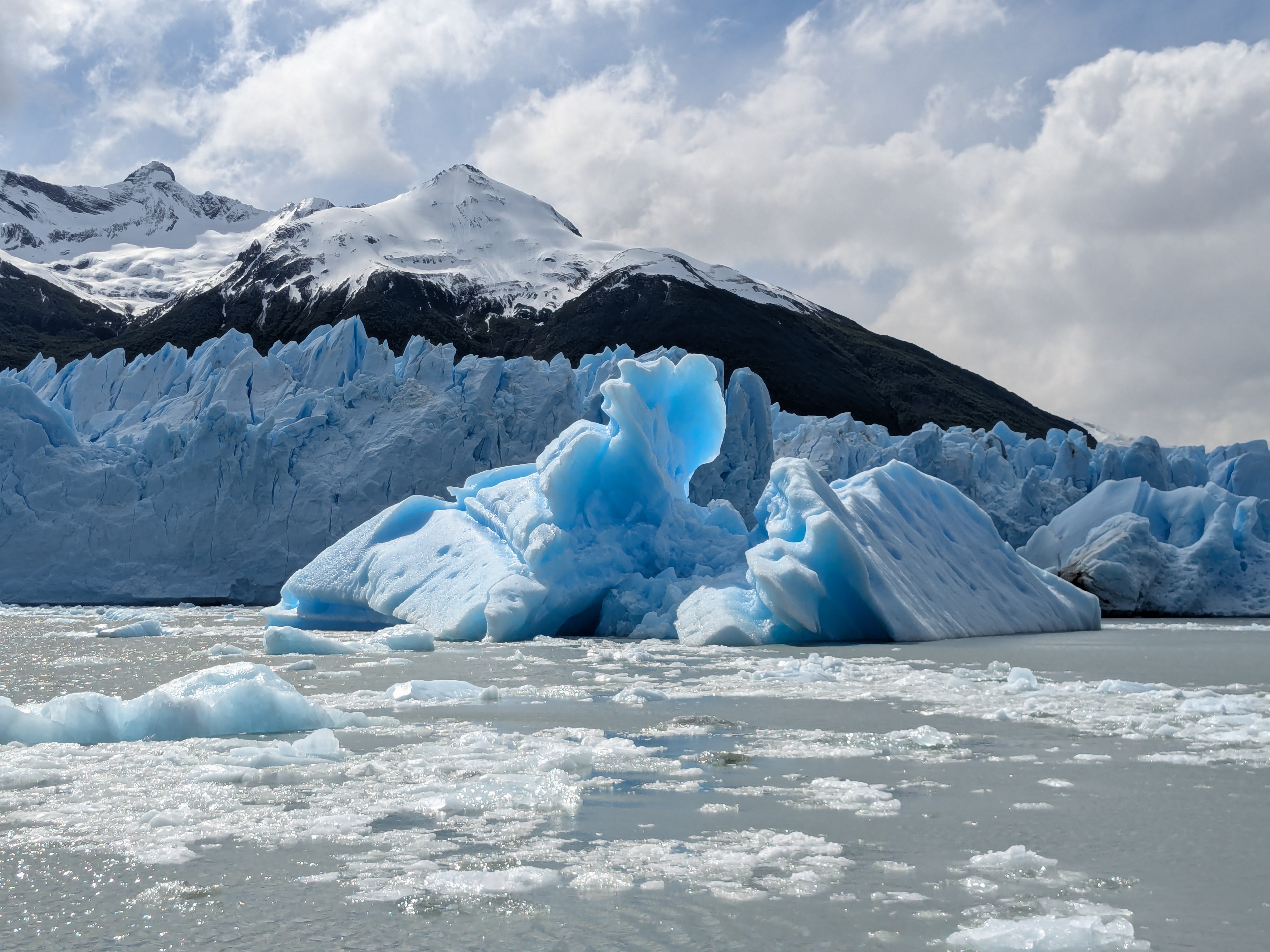
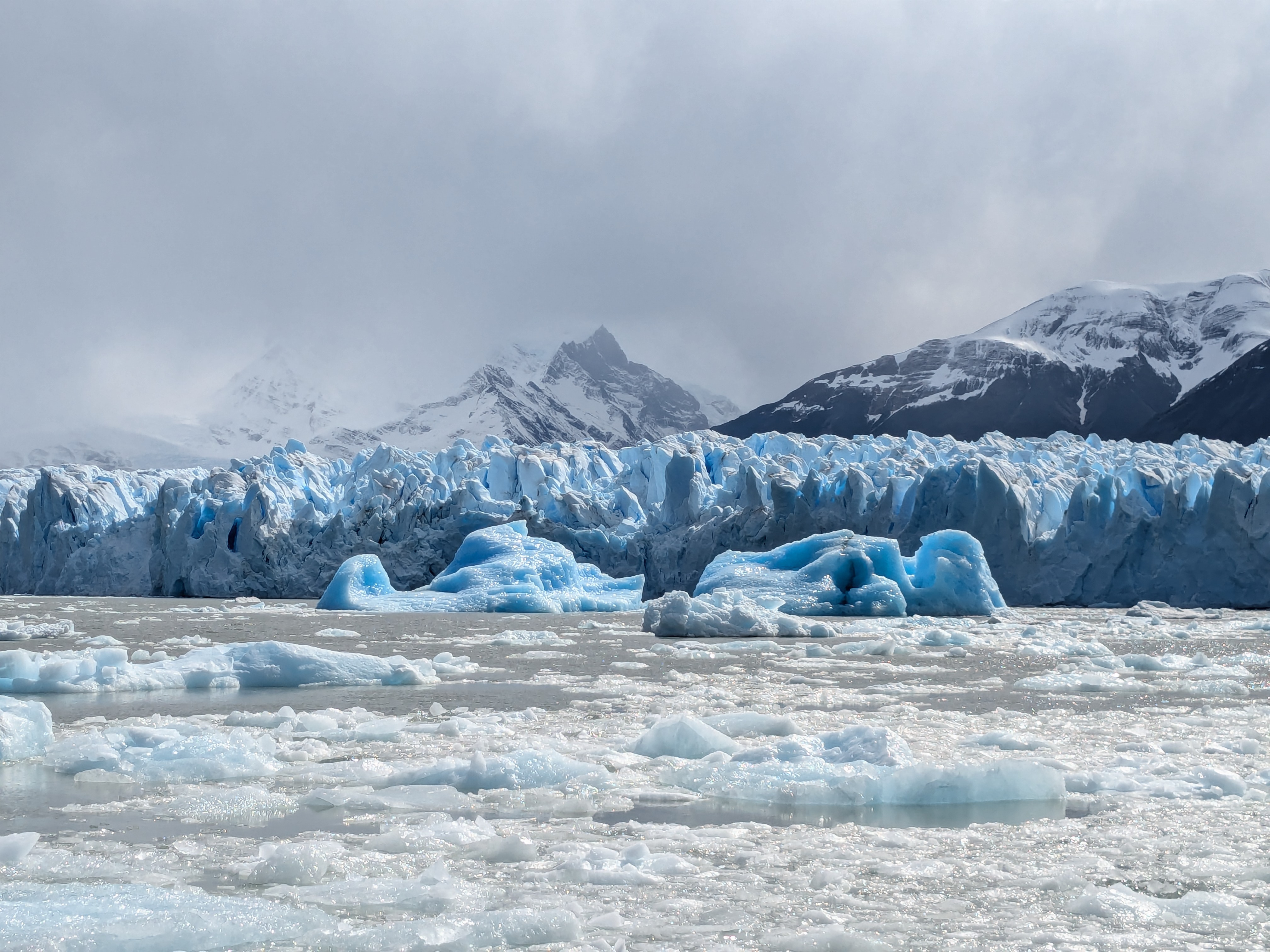
The next day, we joined a one-day tour, inclusive of all transportation and a boat ride, to Moreno Glacier inside Los Glaciares National Park. Moreno Glacier looks like a gigantic flat top “icy mountain” with jagged landscape that look like cliffs and spires on its sides. Because of its vastness, the glacier does not look like its average height of 240 feet above the surface of Lake Argentino. In a direct comparison, the Perito Moreno Glacier is larger than the city of Buenos Aires!
To take the Moreno glacier all in, we spent a few hours on well paved boardwalks and stairs built across the Glacier. There are plenty of photo opportunities of the different sides of the Glacier. On these boardwalks, we occasionally heard the cracking and thundering noise that reminded us of the glacier calving and the power of nature. To get closer, we took a boat ride to fully admire the gigantic Glacier, its beautiful blue and white floating ice blocks everywhere and its chills. It is a scene to remember for a very long time. Perito Moreno Glacier alone would have been worth the long trip to Patagonia. But there is much more waiting in Patagonia.
Some travelers may have only one day to explore Iguaçu Falls. After spending a day in Argentina and another day in Brazil, we asked ourselves the question “which side would we go if we only had a day to spare?”
We arranged a one-day driver service for about $100 USD. The service includes picking us up from the Airbnb, helps us to cross the border to Brazil, drop us off at the Iguaçu National Park, and take us back to the Airbnb. It relieved us from the logistic distractions.
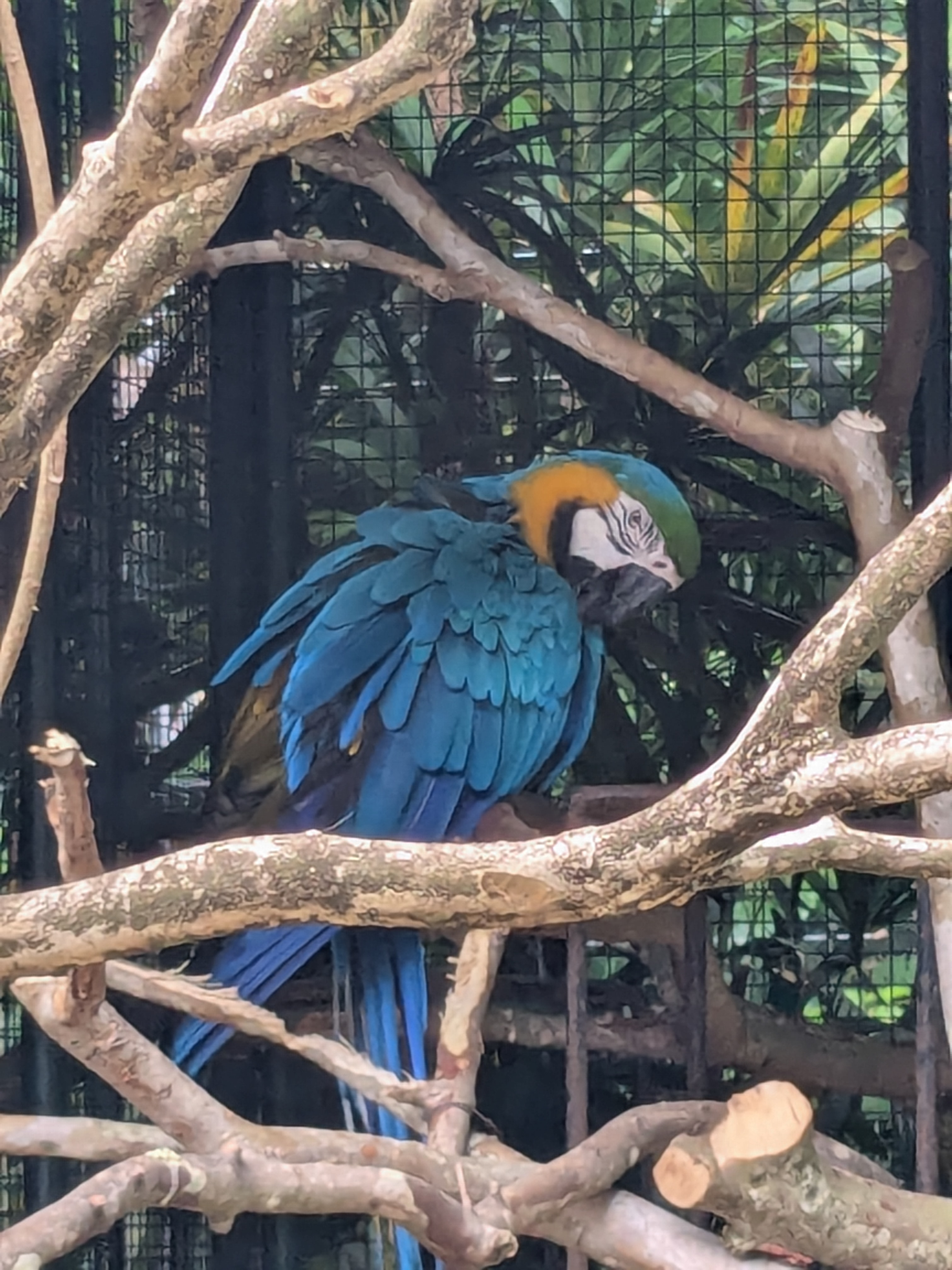
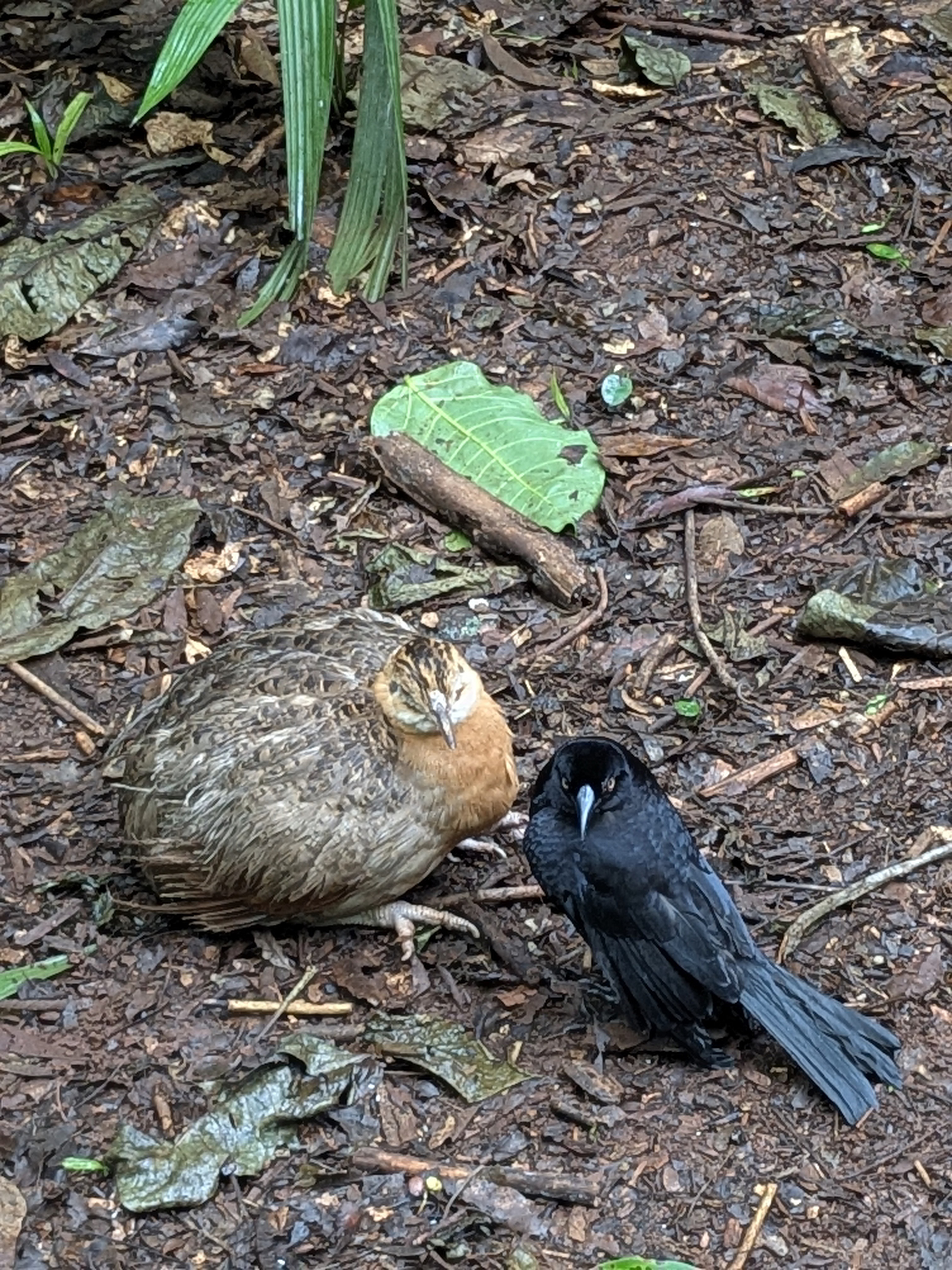
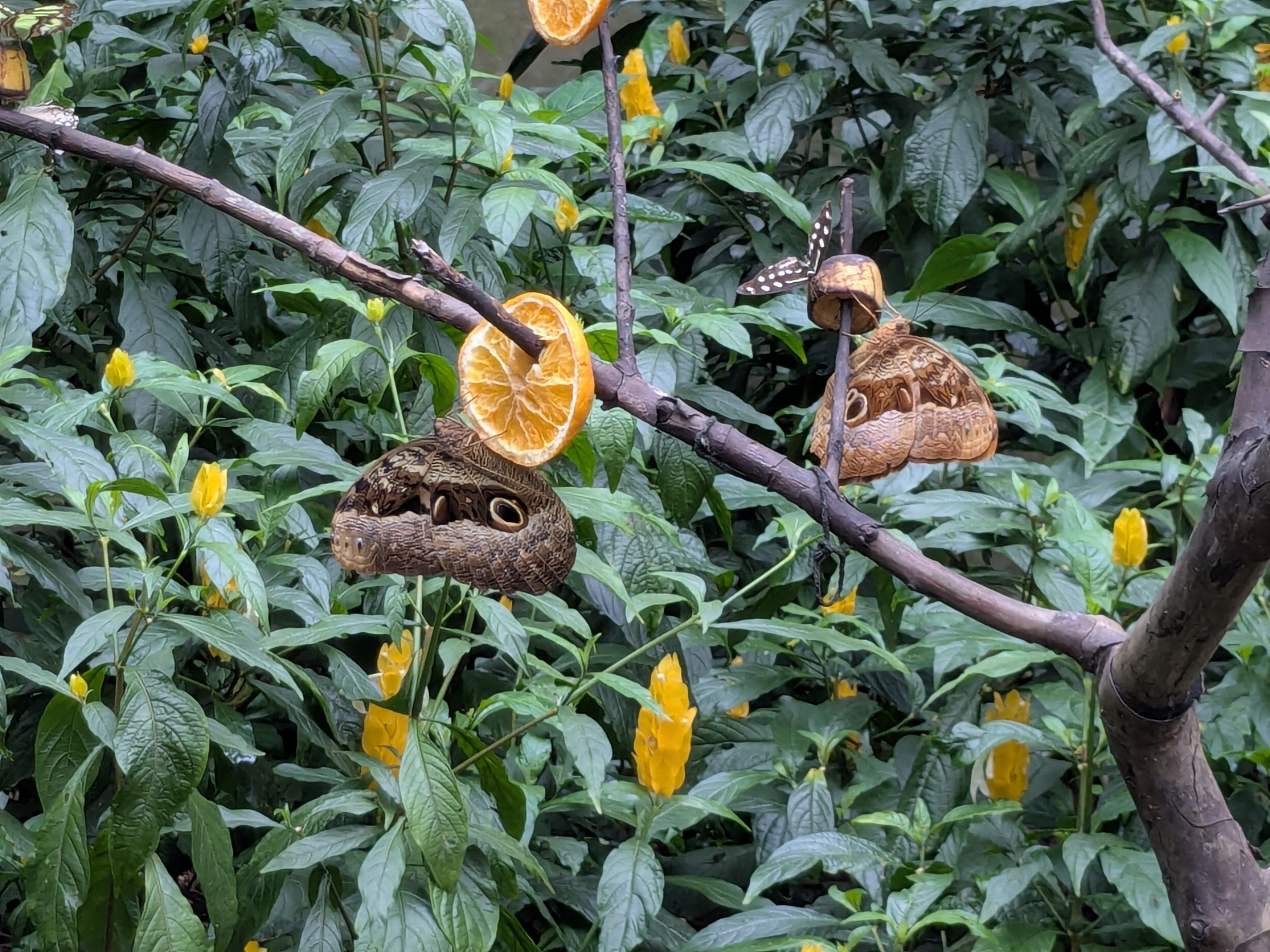
Across Iguaçu National Park, there is a bird park Parque das Aves. The bird park is among the best places for us to enjoy the exotic and colorful birds, not commonly seen in North America. Unlike its unassuming entrance, the park is well maintained showing great care to the birds. There are large aviaries and lots of spaces for the birds. There are restaurants and rest places for the travellers. The park is designed very well with beautiful flora, lots of educational signage along the trail and secure entrances/exits from one aviary to another. We ended up spending almost three hours in the park, appreciating the stylish Owls, the graceful Flamingoes, the beautiful Scarlet Ibis, the colorful Toucans, and many many more. We can spend more time there if not for the reserved admission time of Iguaçu National Park.
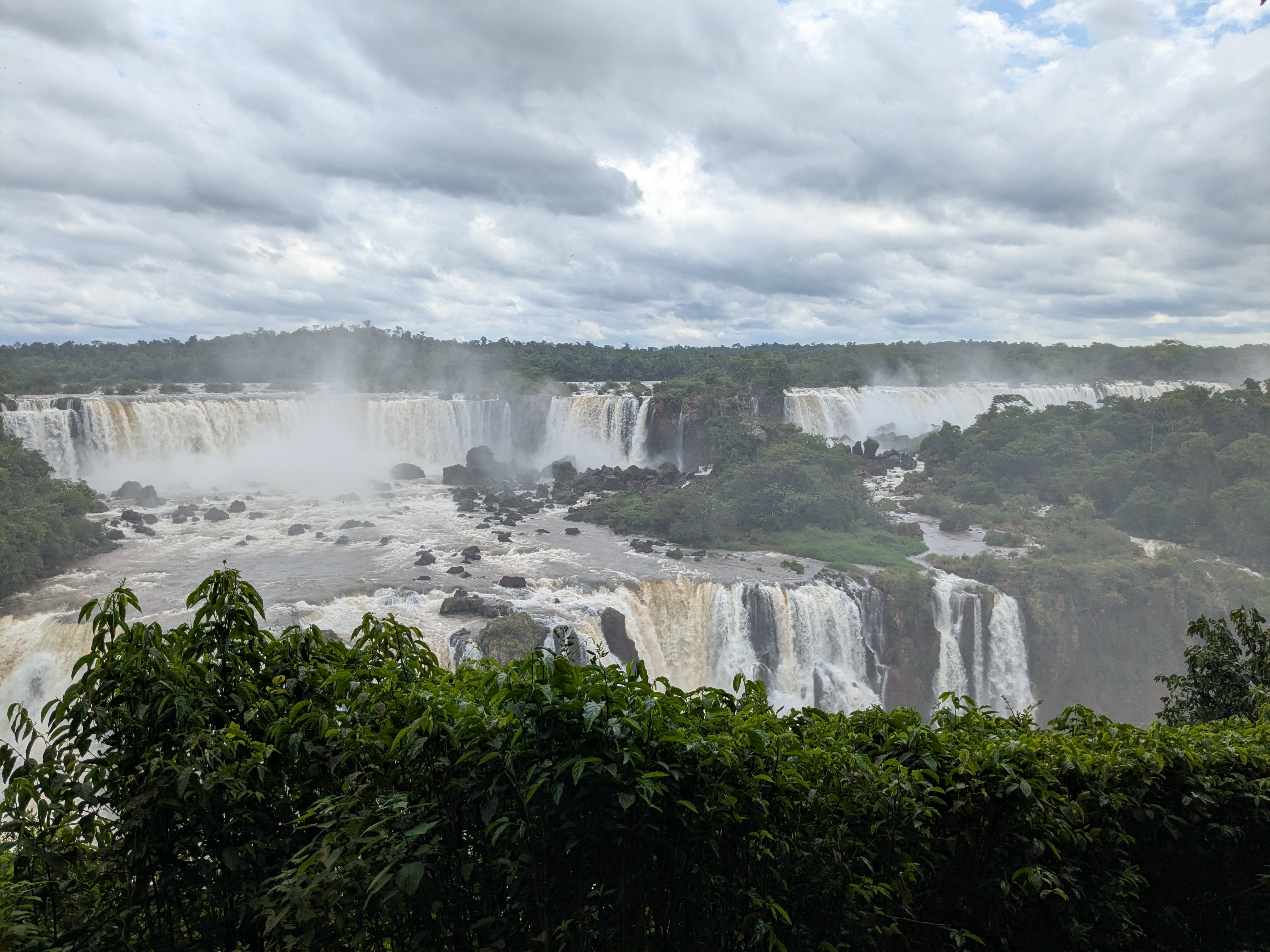
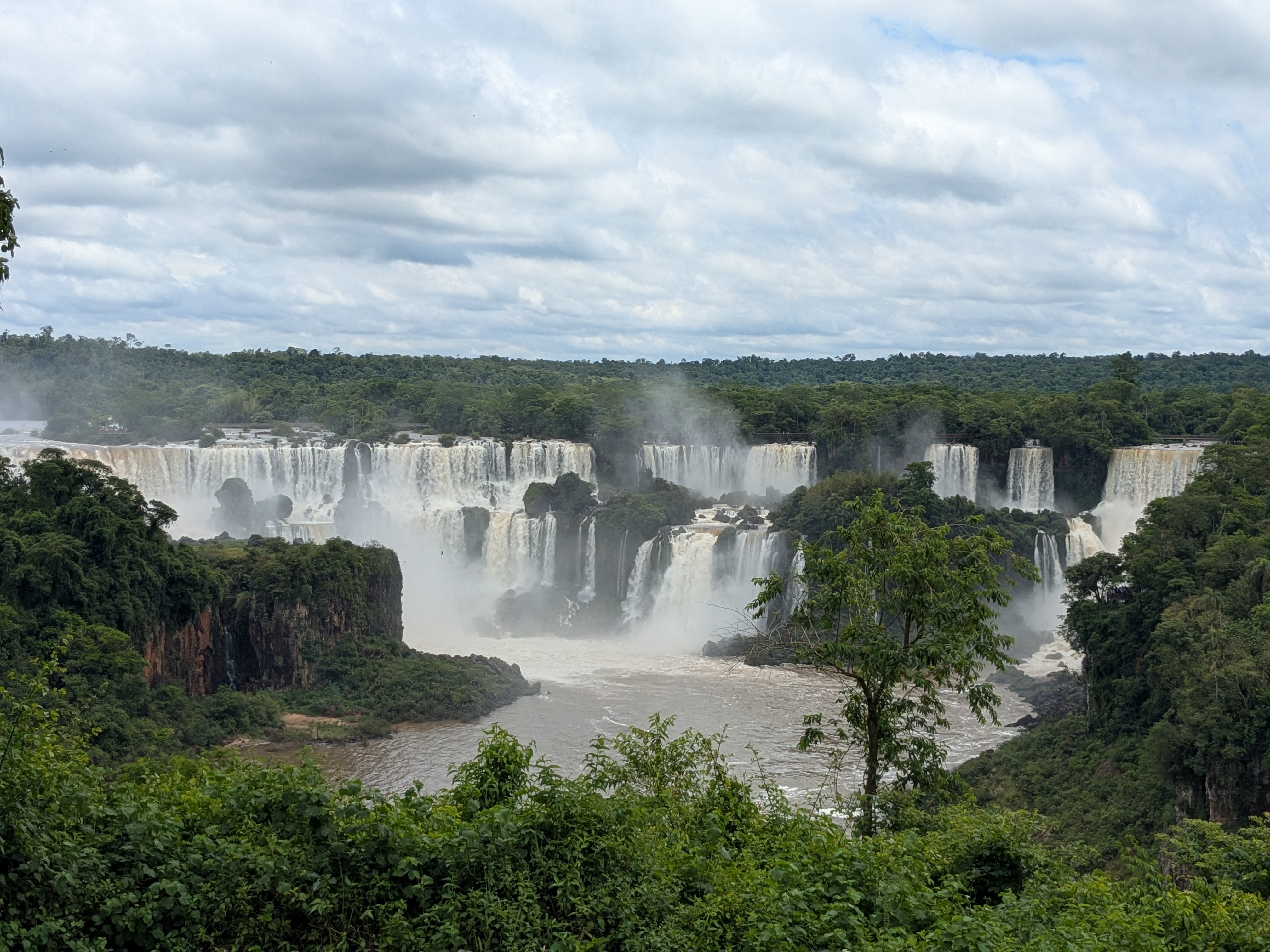
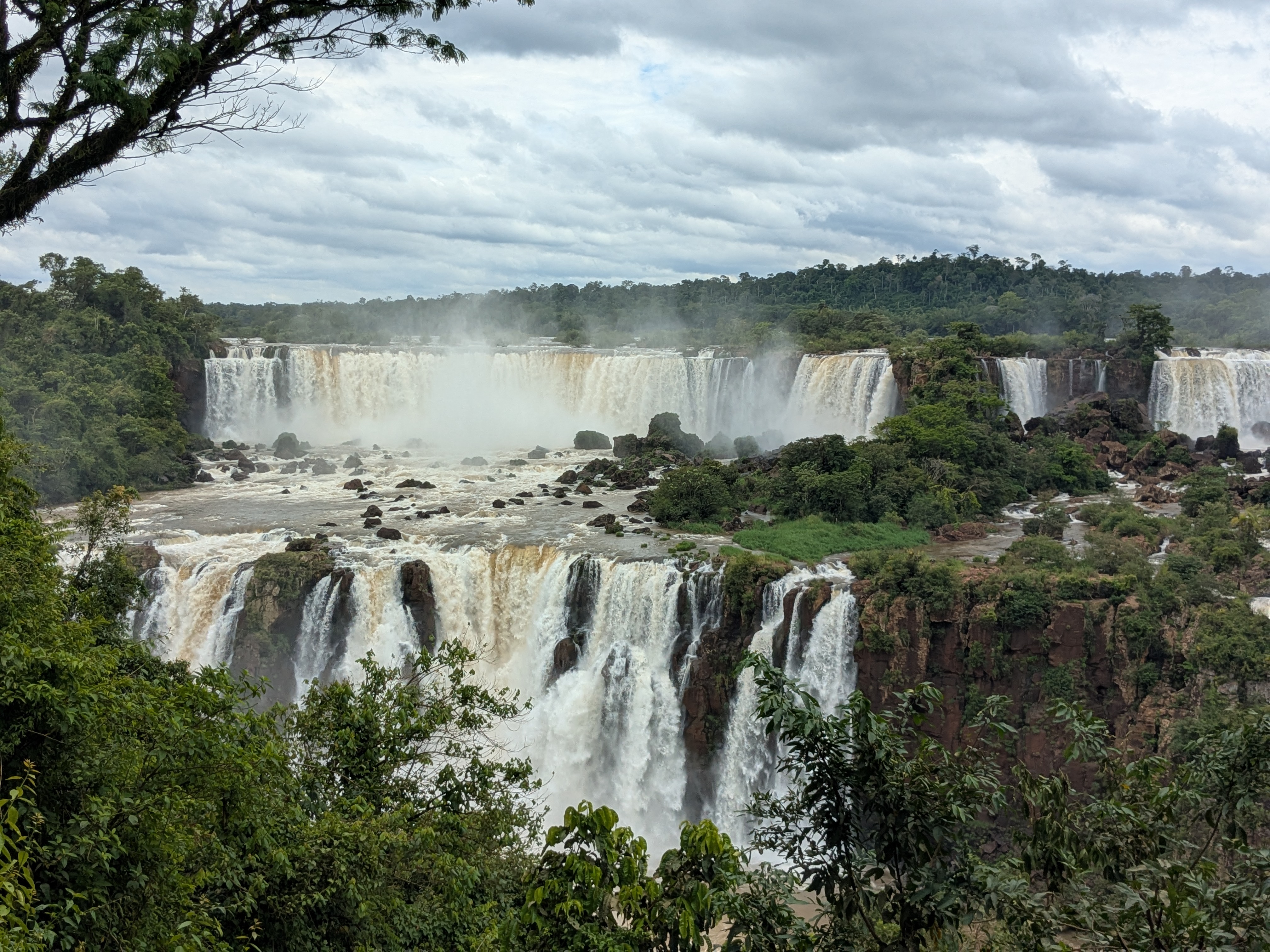
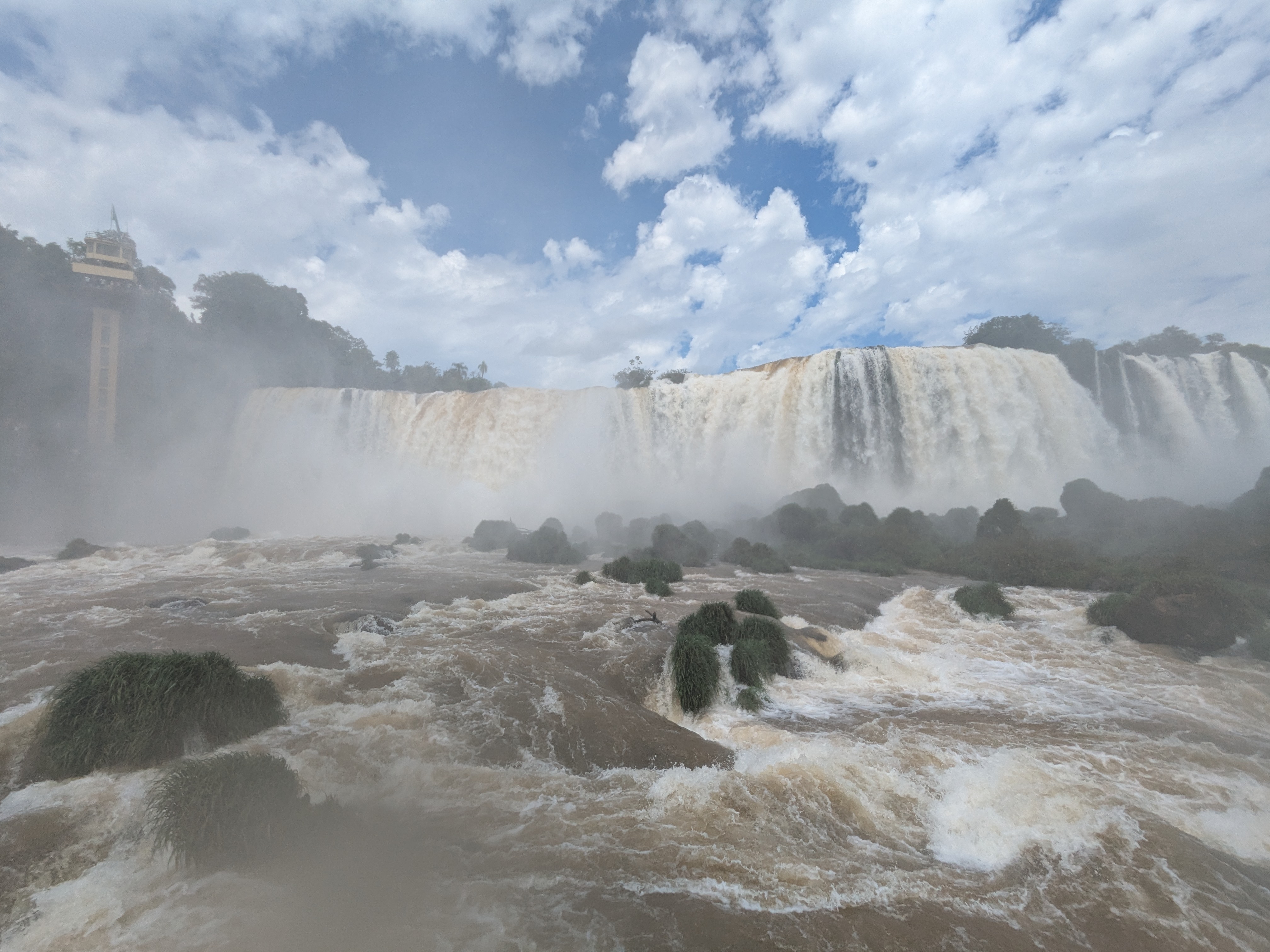
The logistics of Iguaçu National Park of Brazil are different from that of Argentina. In Argentina, helicopter service is prohibited due to environmental concerns such as noise level, impact to the animals. The Iguazu Falls National Park on the Argentina side is connected by trains and trails. In Brazil, there are helicopter services to see the falls and there are buses, with long queues, at the entrance to take you to a fixed number of stops in the park. We got off at the arguably most popular stop right across the Belmond Hotel das Cataratas inside the park. From there, there is an easy stroll full of photo opportunities of the Falls. This Brazilian side offers sweeping panoramic views of roughly 80% of the waterfalls located in Argentina and the staircase character of the falls. There are boardwalks to take you close to some individual falls to experience the waterfall mists and the winds. It was fun and wet.
So “where (which side) would we go if we only had a day to spare?” We think the Brazilian side has the edge with the amazing panoramic views to see its scale and the grandeur. For boat rides, Argentina has the edge. Our recommendation: It takes quite some logistics to visit Iguazu Falls. Why not spend more days in the biggest waterfall systems of the world?
The Iguazu Falls (Argentina) or Iguaçu Falls (Brazil) are major tourist attractions in South America. Upon seeing Iguazu, the United States First Lady Eleanor Roosevelt reportedly exclaimed, “Poor Niagara!”. In November, we visited Iguazu and spent two full days there.
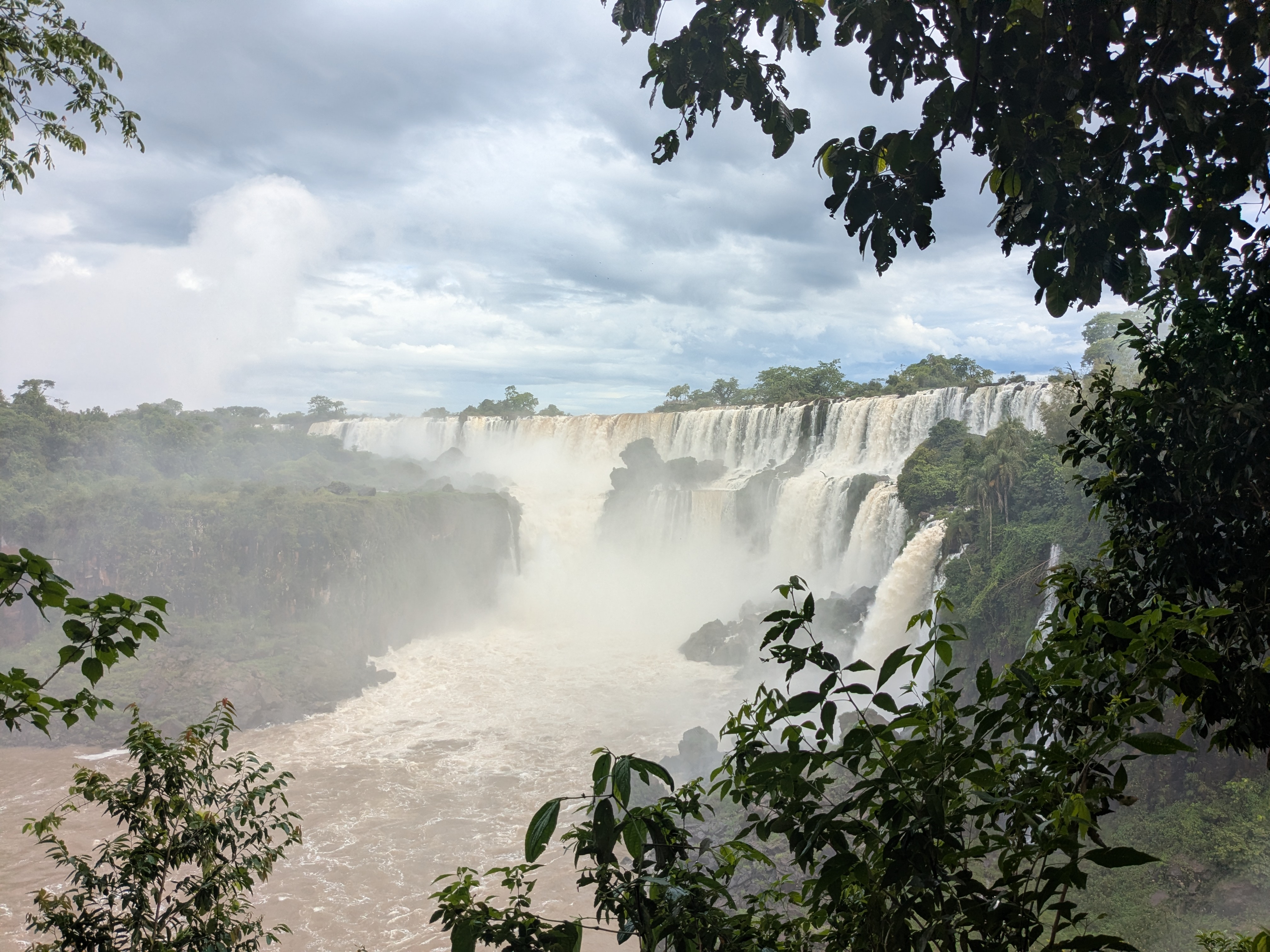
Spanning across 1.7 miles, Iguazu Falls are arranged in a massive, semicircular “horseshoe” shape and composed of over 200 individual falls. In comparison, Victoria Falls in Africa are 1.1 miles wide and Niagara Falls in Canada are 0.6 miles wide. The river of the Iguazu Falls is the Iguazu River, which flows from Brazil, forms the border between Argentina and Brazil, and then empties into the Paraná River, creating one of the world’s largest waterfall systems, if not the. About half of the river’s flow falls into a long and narrow chasm called the Devil’s Throat, along the Argentina–Brazil border. On the right bank is the Brazilian territory, which is home to more than 95% of the Iguazu River basin but has just over 20% of the jumps of these falls, and the left side jumps are Argentine, which make up almost 80% of the falls. From the Argentine territory, you have the chance to boat up close or hike up close to hear its thunder and experience its power. From the Brazilian territory, it is easier to take more impressive panoramic pictures of the 80% of the falls in Argentina.
A day in Argentina
It is a two hour flight from AEP (Buenos Aires) to IGR (Iguazu). Uber is not as consistently available in Argentina outside of Buenos Aires. At IGR, we met the taxi driver Ada who spoke bits and pieces of English phrases on the ride to our Airbnb. We understood each other well enough that Ada became our driver for another few rides. The ride from IGR airport to our Airbnb was very scenic with forest along the way and lots of butterflies hovering above the flowers paving the road. We were pleasantly reminded that November is Spring time in South America. The Airbnb is very spacious, modern and comfortable and it has a water dispenser which saves us the effort of buying bottles of water. There are restaurants and grocery markets within easy walking distances. The neighborhood seems more for locals than for tourists and lacks the camaraderie of fellow travelers.
The Iguazu Falls, on the side of Argentina, reside in the Argentine province of Misiones, and make up close to 80% of the falls. We had a reservation for a 3-hour boat ride, including jungle transport to the river. The open-top jungle transport was a comfortable ride. There were birds chirping, we saw colorful Toucans and enjoyed the forest as we rode through the jungle with fellow travellers. The tourist guide explained everything in both English and Spanish.
After hundreds of stairs going down, we arrived at the river, were given life vests and a big waterproof bag, to put everything in, and were reminded that no raingear would save us from getting soaking wet. Then began the boat ride. The first leg was on a quiet river flow. Soon, there were individual waterfalls and more waterfalls. As the boat approached the waterfalls up close, it felt more like a roller coaster ride, except this ride, we were under the waterfalls. At times, it was like being in a shower. At other times, it was like being “hit” by powerful water jets. We got soaking wet and the boat kept going back to be under the waterfalls. When we had enough, the boat was back to the quiet river again and we headed back to the jungle. It was cold, fun and exciting. If you go for the boat ride, just remember to bring a spare set of clothes, unless you want to spend the remainder of the day in wet apparels.
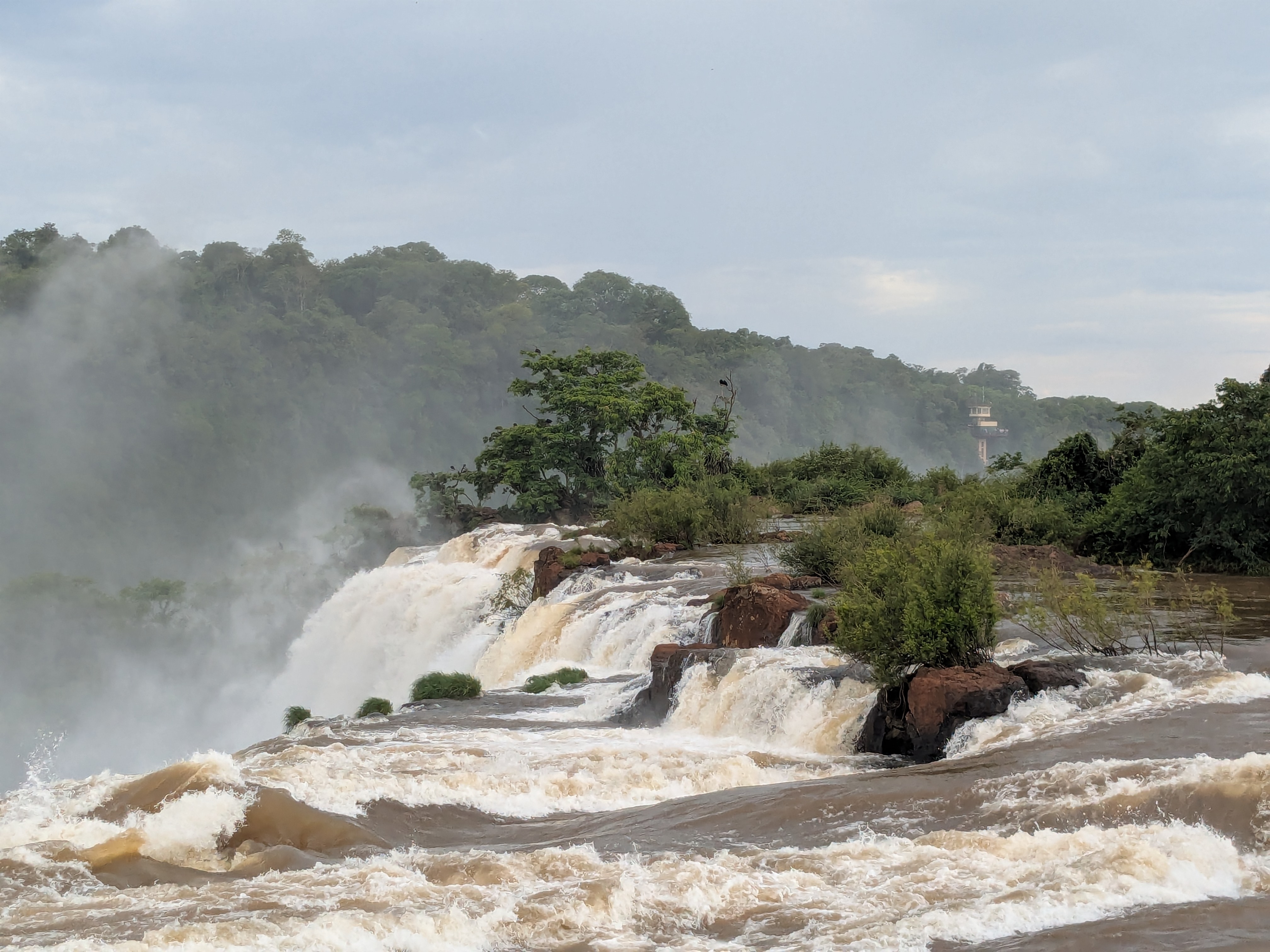
In the afternoon, we took the slow moving and comfortable train ride in the park, and did the popular hikes : the Devil’s Throat trail first, and then the Upper Circuit, Lower Circuit. The Devil’s Throat trail leads to the most powerful section of the falls with well paved suspended walkways. At the Devil’s Throat, we were level with the waterfall, hearing its thunder and feeling its mist as the water jumped down the 200 feet canyon. The Upper Circuit allows us to see the waterfalls from above. The lower circuit allows relaxing stroll on boardwalk over the river, and gets us close-up views from below. There were many many individual waterfalls we visited along these hikes. These hikes, some with stairs, are overall friendly to travellers of different degrees of fitness.
The boat ride, the trains and the hikes offer stunning and varied perspectives of the falls.
Weekdays in Buenos Aires are spent working, and weekends are for discovering the city. It still offers me plenty of opportunities to get to know the capital city in my three-week stay. Buenos Aires feels like a Spanish-speaking New York city look alike with visible Italian influences from Tango, music, pizza and pasta. Like New York, it takes time to discover and appreciate what the city offers.
Buenos Aires has vastly distinct neighborhoods.
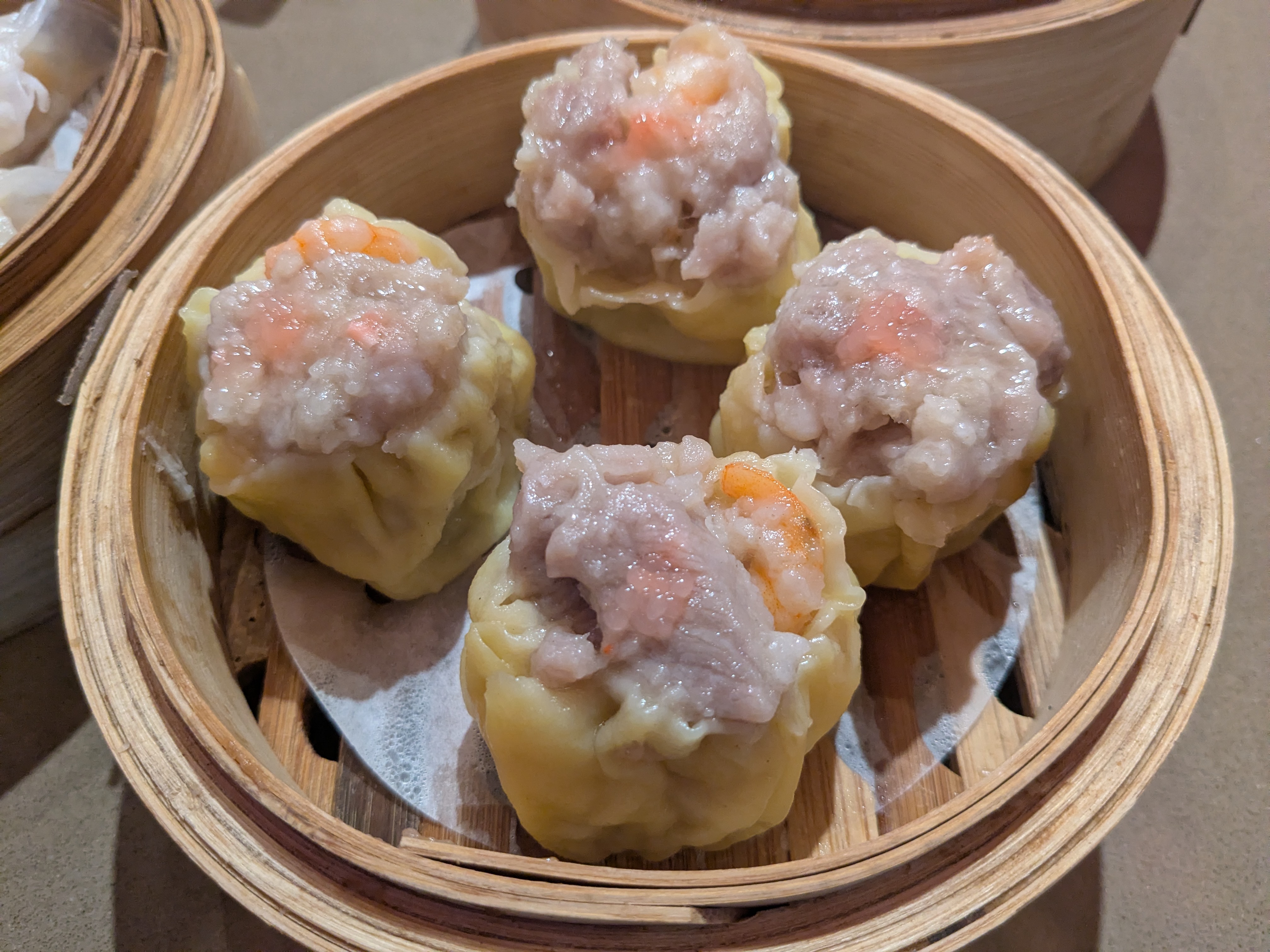
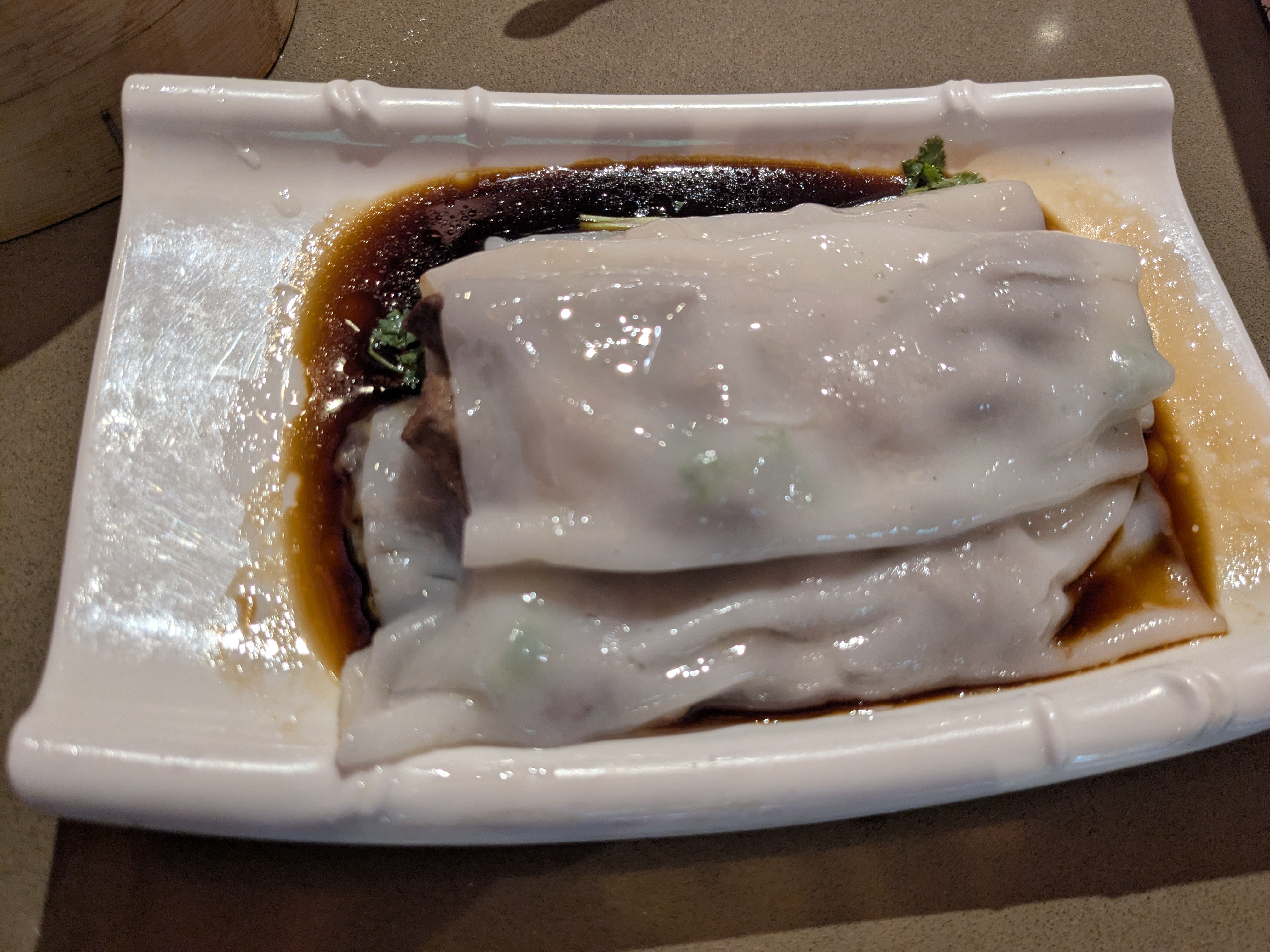
As the capital of Argentina, Buenos Aires does not have much Asian presence. We hardly run into Asians, and hardly hear anyone speaking Mandarin or Cantonese (or Japanese or Korean or Vietnamese or even English) on the street. Buenos Aires has a sizable Chinatown, in the Belgrano neighborhood, that feels more like an Asian town with varieties of Asian eateries, and shops. It is very pleasant to visit over a weekend. It is probably the place in Buenos Aires that I have run into the most Asian restaurants. Even though Chinese cuisines are popular worldwide, Chinese restaurants are also rare other than the buffet style Chinese dishes, served as fast food and sold by the kilos with an unappealing look and equally unappealing tastes. The only dim sum restaurant we discover is the one in Chinatown and it is good.
Cemetery and Beauty do not naturally come together, the Recoleta neighborhood has the famous Recoleta cemetery highly regarded in its beauty. If you are in the area, don’t miss Floralis Genérica, the iconic “flora garden” next to Recoleta. Floralis Genérica is home to a massive, mechanized aluminum flower sculpture in the Plaza de las Naciones Unidas (United Nations Square) that opens its petals during the day and closes them at night, representing all flowers in the world. I can be there all day appreciating the simple beauty and grandeur of the flower sculpture.
The San Nicolás neighborhood has the Opera house, the Obelisk as the landmark. The historic Monserrat neighborhood has the Casa Rosada, the Pink House equivalent of the White House. The Puerto Madero area has another landmark of the Woman’s Bridge, Puente de la Mujer, and the surrounding eateries have attracted crowds of locals and tourists. The San Nicolás, Monserrat, Puerto Madero neighborhoods are more reminiscent of the European colonial times. They are mostly upscale with some neighborhoods that feel like miles and miles of parks full of greeneries.
The Palermo neighborhood, where our Airbnb is, is a vibrant area, with markets and shops. There is a 10-lane road that takes a minute to walk across. Airbnb made my home office during my stay, so we picked the more pricey unit. We got a 2-story unit on the 27th floor in the center of Palermo, with a home office and a big bed upstairs, a kitchen and living space downstairs with floor-to-ceiling windows. Every morning, we were greeted with an expansive city view and lots of birds chirping. In the evening a beautiful sunset created a glow to the city. There is a well-equipped gym at the top floor, overseeing the plane taking off from the AEP airport from afar and the view of the Rio de la Plata. There is also a sauna room below the gym, and every time we used it, there was no-one else, making it a private sauna. There is also a long outdoor pool, open during the summer months. When I need to take a break from work, I can get a coffee, an orange juice, a slice of pizza and an empanada within a few minutes of walking. We paid ~$120 per night, which is a stark reminder of the differences in cost of living of different cities.
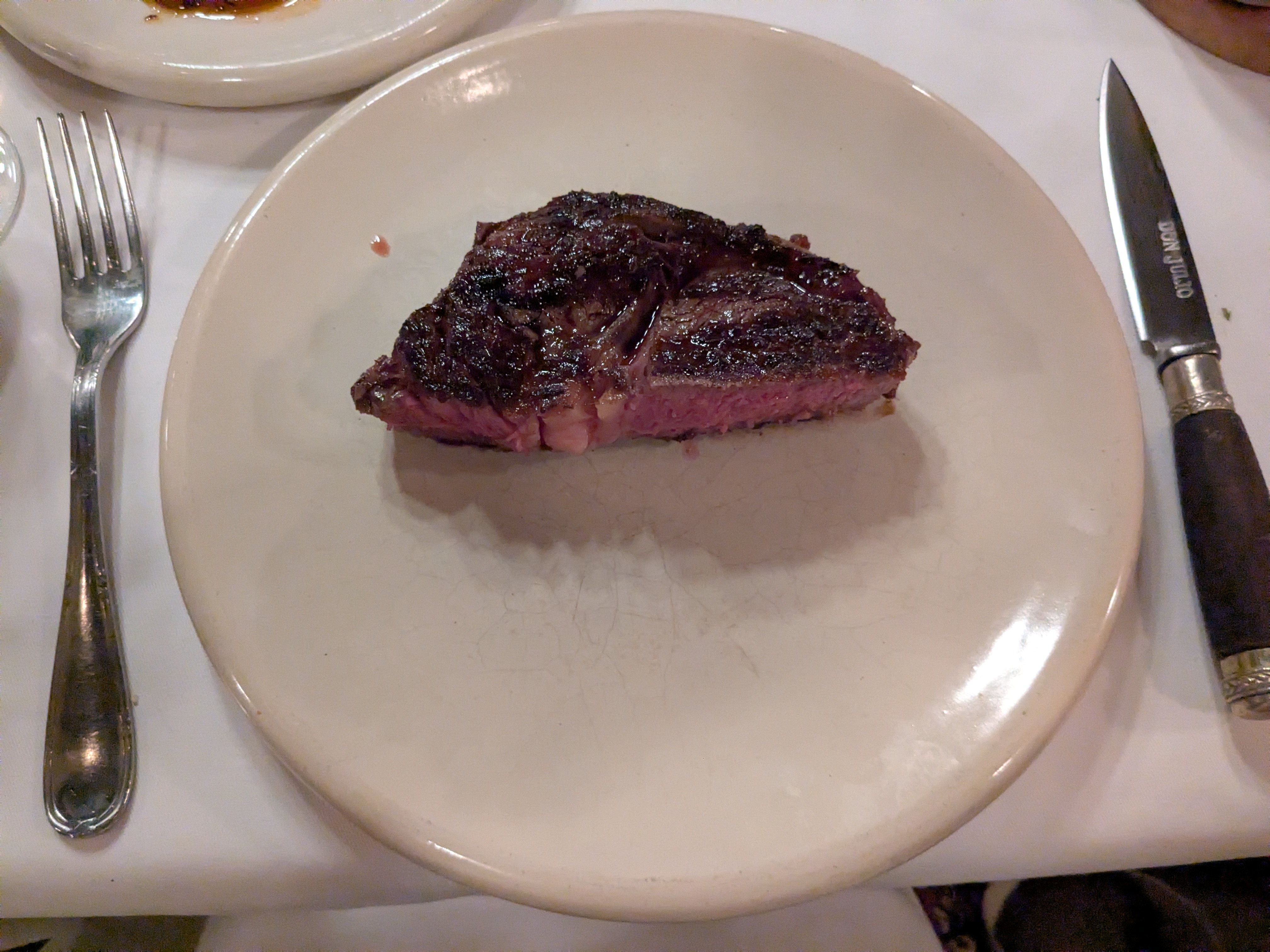
Just about a 10 to 15 minute walk, there are a variety of restaurants on the clusters of streets, each named after a Latin American country. Argentines have very late dinner hours. We kept our early dinner hours, and often were treated to have a restaurant all for ourselves, well not for the world-famous Don Julio restaurant. Don Julio is a popular Michelin Star restaurant located on Guatemala street. It is considered as the #1 restaurant in the Latin American region. Every evening, there are lines formed by steak-loving diners, who have made reservations, waiting for the opening of Don Julio restaurant. We went there for dinner one evening and it lived up to its reputation.
San Telmo is among the oldest neighborhoods in Buenos Aires, well preserved with colorful houses, and is worth a stroll during the day time. The nearby neighborhood like La Boca, famous for its soccer stadium and the immortal Argentine Maradona, is a rundown neighborhood to avoid after dark and maybe even during the day. These neighborhoods are where Tango originated as a blend of European, African, and criollo rhythms in the late 19th century.
Just like major cities, we always need to be mindful of the surroundings. In Buenos Aires, there are often bar-protected shops, and it is not uncommon to find gun-carrying police or security personnel on the streets. It constantly reminds us to be mindful of safety in major cities like Buenos Aires or New York City. There are “land mines” in the city, as a result of the many dogs and their dog owners. Not all dog owners clean up the waste so there are “land mines” to keep you paying attention all the time. I just hope that the city does something about it, be it by penalizing the dog owners or other smarter alternatives.
The Argentines have the best use case of WhatsApp. Airbnb, hotels, delivery and many teams use WhatsApp for communication, and over time, we get used to connecting with “these service teams” over WhatsApp and often get real-time if not even 7*24 support. We also feel more confident in connecting with fellow travellers over WhatsApp to share travel tips. These use cases confirm Messaging Apps, like WhatsApp, lives up to its promises of connecting people. We are very thankful for these Messaging Apps.
Considered as one of the ten best opera houses in the world by National Geographic, the Teatro Colón Opera House is a historic opera house in Buenos Aires. Leading international opera directors claim that it has the room with the best acoustics for opera. We decided to catch the opera Salome by Richard Strauss to experience the coziness and grandeur of the Opera House, and the Opera performance.
Tango shows often start at 10pm. It is in line with the late dinner hours of the Argentines. The late start is prohibitive to us early sleepers. Instead, my spouse and I experienced some Tango dancing street performance, and we signed up for a one-time Tango lesson. It is not only Tango dancing. The lesson is a mix of Tango music appreciation and learning simple Tango steps. I would remember this experience for a long time and definitely recommend the lessons to fellow travellers.
Soccer is the love of Argentines. What better to experience Argentina and the love of soccer than watching a soccer game at the River Plate Estadio Monumental stadium. This stadium houses 85000 spectators and it is hard to get tickets. For the full soccer fan experience, we joined a local tour with a guide who took care of the tickets, arranged a pre-game beer social get together with the group, and took care of us before and after the game. A WhatsApp group was set up for communication. Hours before the game time, we met up and a bus took us to a restobar. We bonded with other travellers over the beer, and shared our travel experiences. It was very fun. The restobar is within walking distance of the Stadium. After an hour or so of social time, we headed towards the Stadium. There were food booths along the way, and the crowd grew as we got closer to the stadium and the game time. The fans behave respectfully, are loyal and disciplined. I still remember the first impression of the Stadium – the vastness, the non-stopping chanting of fans creating peak decibels (dB) like in a sold-out rock concert, the flying flags and the energy of the crowd that filled the stadium.
The game was meant to be an easy win for the River Plate home team. The opponent Gimnasia is a team which the home team has not lost against for the last two decades. In that evening, the River Plate home team put up an unimpressive performance, even failing to convert the penalty kick gifted to the team in the last minute and ended up losing 0-1. In spite of the dramatic upset, the fans were obviously super loyal as they continued to chant for their home team to the last minutes and after the game. The loyalty and behaviors of the fans set a great model for the other soccer fans across the world.
A week after, the River Plate team and the Boca Juniors team met in the Superclásico, considered as one of the “top 50 sporting things you must do before you die”. The ill fortune of the River Plate team continued and they lost against their all-time rivalry. It was quite an experience to run into their fans and their bus on the streets before and after the game. The fans, wearing the team jerseys were everywhere on the day. The city experience of Superclásico made one of our most memorable experiences in the city. If you ever visit the city, watching a soccer game is a must, and we recommend the more upscale Estadio Monumental, more so than the La Bocca stadium due to the neighborhood.
It is hard to believe that Colonia del Sacramento of Uruguay is only a ferry ride from Buenos Aires. Colonia del Sacramento is a beautiful historic town, a UNESCOWorld Heritage Site that has the remnants of both the Portuguese and Spanish influence. The old town, made up of a myriad of cobblestoned streets, makes a lovely stroll for half of the day, with as frequent stops as you wish at the variety of restaurants. As we ventured outside of the old town to the less touristy area, we saw many small groups of friends and families carrying gourds, bombillas, and thermoses of warm water, quietly chatting and enjoying Mate as much as each other’s company. Colonia del Sacramento makes a good day-trip from Buenos Aires.
My company offers “work from anywhere for 4 weeks every year” as a perk. Inspired by my son’s lavish praise of Argentina after his recent trip and as an escape from the winter weeks in CaliforniaI, I used this perk to visit Argentina.
Established in 1536, Argentina is the 8th largest country in the world by total area. It covers about 2.78 million square kilometers, making it the second-largest in South America after Brazil. Among the many countries I have visited, Argentina is not an easy destination in terms of the effort taken to plan a trip there. These 6 weeks in Argentina make for the longest trip away from home.
It has been my very first time visiting South America. America with two continents of South America and North America, is a vast piece of land. The map may have disguised that it was a short distance down from North to South America. It took us two 7 hours plus flights to fly from San Francisco to Buenos Aires via Panama City. For travellers in Asia, it takes over a day or over 40+ hours from Asia to get to Buenos Aires, making it pretty prohibitive except for the very determined. Staying in Argentina for almost six weeks, we stood out with our lack of Spanish speaking ability, our Chinese appearances, we were recognized by airlines staff – we lost a piece of our luggages in the domestic flight from Buenos Aires to Iguazu, the airline staff helping us to track our luggage recognized us a few days later when we checked in at the airport for another flight.
Currency is another discovery. Argentine Peso is among the very few currencies I cannot order from the US banks. Why? The guess is that some form of currency control is in place, to control the inflation whose monthly inflation dwarfs the annual US inflation rate that our Fed has worked very hard to keep within 2 % annual rate. Argentina’s monthly inflation can be 3% or higher month over month. The way to get some Argentina Peso is to go through currency exchange shops or to go through West Union Bank. The exchange rates vary. Having some Argentine Pesos is useful as some local shops can give discounts if paid in cash or ask for surcharge if paid in credit card. For the same token that one cannot get Argentine Peso outside of Argentina, there is little reason to keep the Argentina Peso outside of the country. With such a vast piece of land, and the population seemingly working hard, and there are no major wars for the country, what causes the economy in such a dire state is not something I can understand in our weeks of stay. For those who have watched the movie “Evita” or love the song “Don’t cry for me Argentina”, there maybe something to do with the Peronism, the Argentinian movement, centered on social justice, economic independence, and political sovereignty, advocating for pro-labor policies, state intervention in the economy, and national autonomy. After close to eight decades, that ideal seems to be just as far away. In spite of this, we still see the remembrance of Evita Peron quite often, and the cemetery of Evita Peron remains the most visited in the famous Recoleta Cemetery in Buenos Aires. The current government tilts towards US-style capitalism more, leaving some claim that there is only rich and poor in the country, and there is no more middle class. Whether the labor-friendly Peronism or the current radical “shock therapy” program aimed at dismantling Argentina’s interventionist economic model, the country has substantial economic challenges.
The cost of living is not particularly cheap. It is possible to spend 2 to 4 USD for a comfort food meal. The coffee shop is 20% to 30% cheaper than that of the US. The steakhouse, serving very good steak, can be 30% to 50% cheaper. The Don Julio restaurant, #1 in Latin America with Michelin star, is also cheaper than the US fine dining. It still feels like a challenging country for the locals to live in with the relative income and the high inflation. We do not however observe unhappiness. In fact, Argentina’s happiness ranking places it well in South America, with recent data ranking around 42nd globally, not bad for the economic challenges the country is in. There was an election during our stay, the citizens still support the current radical reform. (We also learned that during election day, the restaurants cannot sell alcohol).
Argentina is part of Latin America in terms of culture (note that Latin America is not a continent) and geographically part of America. Culture wise, it is very different from North America English speaking culture. Even in Buenos Aires, the capital, it is common to get a clear “No” response when asking ¿hablas inglés? (Do you speak English?). The place with the best spoken English is the airport and the staff doing the check-in. And for the few lucky chances we run into someone who speaks English well, it comes across that these few are gifted in languages. It is clear to us, living in this part of the world, speaking Spanish is more than sufficient.
Google Translate and Google Lens are amazing innovations for travellers like us. I must admit that using a translator all the time takes effort in every conversation and shopping, not to mention when the technology can decide to stop working when you need it. I feel like becoming mute in expressing beyond basic needs. There was one time that we wanted to tell the Uber driver that he was on the wrong route and it was just hard to communicate without him getting off the highway and stopping on the roadside after quite some effort. Even with more technology, the ability to communicate naturally with each other remains an important part of human-to-human connections. I have learned some Spanish, probably enough to figure out roughly what is on the menu. It becomes obvious an extensive immersive experience, way beyond 6 weeks, is necessary to acquire a foreign language.
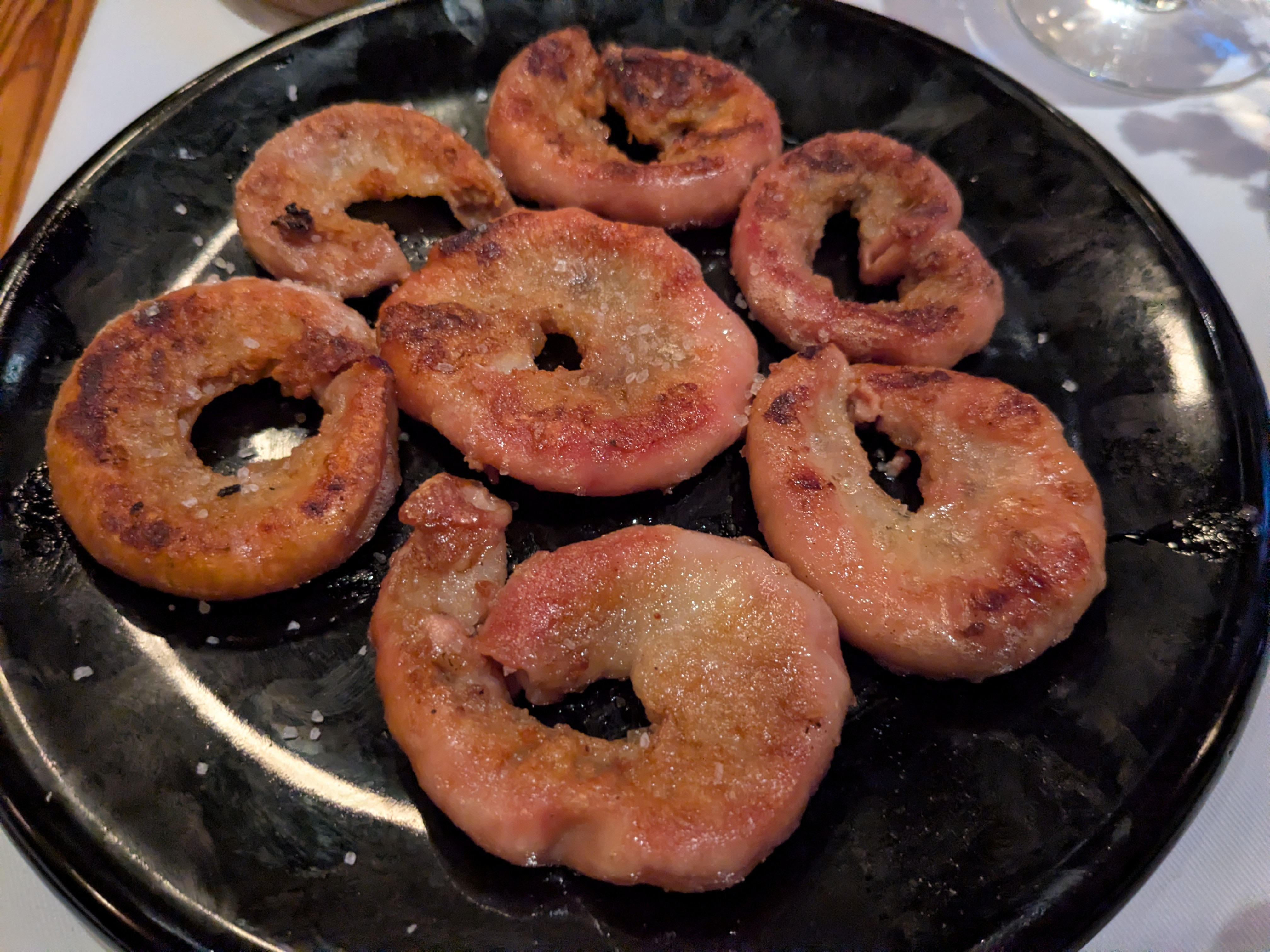
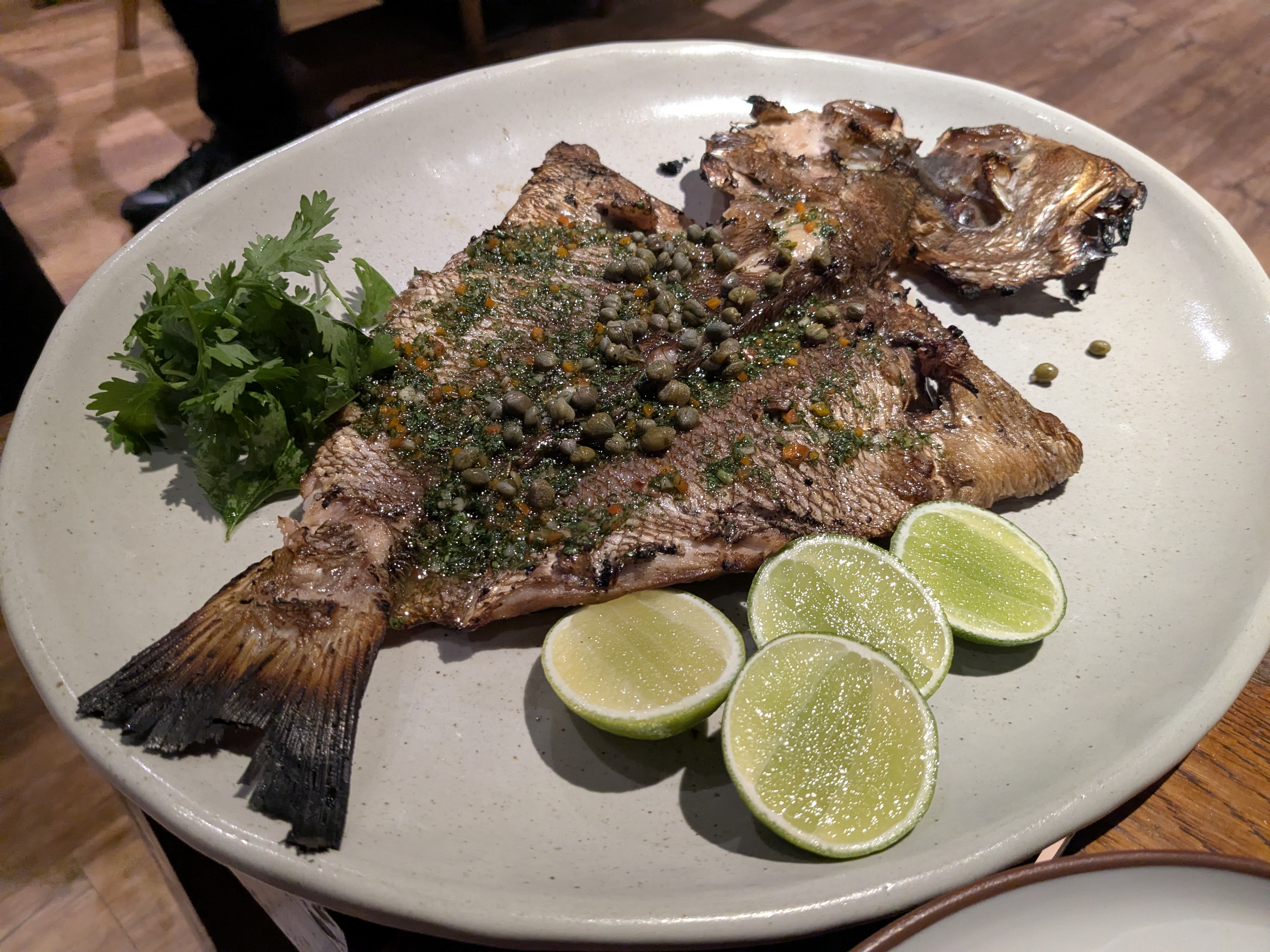
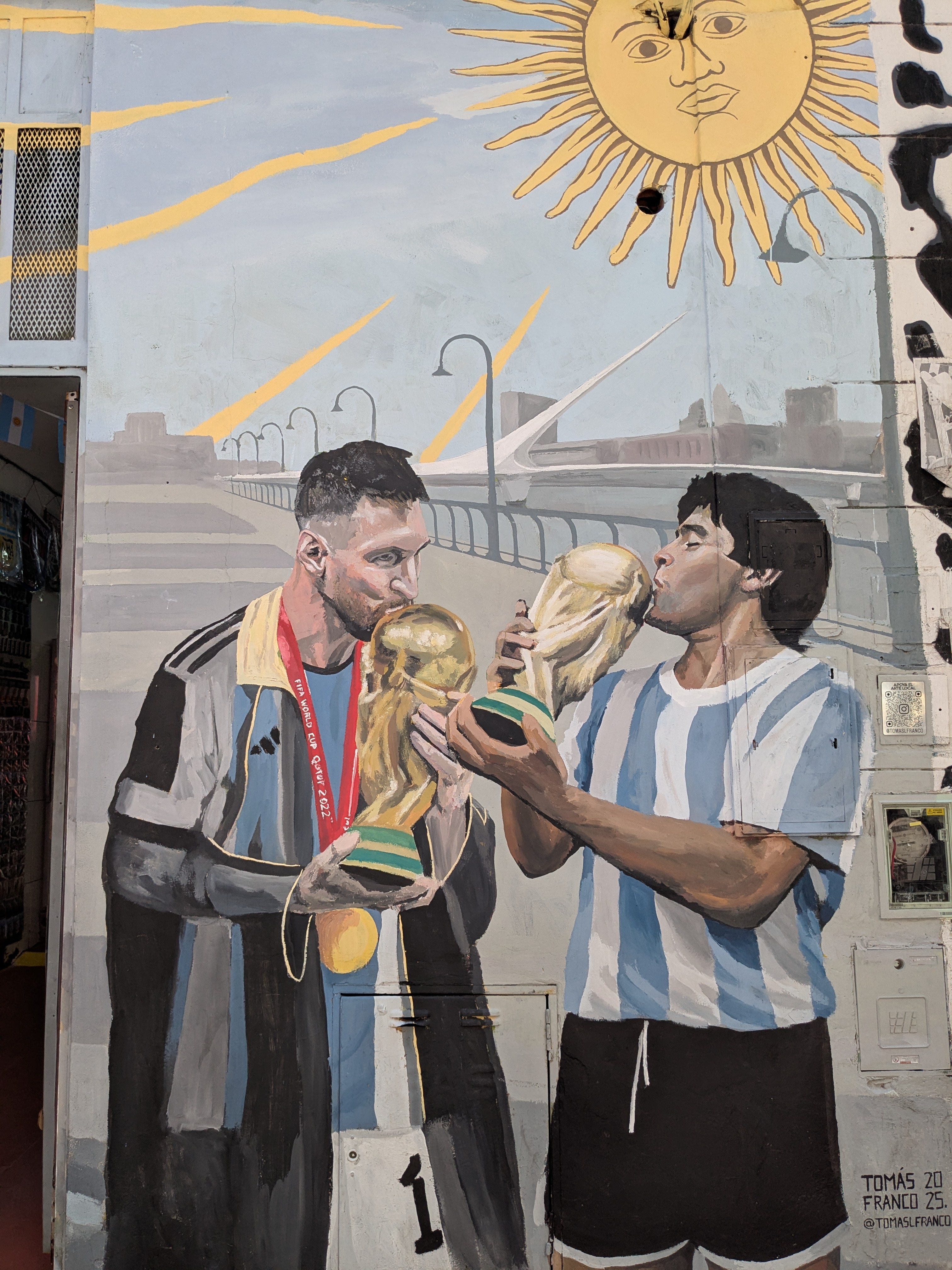
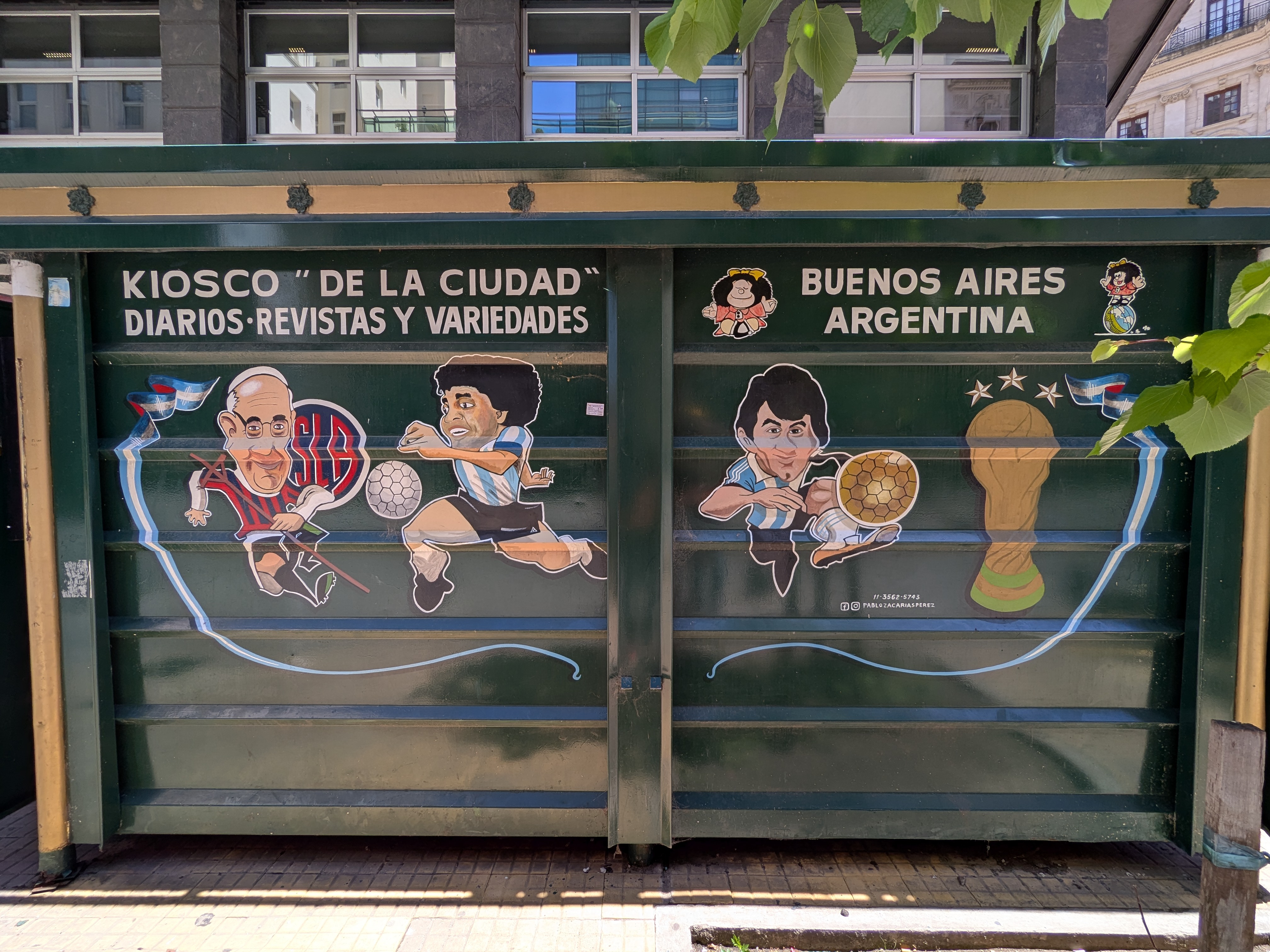
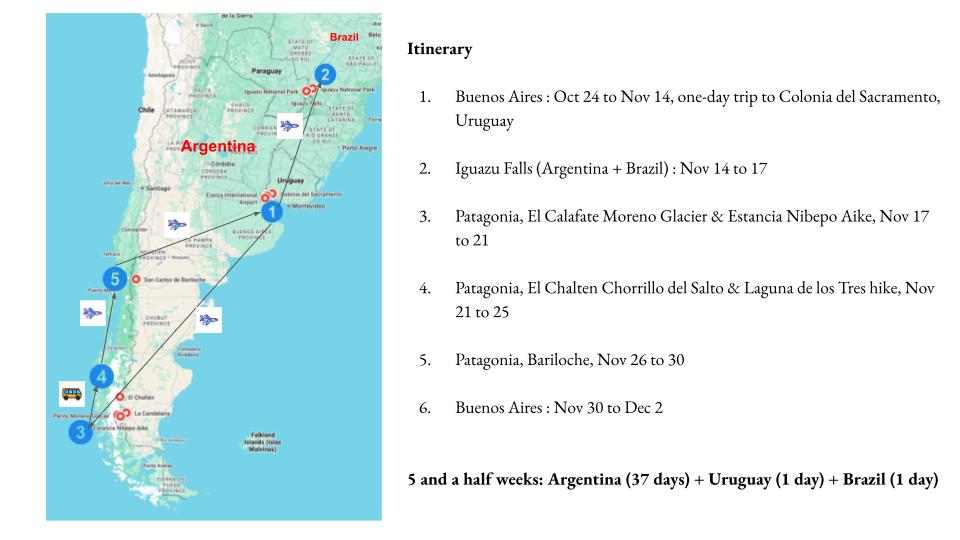
We visited Buenos Aires, Iguazu Falls, El Calafate, El Chaten and Bariloche in Argentina; one day on the Colonia del Sacramento in Uruguay, one day on the Brazilian side of the gigantic Iguazu falls. These cities/towns are very different from one another. Still the Parrillo/Asado (BBQ meat) together with Spanish cuisines like choripan, empanada, alfajor and Italian cuisines like pizza, pasta, gelato are found everywhere. Argentina is a place for meat lovers and dessert lovers. Of course, it is a country of soccer lovers too where Messi and Maradona have been immortalized with countless murals in every city.
Argentine immortals: Diego Maradona, Eva Perón (Evita), Che Guevara, Mafalda, Carlos Gardel, Pope Francis, Lionel Messi




















 oliviatamccue