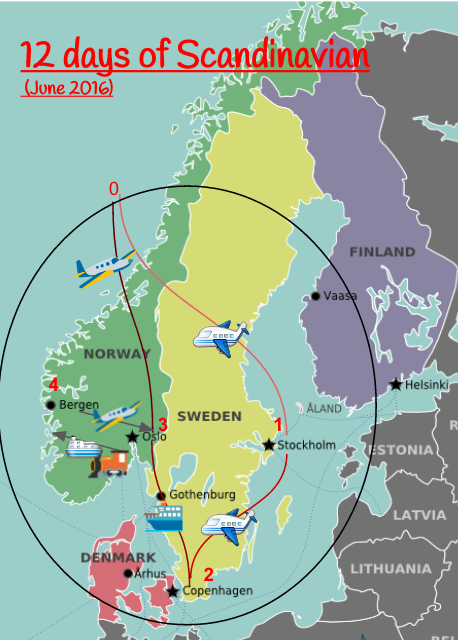
It has been five years since I stepped foot on a new country. This June, we went to 3 countries for 12 days.
Travelling as a family required agreement or at least the two parents to agree. Scandinavian Countries in Europe are often among the happiest in the world. Who wouldn’t want to go there in summer? We had the habit of travelling by ourselves, so we did some reading, worked the transportation, shopped for the accommodation and planned the itinerary.
How to go about?
First thing was to firm up the transportation of the longest leg. There is no direct flight from San Francisco Airport (SFO)  to Scandinavian countries. Instead, there is direct flight from Oakland to Oslo, Norway or Stockholm, Sweden, operated by Norwegian airline. Our choice was to fly direct to Stockholm, travel westward, and flew direct back from Oslo. Norwegian airline has been rated as the best low-cost airline in Europe. The base price was quite attractive, but the travelers would pay more to have meals, to have seating reservation as well as other options. We ended up paying $100 more over the base price just to have the meals and the seat reservation; it has not been that cheap with the add-on. Another thing was to pay the airfare using a credit with travel insurance coverage, just in case.
With limited time, we targeted the capital cities. Next, we made arrangement on transportation from city to city. Many years ago, Eurorail was the answer to travel within Europe. Airline and cruise ship have been doing a good job to change that; now we can choose among train, flight, and ship. Our transportation involved a combination of air, ship and train.
Oakland to Stockholm by Norwegian air, direct, ~10 hours
Stockholm ARN to Copenhagen CPN by Norwegian air, ~1 hour
Copenhagen to Oslo by DFDS Seaways, ~18 hours, overnight
Oslo to Flam via Myrdal by train (most scenic train in North Europe), ~6 hours
Flam to Bergen via express boat (scenic Fjord), ~5 hours
Bergen to Oslo by Norwegian air, ~1 hour
Oslo to Oakland by Norwegian air, ~10 hours.
Where to sleep?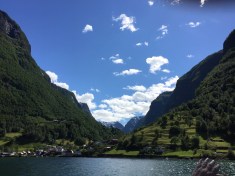
The transportation pretty much fixed where we would stay. Accommodation is no different from many things in life – what you get is what you pay for. What you pay for, is not just the money but also the time and interest to shop around. It is possible to optimize based on your needs. Some folks like 5-star hotel, some folks like homely and cozy stay, some folks like location, some like it cheap.. For us, we ended up with a variety – city backpackers hostel at Stockholm, a home away from home at Copenhagen, and one-night-stay at different hotels in 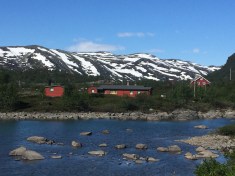 Norway.
Staying connected
Wi-Fi is gradually becoming as relevant as electricity. I remember those days, when power was out,, we went to bed; now the younger generation rest when the Wi-Fi is not available. 2-weeks ahead of the travel dates, we ordered a tep wireless device which worked like a hot spot for 5 devices with unlimited data.
What to do?
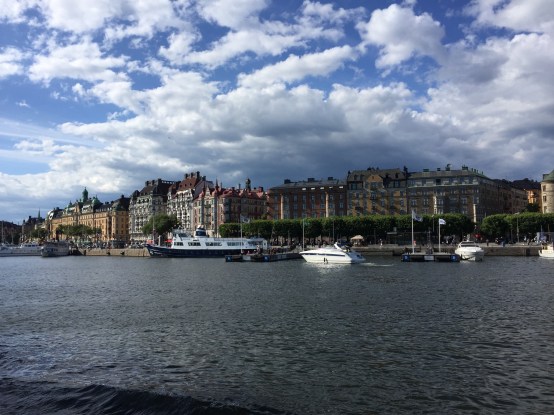
Once the accommodation and transportation were fixed, we could shape the detailed itinerary on the long flight and along the way. Some attractions offer guided tour, which does not require advanced reservation. In the end, we joined guided tours at the Stockholm City Hall (where the Nobel banquet was hosted), the Copenhagen City Tour and the Bergen museum; love all three of them. And there is no need to plan ahead.
And a special treat
One more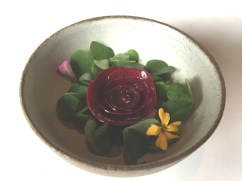 thing that needs to book ahead – there are some world famous restaurants in these cities, including Noma. For four years, Noma was ranked as the Best Restaurant in the World by Restaurant magazine. By the time we fixed the plan, the restaurant reservation was fully booked. Still with some strategy, persistence and luck, we were able to enjoy a lunch just before we take the cruise from Copenhagen to Oslo.
Planning is part of the fun in travelling to new places. If the preparation work sounds like mundane work, you would be better off to join a tour.

 of years ahead. It is a future time machine. It is about love. It is easy to love a bright future, it is something else to love the last mile of a journey. It is humbling and same deal to most. What motivates may just be the constant need to overcome new loss of ability to slow down the deterioration. Life is circular and we end where we start – nothing. Yet, if life is a circle, some draws a humongous one; some is more like a dot, a small number with negative radius. The world is almost shaped by those few who journeys a lot in their lives. Take an example, the smart phones are not a result of public voting, yet it changes how billions are spending their time every day. Internet and search are not the result of the work of the majority; it changes the lives of many. Automation of repetitive tasks is not the choice of majority of workers; it is the effort of bright minds who believe human intelligence will better be consumed in higher order than repetitive and mundane activities, maybe many would not mind mundane jobs to make a possible living. How the world evolves does not tie neatly with the advocacy of democracy in many political systems. No-one protest about technology, the smart phones, Internet, Wi-Fi nor the many apps, we endorse it most wholeheartedly. Are people being selective in the pursuit of democracy?
 of mostly disruptive behavior, however people justify them. The city has its share of problems, and more shares of fortunes when compared to many other places. The way it is going creates a real possibility that this generation grows up to see things from great to good, and could be in the hands of a few folks, from good to bad. There could be better outcome from brighter minds, and if not, life is circular so could the path of a city.
 n do we have a work week made up of two work days and three days of company holiday? It happened in this week of winter solstice, Christmas Eve, Christmas and Boxing Day. The anticipation for the week started after Thanksgiving holiday. And the week had its fair share of movies, feast and gifts.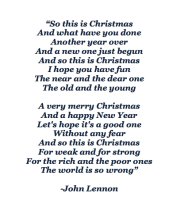
 ta and information”, taught by Mr. Edward Tufte. Mr. Tufte is a professor emeritus of political science, statistics, and computer science at Yale University. He is a pioneer in data visualization. With hundreds of “adult students” in attendance, he brought his unique perspective on data and gave us highlights of the rich content of his four books on data visualization. It was back to classroom lecture and had reading material that took more of the brain bandwidth and really needed focus. Over the years, we build the habit of the right “messaging” in our presentation with data filtering; we worry about complexity to our audience, and cherry pick “easy” and relevant information to our target audience; our challenge becomes less of a mental and content but more of a political and presentation. It is a day of reminder that rich content is superior to beautiful slides; a reminder to not distort data; and the expectation that communication could be clear, precise and efficient at the same time.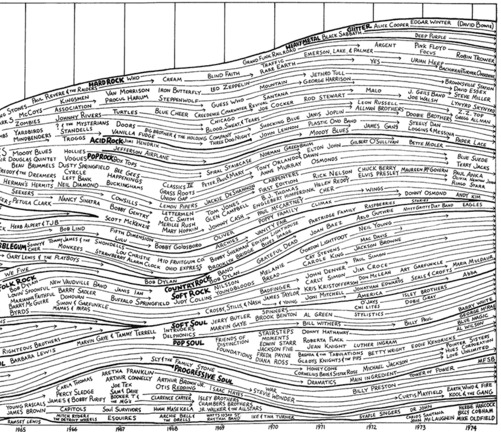
 any things convenient, efficient and improves the well-beings of many lives; and it is winning the race with non-technology alternatives. Yet, it is hard to wholeheartedly embrace a complete victory of technology.
 ikely way lower than the gasoline consumed in getting to shopping malls. It is as great a thing as free Wi-Fi.
 ng a hundred times will give a deeper understanding than the first attempt. After writing 100 blogs, I have learned or “relearned” a few things.
 not there, nor do I want to be there. They may just make it look easy.
 dset brings more inspiration. Three years have gone by between the 1st and the 100th. There are changes every day, let alone three years – mindset, parents, children, friends, career, workload and health. When we are relaxed and happy, the same thing looks more interesting and the world looks wonderful; no wonder the tennis players p
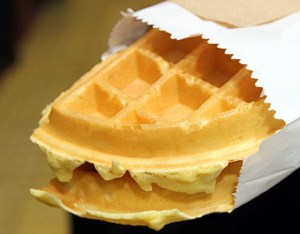 g nature that goes well with peanut butter, or ice cream or fruits or other companions. There are fries or pastries that are presented in the shape of a mini-waffle, which alone, improve their appeal. My best and worst waffles were both at a hotel near university campus. My best experience happened nearby the Harvard campus at Cambridge. The hotel was upscale where the ingredients were organic and carefully selected; the restaurant was filled with Harvard students with their families. It could be the ambiance, it could be the vacation appetite – the waffle breakfast was absolutely delicious. Fast forward a couple of years, I arrived at Ann Arbor near University of Michigan, just off a red-eye flight. Tired with little appetite and much time to kill, I was at this buffet-style breakfast served at the hotel. It could be the sleep deprivation, it could be the lack of diners, and it could be the waffles have been waiting for a diner for days, the waffle tasted so poorly that it was hard to reproduce. Waffle continues to be my favorite choice, though its carbohydrates make it a challenge now.
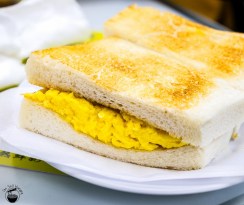 nforgettable. The best, in my book, is served in this modest and absolutely cramped
 the highest priorities at some stages of our lives. If we can earn money, can we earn happiness? There was a song about “happiness” by the Canto pop superstar Sam Hui in Hong Kong years ago. Many of the lyrics still hold true to this day. The lyrics translate into:
 “Happiness is driving a car with a full tank”
 oliviatamccue