oliviatamccue

about everything, anything or something

College Application to Business Growth

Could college application process be leveraged to check the health of the business in workplace?

Parents, with high school children, have different level of involvement in the college application process.  Most strive for the match of their children to the best college for their path.   There goes this industry of SAT preparation, college admission, and all kinds of consultation, with prices that could go as deep as an expensive consultant in the workplace.

Like many other parents, we soon find that we are hearing a bit of the same thing over and over again – GPA (Grade Point AverageCollege next exit), SAT  and extracurricular.   Do these factors weigh the same?   They are all important in some ways.  GPA and SAT are more the entry criteria to be met, and extracurricular is relevant for those who meet the entry criteria.   If SAT is the more of an absolute standard, GPA is a bit relative to the peers in the school.  Unless your extracurricular is super unique, there is that entry criteria of GPA and SAT.   There is also that natural selection process where students would filter colleges based on their GPA and SAT to some extent.   Without the natural selection, the public and private Ivy would get far more revenue just from the admission application fee.

How does it relate to the workplace?   Many companies have strategies to sell in different markets. In health care, many companies would like to get the business of IDN (Integrated Delivery Network of facilities and providers that work together to offer a continuum of care to a specific geographic area or market.). In high tech, many companies may offer security products, cloud services or big data analytics.   In other companies, they may want to get business from particular customer segments, be in being SMB (Small & Medium Business) or Enterprise customers.  What are the GPA, SAT and extracurricular equivalent of the markets the company wants to get to?

Unlike college admission, where the GPA, SAT is well defined, it is not that obvious what their equivalent means in the workplace.  Yet, the similarity is that until it is clear on the entry criteria of the market, any effort to spare on “extracurricular like” is not going to yield much return on investment.

In the company you are in, how do they stack up?Business-Growth-Coaching-web

  • Does it know enough about the market segments to tell the GPA and SAT basic filter and entry criteria?
  • Where is it in terms of those criteria? Is it a GPA 4 out of 4, SAT 2400 out of 2400 where it is r
    eady?  Or is it GPA 3, SAT 1800 while the market is expecting GPA 3.5, SAT 2000, and there is work to be done?
  • For company not in position to meet the basic, are the next generation investments in line with meeting the entry criteria, or are they focused on improving the extracurricular areas?

When a company is clear and honest about what its GPA and SAT equivalent are for the markets, it is probably already winning half of the battle.

Leave a comment »

Are you flourishing at work?

Just that happiness is a pursuit of so many, when I search books related to “happiness” on Amazon, some 39,453 matches are returned.

In his book “Floflourish bookurish”, Martin E. P. Seligman provides a visionary new understanding of Happiness and Well-being.  Both Happiness and Well-being are the topic of Positive Psychology.  Martin E.P. Seligman, Professor of Psychology at the University of Pennsylvania, has led the Positive Psychology movement for fifteen years, where the goal is about raising the bar for the human condition.  In as much as the national wealth is measured by Gross Domestic Product (GDP) or Federal deficit, there is yet a well-known metric to measure the well-being of the countrymen.



What is the Well-Being Theory?  It has 5 elements:  Positive emotion, Engagement, positive Relationship, Meaning and Accomplishment (PERMA).  This theory has far reaching effects including the idea and implementation of “Strength Finder”.

How would such a “Well-Being” index look like for a company workforce?  My starter …

Positive emotion: the ratio of positive emotion (feedback) versus negative emotion (criticism) in a day’s work.  Culture, the interactions across functions, the interactions among teams, the management style and the team would have their influence.  Do co-workers give credits to others?  Or do they criticize on others’ work?  And how is the annual performance review being managed?  D
Flourishing-Leavesoes
it focus on the accomplishments and build on strengths? Or does it look more for areas of improvements?

Engagement: the frequency of leaders communicates such as employee meetings, informal chat with workforce in the o
ffice, or that the leaders are being seen in the office.  The workforce treats co-workers and customers in similar ways as how they are being treated.   Much of the company results depend on an engaged (and committed) workforce.

Positive Relationship:  # of people in the company to become friends when the employee is no longer in the same company.   What does he/she say about this statement – “I have a best friend at work”?

Meaning:  the extent the work matters to the individual and he/she is willing to spend extra effort.

Accomplishment:  the extent the employee feels that he/she has achieved something at work.

Well-Being of the Workforce:  all things considered, the probability to stay in spite of another better offer; or reciprocal of the probability to leave without anything equivalent.   If people are leaving a position without a job in this tough economy, it is a clear sign that he/she is neither happy nor well.

How would you assess the company with which you are spending majority of your waking hours?

If it does not bring well-being to you, it may be time to change.

Leave a comment »

Company Language


A couple of decades’ in a fortune-500 global company create an experience of what happens as a company grows; and how to work with people speaking different languages. It injects subtle insight to predict the growth potential of companies of much smaller size.    

There are many factors to decide if a company makes it to a giant such as the industry, the products, the innovation and the people.   Zooming in the people factor, a lot could be told from observing the culture, the leadership style, the performance review system. I find it reflecting when observing the language. Just like country has its language, company has its language as well.

  • Name-based language or what I would call “Peter, Paul and Mary”.
    • How does name-based sound like? “I have Peter working with Mary on this stuff, with Paul”. A quick clarification – It is not name-dropping of mentioning important people in conversations. Peter, Paul and Mary could be anyone and at times even the folks working for the vendors or customers.
    • What is the implication? Individual first, tasks/objectives to follow. (This is something that people in very large company miss, after a while, individual does not matter.   It could show only those individuals know the stuff, especially if the stuff is not very clear.   It is more about “who is involved” more so than “what gets done”.
    • Imagine there are multiple Peter, many Paul and hundreds of Mary as the company grows, it becomes as cryptic as listening to a language that one has never heard of.    As company grows, the “who” may need to be refined if not replaced by “who plus a clear what”.
  • Acronyms-based language.
    • Most companies have this. Neither Google nor Yahoo can help. Those acronyms are often unique to the company and have totally different meaning from what Google reveals.
    • Well, acronyms are like new vocabularies. If the context of communication is clear, then acronyms sound more like learning new word or a new accent of a language that one speaks.   This seems an easier portion to pick up than “Peter, Paul and Mary” and continues to exist no matter the size of the company.
  • Scientific or ambiguous language.
    • Is the language consistent in saying the same thing with the same words? Or is there a lot of thesaurus that creates a total different ways of saying? Too much variety could be an obstacle in massive and global communication.
  • Communication Style, whatever the language, how is it used?
    • Do people communicate (directly)? What is the distance that a message has to travel before reaching the target audience? The more direct, the shorter the distance.
    • Do they even communicate and do it consistently? Do the leaders take initiative to talk not just the earning results, but also the objectives and directions?

Each company has its own language. If one listens to the company language carefully, it helps to predict how far the language could go, how clear the communication is, and how much the people need to adjust the language if the company grows.

Is it worth to research on the correlation between company language and its growth trajectory?


Leave a comment »

Are you stressed? Positive or Negative

Just that I have got stomach issue, for the last few months, gets me this question a lot: “are you stressed?” stomach_ache

So what is stress?  In the dictionary, the definition goes from “importance attached to a thing”, “phonetics, accent or emphasis on syllables”, “emphasis in melody” to “physical pressure, pull or other things”.

It feels that it is something natural that would happen, yet many prefer stress-free life these day.  Is stress bad?   It depends on how you look at stress and whether you are looking for positive or negative.

What could be positive stress?

When we are nervous, tightened up, could not sleep well just before an important presentation, recital, competition and the like, that we just want to do everything to be at our very best.

  • Tennis players playing in Wimbledon final or athletes competing in the Olympic games
  • Job seekers attending interviews of a dream company or a dream job.
  • Or presentation on topics that are important to you or the audience is important to you.

I think the physical body can take in the stress a bit, and earn the satisfaction of achievement after.

What could be the negative stress? Well, think of the stress in the following situationsLosing-it-Stress

  • In a (company or country) culture that you don’t understand nor appreciate
  • Tiring people dynamics that are in the way of your goals.
  • Overwork on something that you don’t care about yet with unrealistic objective.

How to manage stress then?  Simply increase the positive and reduce the negative.

Assuming the stomach issue is related to stress, I am thankful that my stomach is offering real-time response to the state of my mind.  This is how the body and mind connect, isn’t it?

Leave a comment »

2013 Online Courses (all for free) Transcript

Further to the College Tiers in Online Classes, here is a summary of the Online Courses travelled in 2013 when the year is still visible in the rear mirror:

  • Software as a Service, BerkeleyX (www.edx.org), 6-week
    • What better to get first-hand experience of the Online Course Idea than taking a class, so this being the first one.  There is also intent to refresh knowledge in technology and more interestingly, discover what is taught in Computer Science Major between now and then (then is a 20+ years or so ago).  Most of the course material is the video-taping of the campus lectures.  It is enlightening to see how things become easier and more fun over time, in writing codes to achieve something.   The professors are passionate, engaging; material first class, and homework quite a challenge.   This requires time and effort on textbook and homework (coding and troubleshooting).  As everything else, we learn proportional to the effort, rated this as A.SaaS
  • Advanced Software as a Service, BerkeleyX (www.edx.org), 6-week
    • The 2nd semester of the above class.   I  particularly like the lecture of the last week where it covers career advice; a bit of the “from the class to life” perspective of Professional David Patterson.  Rated the same, with the teaching team A+.
  • Introduction to Data Science, University of Washington (www.coursera.org), 12-week
    • Big Data Analytics is another growing buzz.  What better to go beyond day-to-day articles than taking a formal training and for free.  It is not an easy one, covering the data manipulation, analytics anbig data analyticsd presentation.   Some statistics can bring you to knees and needs a take-2 of the video viewing.  The homework is challenging and interesting (e.g. data mining of social media to see what States have happiest folks; or predicting the survivors of “Titanic”).  I learn a lot in this class.  Rated this as A, and the teaching team deserves A+ with their effort to connect willing students with industry projects.
  • Inter Professional Healthcare Informatics, University of Minnesota (www.coursera.org), 10-week
    • Going from High Tech IT to Health Care related areas, I sign up a few health care related courses, this being one of the first, with an intriguing course title.   It covers good overview but not much depth; it also provides quite a number of references to where additional information can be found.   Rated this as B-.
  • Take Your Medicine – the Impact of Drug Development, UTAustinX (www.edx.org), 8-week
    • Continue the path to take more healthcare related course.  This is one easy course, learn some good concepts, yet, not much of an impression.  Rated this as B.
  • The Science of Safety in Healthcare, Johns Hopkins University (www.coursera.org), 5-week
    • Sign up to get a better understanding of patient safety.  Impressive teaching team, decent course material, homework was overdue by the time of my late enrollment.  If it is offered again, would consider a retake to complete the case study and participate in online discussion.  Rated this as B+.
  • Fundamentals of Clinical Trials, HarvardX (www.edx.org), 12-week
    • Intend to further the understanding the drug development process in Health Care.  Just Harvhealthcareard’s name creates sort of a higher expectation going into the class.  This is one serious class on the scientific, statistical, policy, and ethical aspects of clinical trials research.  It provides a comprehensive overview of the design and analysis of clinical trials, including first-in-human studies (dose-finding, safety, proof of concept, Phase 1), Phase II, Phase III, and Phase IV studies.   For the case study, it is easy to see many students putting in a fair amount of effort in it.  This is a 12-week course, with some more weeks to go.  No rating for now.
  • Think again, how to reason and argue, Duke University (www.coursera.org), 12-week
    • This is one of the few classes that I did not finish.  I sign-up not for myself, but more from a school-aged child.  The first couple of classes are basic introduction to valid argument, sound argument and deduction;  as it goes further, it goes deeper into reasoning and argument, and then it really gets the head spinning to figure out the validity and soundness of complex argument.  This is serious class, and helps one to develop a sound mind to assess the arguments of politicians, salesmen, and more.  Solid class material and pretty difficult quizzes.  This feels like a pretty good class for those interested in the field.
Leave a comment »

Small town, big city, small and big company

Some movies describe life in small town as everyone knows everyone else; how gossip goes quicker than laser, the power of personal relationship and then come the plot.  My upbringing in city does not lend familiarity to life in small town.   In a city, it is more like people do not know their neighbor, or after saying “good morning” to each other, we are busy with our doings of the day.  After years, it is a comfortable habit in such detached interactions.

This small company gives me the experience of townsman.  At meal-time conversations, they talkSmallTown about individual co-workers and their years of history in the company – a bit like reading the People magazine.  And when things happen, they cite examples of “similar things happening in the past” and could get emotional. Behavior is not sophisticated and people could have open disagreements, yet there is a fair amount of intimacy, a bit like relatives who argue one day and reconcile later.  The decision making process may not be scientific nor result oriented, rather people oriented.  For people around in the company for a while and have the knowledge in the products, they could be pretty safe in the position no matter how ill-fitted they maybe for the current assignment.

If working in large cohongkongmpany is like living in a big international city like New York, Hong Kong or Tokyo, working in smaller company echo living in a town.  If folks in big companies talk about organizations, folks in smaller companies talk about people.  And if big companies make decision based on data and process and too much, smaller companies make subjective decision based on people they trust.  If big companies make each employee feel completely dispensable, does smaller company give employees more sense of importance?  If employees are used to constant reorganization in big companies, employees in this company still talks about re-organization of the company more than a year ago.

Such contrast creates the subtlety and the adjustment required to traverse from a large company to smaller company.

Leave a comment »

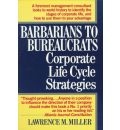
Barbarians to Bureaucrats by Lawrence M. Miller

Google search on “Corporate Life Cycle Strategies” has not revealed much recent coverage of the topic.   The book “Barbarians to Bureaucrats” by Lawrence Miller, published in 1989, shows up on the top page.

This boobarbarians to bureaucratsk reviews the life cycle of companies – how a company progresses from the early stage of formation to its decline.   As its title suggests, it talks through the Prophetic Age, the Barbarian Age, the Builder Age, the Administration Age, the Bureaucratic age to the Aristocrat Age; with the business strides from start-up, growth and maturity to decline.  The book sums it up well in the last chapter the business environment, the company structure and the leadership in each stage; their belief, mission and style of decision making.   To avoid the natural cycle of rise and fall, it gives the Synergist prescription, where the leader and organization escapes from a monolithic stage to a balanced and blend of leadership as needed; and how the synergist style cultivates unity and teamwork.company life cycle

The author has intertwined the corporate life cycle with historical events of the society or corporate events.  The analogy is a mix – at times improving the readability and sophistication; other times a bit artificial or weak.

I marvel how far the corporate dynamics have come along in these 30 years.   It could be – corporate executives have already put the insight of Barbarians to Bureaucrats and like into practice to regenerate their own companies.  Economies, industries and companies have their seasonality – most companies, those survive and thrive, reflect huge abilities to change, adjust and reorganize in maybe too quick a manner these days.

The book does a neat job in summarizing the topic, it provides a good reference when you start a new company or start in a new environment – consider a preview by reading the last chapter of “A life cycle overview” and skip to the specific stage that is most relevant to get the most of the book.

After 1989, such many events have taken place – just to name a few, the IPO days, the Y2K, the start-up, internet boom and bust to the increasing presence of technology.   It seems about time to see another publish on the topic.

Leave a comment »

Company Life Cycle

Software Development Life Cycle (SDLC) is related to design, development, testing and move-to-production.   Product Development Life Cycle is around concept, definition, development, testing and launch.    As the software or product repeat its cycle, the product ages over time, then it gets to retirement and/or is being replaced by the next generation.

Isn’t it a bit like our Life Cycle from birth, growth, maturity, decline and then death; and go on with the next generation?

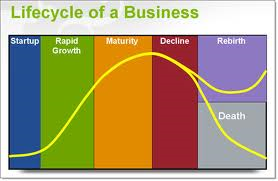
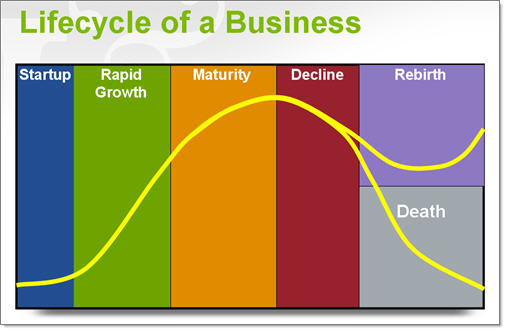
Does a company have a life cycle too?   Google returns the following result on a search of “Company Life Cycle” – the 7 stages of business life cycle, the organizational life cycle, and something about industry life cycle…

When you start in a codepositphotos_6184268-Human-Life-Baby-Child-Student-Work-Old-Man-Deathmpany, how could you tell at what stage the company is in?  There could be data such as earning reports which tell the business results of the time, % of growth year-over-year.   I believe the business result is a delayed signal to the stage of the company life cycle.   There could be equivalence of company life cycle with human life cycle.

I have witnessed company in growth, but not when it was born.  I imagine it as transformational as a new born coming to life.  There are a lot of changes, fast pace, demanding, relentless, yet everyday there is something exciting and there is a lot of belief.  And the founder is the center of the attention.

What does a company in growth stage look like?  Maybe it is a bit unstructured, lots of ideas and inconsistent in execution.  There are lots of growth and energy.corporatelifecyclebest1

Let’s look at this company of a thousand employees.  It is no longer at its creation stage.   The company is looking to grow more by acquisition than product differentiation, it has reorganized in the past three years, employees and managers alike feel they can do little to effect meaningful changes, the managers do not show belief in their own people, they talk about good old days, and fixing a product receives more time and attention than new features.   What stage is this company in?

Let’s look at another company where the visionary leader on his ideas the company was found; the organization is hectic as it had no proven track record in the marketplace, and things change almost daily, yet there is excitement and belief  in the staff on they are trying to achieve.   What stage is this company in?

Does the life cycle of the company affect the mental state of our own life cycle?  Does a startup make a person younger?  Or a company in decline creates stress and problem for our own life stage, much like aging could?

Leave a comment »

What does it tell of a company with returning employees . . .

When a person returns to a previous company, does it tell us anything about the company?

I was in a Human Resources presentation recently.   From HR perspective, a high return rate is something to be valued and a proof that the company is good.

What do we think of this argument ? – When there is a high return ratequit job, the company is good.

Could a company be not so good and the worker returns?  Think so – the company could be not so good, but the worker goes to some other employment that is even worse.

Or could a company be not so good and could not find better workers that it hires someone who has left?

Could a company be very good when there is a not a high return rate?  Think so – the company could be good, yet the worker has other opportunity that is even better.

The argument “when there is a high return rate, the company is good” is neither valid nor sound.

We can say “when there is a high return rate, the company is not the worst of all”.  Well, setting aside philosophical discussion of the argument validity and soundness, I asked a few folks on the perception of this situation.

From a veteran in the company, this company is “safe” that the workers can leave and then return without penalty.  Some established companies may have a policy that leaving employees cannot be reemployed for a period of time.   This company does not.sign-realitycheck

Others said “the economy is bad that the worker cannot find a better arrangement after leaving the company (in terms of hours, pay, flexibility etc.)”.

The contrarian claims “the worker in this company is not good, could not be successful in another environment”.

Before making a relationship between the return rate and the goodness of the company, some questions are to be answered:

–   Why do people leave? Do they care enough to share the genuine reasons?

–   Can the career goal be met overall?

–   When a compatible position with similar pay and benefits at another company presents, would the worker leave?

–   Would the worker recommend the company or organization as a great place to work?

These are tough questions, they are telling of the real workforce sentiment towards the company and provide unfiltered insight from the most important asset of the company.

Leave a comment »

New Hire Orientation

Some companies offer new hire orientation in a classroom setting.   At different stages of a career, one may have different sentiment towards orientation types of training.  My recent attendance becomes a realization on how far things may have changed in terms of effective information transfer.

It is a good gesture for a company to offer a new hire orientation.    Good thitraining-3ngs are sometimes harder to inject fundamental change.   Training is a good thing, isn’t it?  Allowing new hire to spend two days to know about the company is a good thing, isn’t it? Trainees would feel obliged to say some good things about it, isn’t it?   If nothing else, the effort of the organizer and the ability to know other folks are among the things that are highly appreciated.   There is no obvious trajectory to change new hire orientation.  Yet it leaves a lingering feeling of “what may happen to this type of training for the future generations?” Would our future generations be welcome to a company in days of orientation?

First, it is a realization of the tiredness created by sitting in a training room, listening to the presenters, for two full days – even for topics that are relevant.  It feels like being forced to watch a TV program without the ability to change the channel, other than the mind wondering around, and the intermittent dozing off as the alternate channel.

In this era of technology offering you tube videos, on-demand program, Netflix, Tivo , we are spoiled.  Free college online classes from Harvard, MIT, UC Berkeley would thoughtfully cut a two-hour lecture into seven or eight small clips, each 15 minutes or less.   With multi-media, there is so much information that can be transferred in a few minutes.  It is so effective that it almost becomes scary.

In ten years, what would the “new hire orientation” be like?  If employer-employee relationship still exists, would training still be in classroom?

Change or not, these types of training deserves votes of appreciation for the effort, the gesture, and the connection with people of different functions.   Maybe in the end, it would stay its course for many generations.

Leave a comment »