oliviatamccue

about everything, anything or something

A Gift of Hope by Danielle Steel

It is a book of the calling to the author to serve the homeless in San Francisco and what she has done.  The author is no other than the famous Danielle Steel.    If you visit any book store or library, her books are everywhere.  She is one of the most popular authors, with millions and millions of her novels sold.

Ms. Steel has worked anonymously for eleven years to provide food, clothing, beddings, tools and toiletries for the homeless on the streets of San Francisco.     This book is a recording of her personal experience in taking to the streets, with a small team, to help the homeless of San Francisco.

After the loss of his son and the breakdown of her marriage, she falls into a personal abyss, where she receives the personal calling to serve the homeless. This calling mingles with the resistance and fear she has to overcome to take to the street to provide the blankets for the homeless for the first night in San Francisco.  Second and many following nights are not getting easier either.  Each of her trips brings inspiration and motivation for her and team to go back to the streets for the many years to follow.

The book has many small personal stories of the few homeless folks – one with cancer, one pregnanhope-boatt woman; one in search of jobs.  Unlike her many novels, these stories do not have the drama, and do not have known start nor known endings.  They are glimpses of the unfortunate lives in the nights that the author and team have provided for them.   Yet the simple and incomplete portraits are touching; and provide a powerful image of the dark sides of the many stories on the streets of San Francisco.

Determined to supply the homeless with the basic necessities to keep the needed alive, Danielle Steel offer much more than the material comfort, she offers them respect and a voice to plead for more effective action to aid this deprived population.

This book is different from her many bestselling novels and is a worthy read.

2 Comments »

Stomach Issue

Since summer, an intermittent stomach pain has been with me.   It does not need invitation and comes at times it chose and often at inconvenient times when I am in the middle of something.

It is almstomach_acheost always that people’s reaction to stomach problem as “are you stressed?’  Some gives an assertive remark of “stressed”.  Even the doctor would ask “are you stressed?”   No matter how, the response would come back as “you get it, you may not know.”  After hearing this the nth time, the group opinion wins over, what else can I say?

First, the internal doctor (internal doctor is really not internal more like family doctor) advises me of over-the-counter pain treatment, with a limited diet.  A limited diet is not fun, and brings to laser focus the enjoyment of food in our everyday life.  There goes the daily coffee or milk tea; then goes the spicy food, then goes the fruit, then goes the vegetable, sashimi…  And as the pain does not subside, there remains banana, rice, saline crackers and just a bit more.  I want this uninvited guest to go away, but it chooses to stay.

After another round of doctor visit, I land on the Gastroenterology section – GI.  Having a GI to see you is a challenge to the body whether it can cure itself in time before the GI appointment.   Some GI specialist has a wait time in months, and some has a shorter one in weeks.  By demand and supply, what does a shorter wahealth-is-wealthit mean?  I don’t want to know.  This case is not so very special; a shorter wait seems a better choice.   First visit results in various types of tests, and fortunately, nothing disastrous comes back.  Neither do they tell the root cause.  Next up is to see what is inside (endoscopy test).  The diagnosis is out with an ulcer – ulcer is like a cut in the stomach lining, the root cause is out.   Two weeks of medication have not covered it, another 6 weeks ahead.  The good thing about medication is that it creates a barrier for the pain to visit.

Am I stressed?  I am certain that the stomach problem and its impact on my food consumption have caused me stress.

Leave a comment »

Company Life Cycle

Software Development Life Cycle (SDLC) is related to design, development, testing and move-to-production.   Product Development Life Cycle is around concept, definition, development, testing and launch.    As the software or product repeat its cycle, the product ages over time, then it gets to retirement and/or is being replaced by the next generation.

Isn’t it a bit like our Life Cycle from birth, growth, maturity, decline and then death; and go on with the next generation?

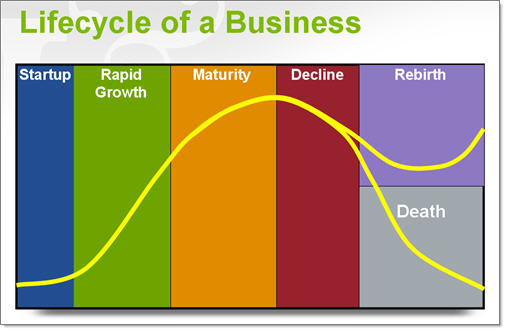
Does a company have a life cycle too?   Google returns the following result on a search of “Company Life Cycle” – the 7 stages of business life cycle, the organizational life cycle, and something about industry life cycle…

When you start in a codepositphotos_6184268-Human-Life-Baby-Child-Student-Work-Old-Man-Deathmpany, how could you tell at what stage the company is in?  There could be data such as earning reports which tell the business results of the time, % of growth year-over-year.   I believe the business result is a delayed signal to the stage of the company life cycle.   There could be equivalence of company life cycle with human life cycle.

I have witnessed company in growth, but not when it was born.  I imagine it as transformational as a new born coming to life.  There are a lot of changes, fast pace, demanding, relentless, yet everyday there is something exciting and there is a lot of belief.  And the founder is the center of the attention.

What does a company in growth stage look like?  Maybe it is a bit unstructured, lots of ideas and inconsistent in execution.  There are lots of growth and energy.corporatelifecyclebest1

Let’s look at this company of a thousand employees.  It is no longer at its creation stage.   The company is looking to grow more by acquisition than product differentiation, it has reorganized in the past three years, employees and managers alike feel they can do little to effect meaningful changes, the managers do not show belief in their own people, they talk about good old days, and fixing a product receives more time and attention than new features.   What stage is this company in?

Let’s look at another company where the visionary leader on his ideas the company was found; the organization is hectic as it had no proven track record in the marketplace, and things change almost daily, yet there is excitement and belief  in the staff on they are trying to achieve.   What stage is this company in?

Does the life cycle of the company affect the mental state of our own life cycle?  Does a startup make a person younger?  Or a company in decline creates stress and problem for our own life stage, much like aging could?

Leave a comment »

What does it tell of a company with returning employees . . .

When a person returns to a previous company, does it tell us anything about the company?

I was in a Human Resources presentation recently.   From HR perspective, a high return rate is something to be valued and a proof that the company is good.

What do we think of this argument ? – When there is a high return ratequit job, the company is good.

Could a company be not so good and the worker returns?  Think so – the company could be not so good, but the worker goes to some other employment that is even worse.

Or could a company be not so good and could not find better workers that it hires someone who has left?

Could a company be very good when there is a not a high return rate?  Think so – the company could be good, yet the worker has other opportunity that is even better.

The argument “when there is a high return rate, the company is good” is neither valid nor sound.

We can say “when there is a high return rate, the company is not the worst of all”.  Well, setting aside philosophical discussion of the argument validity and soundness, I asked a few folks on the perception of this situation.

From a veteran in the company, this company is “safe” that the workers can leave and then return without penalty.  Some established companies may have a policy that leaving employees cannot be reemployed for a period of time.   This company does not.sign-realitycheck

Others said “the economy is bad that the worker cannot find a better arrangement after leaving the company (in terms of hours, pay, flexibility etc.)”.

The contrarian claims “the worker in this company is not good, could not be successful in another environment”.

Before making a relationship between the return rate and the goodness of the company, some questions are to be answered:

–   Why do people leave? Do they care enough to share the genuine reasons?

–   Can the career goal be met overall?

–   When a compatible position with similar pay and benefits at another company presents, would the worker leave?

–   Would the worker recommend the company or organization as a great place to work?

These are tough questions, they are telling of the real workforce sentiment towards the company and provide unfiltered insight from the most important asset of the company.

Leave a comment »